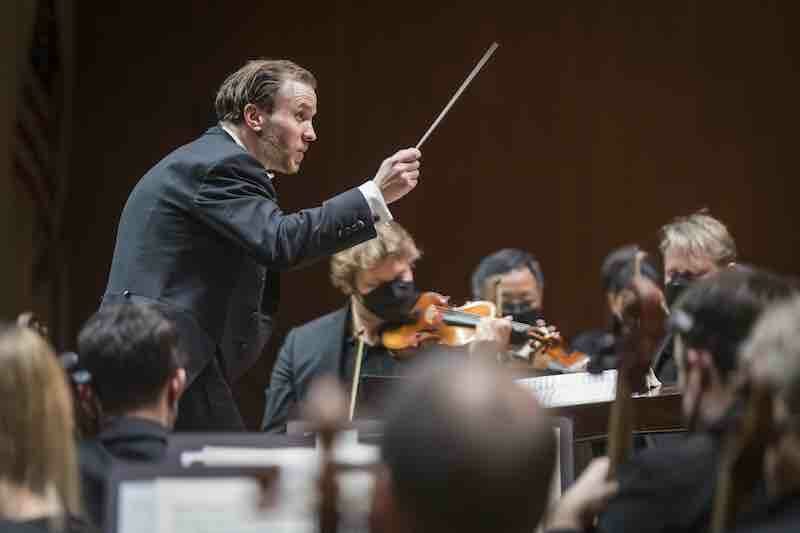
Review: David Danzmayr steps in to conduct the ASO, but doesn’t step up
It’s a relief that Saturday’s concert was performed at all. Over the past month, with surging Covid cases and overflowing hospitals, the Atlanta Symphony Orchestra canceled some concerts and made others online-only.
For the almost-full Symphony Hall audience, we counted our blessings where we could, since an insert in the ASO program booklet announced that the scheduled conductor, Nikolaj Szeps-Znaider, was ill. His replacement, David Danzmayr, is a little-known Austrian in his first season as the Oregon Symphony’s music director.
With a change on the podium came a change in the repertoire. Gone was Lili Boulanger’s “Of A Spring Morning,” a rarity worth a trip to the concert hall. In its place, Danzmayr opened with Jean Sibelius’ popular “Finlandia,” music that’s heroic and proud and that, back in 1900, helped boost nascent Finnish nationalism against a threatening, empire-seeking Russia next door — a fraught geopolitcal standoff not so different from what we see in today’s headlines.
Although I suspect Danzmayr, despite being a late substitute, had the full alloted rehearsal time this week, his “Finlandia” on Saturday was loose and ill-focused. It was also pretty loud, in a one-size-fits-all way. It set the standard for what followed.
The rest of the program was unchanged. Edvard Grieg’s Piano Concerto, always a crowd favorite, was better assembled than the Sibelius, although most of its success came from pianist Saleem Ashkar. His biography describes him as a “double minority in his home country,” as a Palestinian Christian born in Israel. Ashkar played in the greatly admired West-Eastern Divan Orchestra, founded by conductor Daniel Barenboim and scholar Edward Said, aiming to bring together young people from both Palestinian and Israeli backgrounds through music.
Ashkar’s playing was outstanding — rhythmically solid and supple, with crystalline phrasing and no fat, no excess, in his sound. For a concerto that seems to attract kitsch and glitter, his approach made it sound clean and modern. The ASO’s 9-foot Steinway was a full partner in this effort, its tone bright and its voicings evenly balanced across the keyboard. In the cadenza, near the end of the opening movement, Ashkar made the flamboyant Lisztian declaration of the main theme heroic and triumphant, but with an undercurrent of self-doubt. For all the grandiosity, you could feel his inward contemplation. Throughout the concerto, Ashkar found these sorts of new facets, and rarely plumbed depths, in this familiar music.
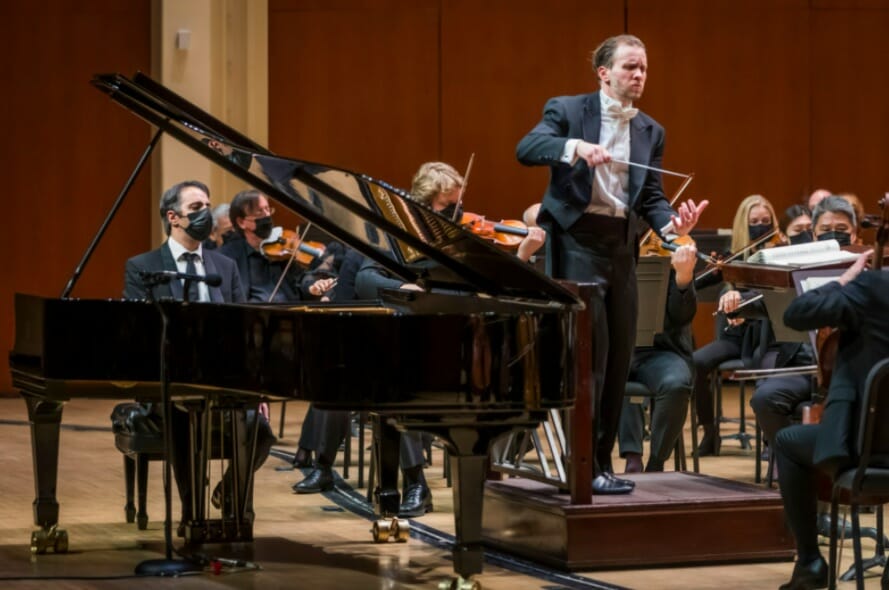
Danzmayr was a less precise partner. He kept the orchestra together with the soloist but not always spot-on. There’s room for passionate give-and-take in a Romantic concerto, but here it wasn’t so much rhythmically fluid as frustratingly hazy. The ASO musicians can play this stuff on auto-pilot. They didn’t seem under the conductor’s control.
After the concerto’s opening movement, the audience applauded, breaking rigid concert-hall protocol — but, wonderfully, an honest reaction to big, fun, tuneful music. It’s likely most of the people who applauded were new to the concert hall, which itself is great to see.
But after the concerto, the audience didn’t seem to know that if they applauded Ashkar just a few moments longer, he likely would have returned to the piano for an encore. For better or worse, that’s another part of protocol. We got no encore.
After intermission came Tchaikovsky’s “Pathetique” Symphony, usually a conductor’s playground of brilliant fanfares and dark expressions of pathos — hence the work’s name. Yet Danzmayr wasn’t clear on the symphonic architecture. The complex first movement dragged overall, ponderously, and lacked cohesion. Then the dancing Allegro con grazia that followed was a little too quick for comfort, as if he didn’t want us to luxuriate in one of Tchaikovsky’s loveliest creations, as much nostalgia as melancholy. He ignored many of the movement’s magical effects, such as the bittersweet, descending woodwind steps near the end, lost in the chatter.
In the third movement, without much panache, he marched that sucker to its inevitable, explosive end. Since he hadn’t laid a foundation for the moody, mostly quiet finale, its rewards — insights on sadness, grief, maybe humanity itself — were unearned. The symphony ends quietly, just cellos and basses at a whisper. To prolong the silence that follows, Danzmayr held up his hand — holding the audience at bay — and he held it, and held it. He held it as if he’d just led us through a profoundly spiritual experience. Instead, he held the silence till it became blatantly insincere. It was Danzmayr once again misreading the situation, as he’d done throughout the concert.
::
Pierre Ruhe was the founding executive director and editor of ArtsATL. He’s been a critic and cultural reporter for the Washington Post, London’s Financial Times and the Atlanta Journal-Constitution, and was director of artistic planning for the Alabama Symphony Orchestra. He is publications director of Early Music America.
STAY UP TO DATE ON ALL THINGS ArtsATL
Subscribe to our free weekly e-newsletter.

PLEASE SUPPORT ARTSATL
Your Gift Sustains the Coverage You Count On!
Related Posts