Review: Concerts@First begins season with an often stirring tribute to Ukraine
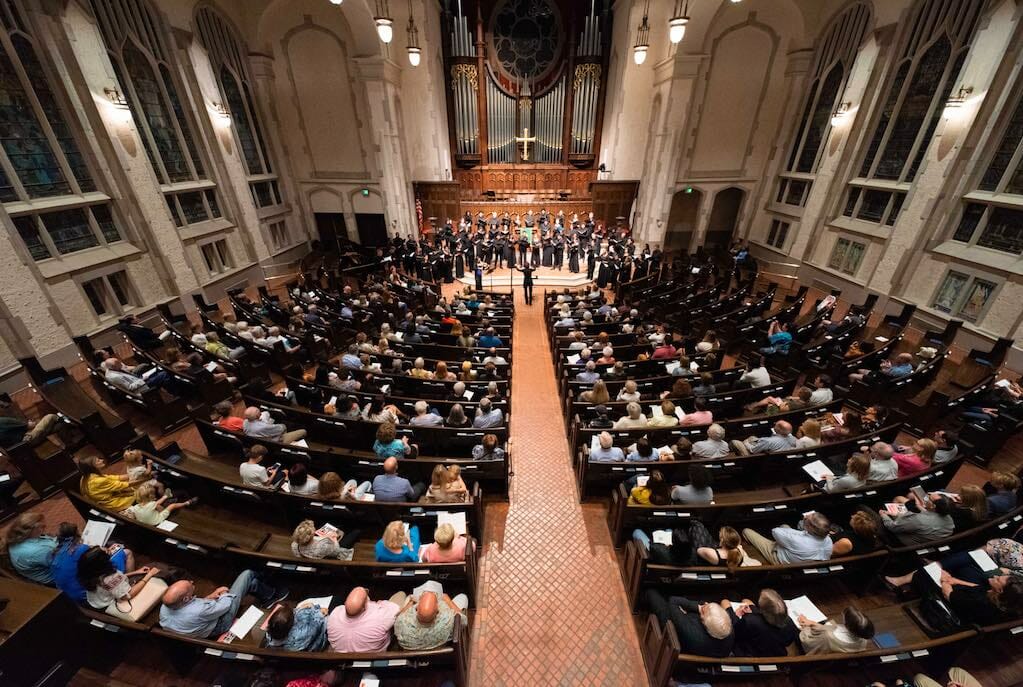
Concerts@First, the First Presbyterian Church of Atlanta’s popular classical chamber music series, played to a packed house Friday evening, with proceeds benefiting the Presbyterian Disaster Assistance Ukraine Relief Fund. More than a mere benefit concert, the event offered a sense of personal connection and shared humanity with the brave Ukranians staring down a warlord’s ominous invasion. It was a life-affirming spectacle, even if the program itself varied in tone to a somewhat jarring degree.
The evening began with a performance by the Georgia State University Singers, the school’s prestigious and highly acclaimed mixed-voice vocal ensemble. The choir opened with Heinrich Schütz’s “Selig sind die Toten,” (literally “Blessed Are The Dead”) a somber though reflective funerary observance that set the tone for the evening ahead.
The piece is haunting, with its text drawn straight from the book of Revelation, and guided the listener into empathetic depths otherwise unreachable. The First Presbyterian chapel offered a stunning acoustic space for the ensemble to inhabit, giving each singer an individual presence even as they all congealed into an angelic whole.
The group followed up with an equally stirring rendition of Stephen Foster’s 1854 American parlor song “Hard Times Come Again No More.” The normally bluesy composition fit comfortably next to its classical predecessor, owing in large part to the arrangement by Shawn Kirchner, whose liberal use of open-chord voicings gave the piece an ominous, gothic quality.
The singers set the stage for what would define the evening’s best selections: a reflective, cathartically somber tone that took the audience into the heart of a people whose human spirit struggles with the sense of loss inherent to war.
That tender tone, pervasive as it was, seemed to be at odds with the occasional selections that felt out of place. The first of these was a performance of Marco Enrico Bossi’s Etude Symphonique op. 78 for solo organ by Victoria Shorokhova. Though Shorokhova’s command of the instrument cannot be faulted, the piece itself is chaotic and blurry, relying on dazzling technical acumen from the player rather than an engaging melodic construction. The result was a brash and wholly unnecessary contrast to the established mood of the evening. Shorokhova would return in the second half for a performance of “Melody” by Myroslav Skoryk that better captured the spirit of the night.
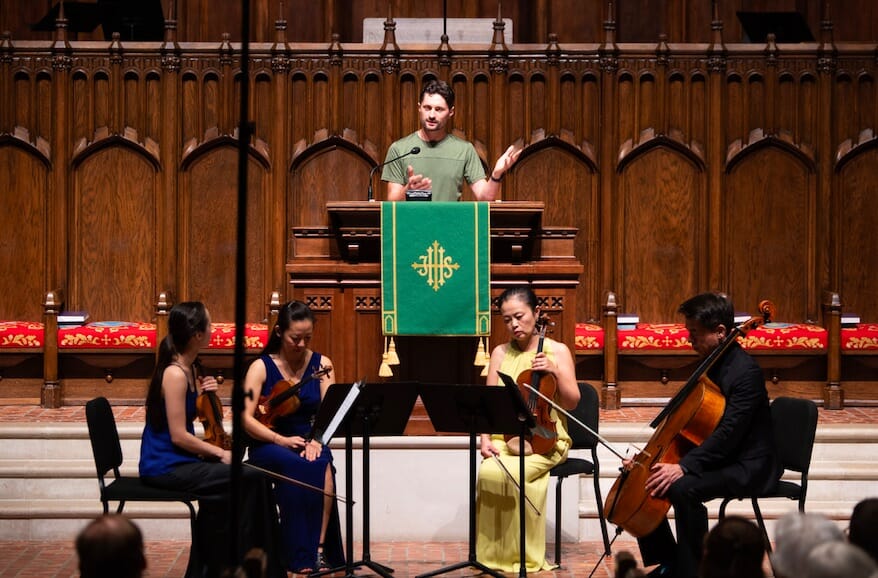
Though chamber concerts aren’t a competitive sport, it was undeniable that the Vega Quartet — the celebrated string combo that has held the status of quartet-in-residence at Emory University for over a decade — won the night. Their rendition of Maurice Ravel’s String Quartet in F Major captured the overall tone wonderfully while still finding room for tasteful displays of technical dynamism. It concluded to thunderous applause and a standing ovation from the enraptured audience.
The Vega Quartet devoted a portion of their set to a brief but moving speech from Ukrainian paramedic Yuriy Soroka. Then they concluded with a traditional piece called “The Willow” that once again returned the mood to a reflective, pastoral tone. It was a fitting end to a largely effective, though occasionally disjointed, first half.
Following a short intermission, the Atlanta Symphony Brass Quartet took the stage for a short set that opened with Kevin McKee’s “Escape.” A thoroughly modern composer who is 32, McKee seemed to be channeling an appreciation of modern film scores with “Escape.”
Unfortunately this ultimately saw him land more in the realm of Raiders of the Lost Ark than Schindler’s List, once again infusing the evening’s delicate nature with unnecessary bombast. The quartet’s subsequent performances of Sergei Prokofiev’s “Dance of the Knights” and Mykola Leontovych’s “Fantasy on Shchedryk” fared better in relation to the evening’s atmosphere.
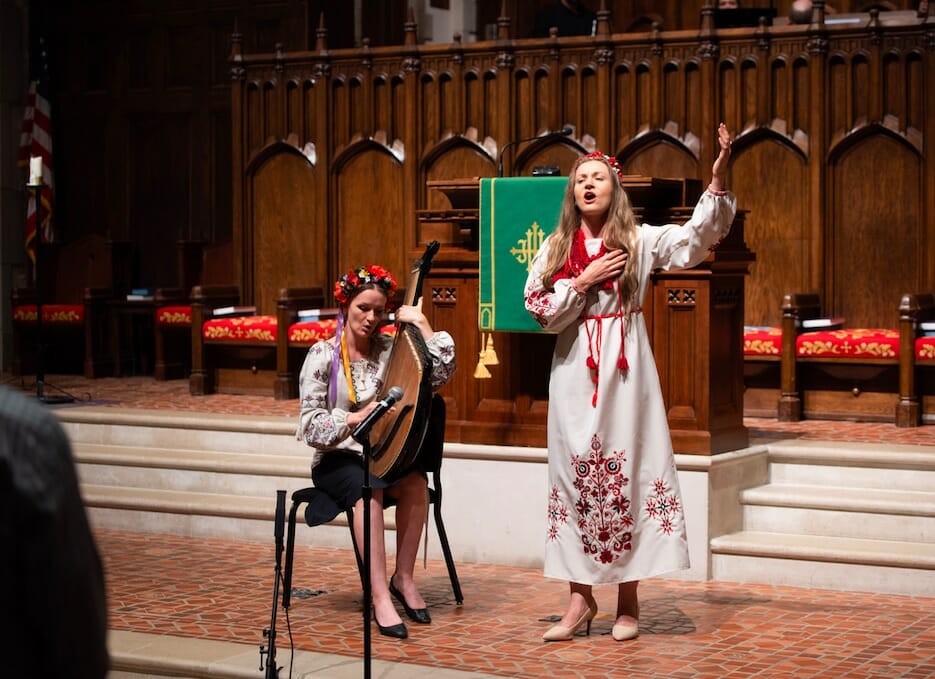
While the concert would close with a stirring performance of the Ukrainian National Anthem (the aptly titled “Ukraine Has Not Yet Perished”), the most notable and quietly stirring performance came in the form of two songs played on the bandura by Olena Kovban.
The first piece, “Prelude” by Kostanian Miaskov, was performed as a solo after which Kovban was joined by soprano Irina Valles for a rendition of “Freedom” by Maryna Krut. In both cases, the tone of the works was defined as much by the silence that filled in the gaps in the minimalist arrangements as by the music itself. Clad in traditional Ukrainian garb and alone on stage, the two women played to an audience consumed by the intimate simplicity of the moment.
Those wishing to view video of the concert as well as make a donation to the cause, can go HERE.
::
Jordan Owen began writing about music professionally at the age of 16 in Oxford, Mississippi. A 2006 graduate of the Berklee College of Music, he is a professional guitarist, bandleader and composer. He is currently the lead guitarist for the jazz group Other Strangers, the power metal band Axis of Empires and the melodic death/thrash metal band Century Spawn.
STAY UP TO DATE ON ALL THINGS ArtsATL
Subscribe to our free weekly e-newsletter.

PLEASE SUPPORT ARTSATL
Your Gift Sustains the Coverage You Count On!
Related Posts