
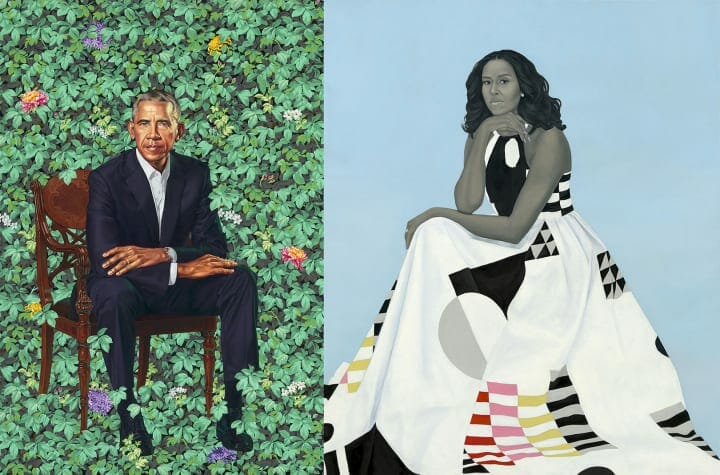
Review: Compelling Obama portraits at the High make dramatic political statements
From time immemorial rulers have used their likenesses to project their authority and, as those who practice contemporary “optics” might put it, to shape their narrative.
Could there be a more glorious leader than Napoleon in Jacques-Louis David’s iconic painting, plumed and uniformed, astride a rearing steed as he leads his troops across the Alps?
The paintings of our presidents at the National Portrait Gallery in Washington, D.C. bear no resemblance to those images of royals and tyrants. Apart from George Washington’s declamatory pose in Gilbert Stuart’s monumental “Lansdowne,” the portraits there eschew grandiosity, presumably a bad optic in a democracy.
Modesty reigns instead. Our presidents, for the most part, are depicted as dignified Everymen in suits. George W. Bush even chucks the gravitas: His portrait looks like a family photo of the Texan relaxing in his living room. The majority are forgettable.
Not, however, the National Gallery’s portraits of Michelle and Barack Obama. Now in Atlanta at the High Museum as part of a national tour, these paintings are dramatic political statements and transfixing works of contemporary art. (The exhibit runs through March 20 and advance tickets are required.)
Clearly, the Obamas approached the commissions with more intentionality and ambition than their predecessors. That they wanted to tap the power of the portrait was evident in their choice of artists. Kehinde Wiley and Amy Sherald make paintings that command attention. And they make meaning: Both use portraiture to explore race and representation. That they are the first Black artists to appear in the presidential galleries is itself commentary.

The president made a canny choice in tapping Wiley to paint his portrait. The artist came to prominence with monumental paintings that mimicked Old Master official portraits, including David’s Napoleon, but replaced the original protagonist with portraits of young Black men he had met on the street. Sardonic commentary on race and power, they are also, Wiley says, an exploration of Black masculinity.
Here, the tables are turned. This subject is already powerful, and Black. In Wiley’s presentation, the mantle of leadership is as perfect a fit as the suit he is wearing. Obama leans slightly forward from his chair, fixing the viewer with a confident, purposeful gaze. There is a distilled energy in the pose and a sense of purpose in his expression. The president is formidable.
The backdrop, a canvas-spanning wall of tightly intertwined vegetation, is an attention-grabber, and not just visually. Nature is not the customary setting for a presidential portrait, nor is bright green. The flowers that dot the greenery and represent aspects of Obama’s life are not typical symbols for presidents, or, for that matter, for men. These choices bespeak a president confident and unafraid to chart a new path.
Sherald’s portrait of Michelle Obama is just as arresting, but her approach is very different. The Georgia-born, Atlanta-trained artist excels in strategic simplification. She sets her figures against a flat featureless swath of a single hue (achieved through multiple layers of color). Her subjects are exclusively Black, intended to redress their historical absence from museum and gallery walls. But their skin is her signature grayscale, sort of no color at all, because, she has said, she didn’t want the discussion to be solely about identity. Their individuality is expressed in their clothing, the one area she endows with color and detail.
The first lady’s portrait is classic Sherald in many ways. Obama is seated against a sky-blue background, her arms elegantly posed, her gaze direct and impassive. The eye is drawn to her flowing white dress before focusing on her face. To my eye, this painting is more monumental than most, thanks to the pyramidal composition created by the drape of long skirt, which takes up half the canvas.
Given the artist’s spare aesthetic, it is tempting to find meaning in her every decision. The scattering of geometric patterns on the dress, which Sherald selected, reminded her of Gee’s Bend quilts. Some interpret that as a reference to the fortitude and creativity of African Americans.
My favorite detail? The bare arms. Early in Obama’s first term, fashionmongers criticized her sleeveless dresses as inappropriate for season or occasion. (Was that really what upset them?) But she stuck to her guns, and those toned arms served as a metaphor for a strong woman secure in her self and her power.
For all their apparent calm, there are tensions in these images. The race/no race of the grayscale is one. The disjunction between the specificity of the clothing and the generality of the skin and background unmoors time. Michelle Obama in this portrait is both a contemporary woman and a secular icon.
The High’s presentation is excellent. The physical experience is an effective bit of theater. Visitors encounter Michelle Obama’s portrait from a distance before crossing the gallery to get a closer look. It reads great both ways. The viewer turns a corner to confront the president’s portrait.
The paintings are accompanied by texts and a video about the commissioning process, the art and the artists that foster greater understanding about what goes into making art and meaning. The paintings speak for themselves, of course, on the art of power and the power of art.
STAY UP TO DATE ON ALL THINGS ArtsATL
Subscribe to our free weekly e-newsletter.

