Review: Bad boy artist Craig Drennen takes on Shakespeare’s “Timon of Athens”
Craig Drennen is a significant and respected artist who is also a proverbial bad boy, constantly testing the viewer. He uses his paintings and installations to poke a hole in the fabric of life and art. Of course, many important artists have used provocation as part of their discourse, from Duchamp’s urinal (Fountain, 1917) to Maurizio Cattelan’s banana, which was duct-taped to the wall at Art Basel in Miami and sold for $120,000 in 2019.
Drennen is part of this tradition, engaging in a serious dialogue of how far he can push and prod the viewer.
First Acts, at Atlanta Contemporary through May 15, masks required, is a mini retrospective of Drennen’s art culled from 15 years of work beginning in 2007 when he was a studio artist at Contemporary. The title refers to his use of Shakespeare’s little-known play Timon of Athens, a tragicomedy. His oeuvre could also be said to belong to that genre, combining in-your-face comedy and raucous visual jokes that contain an underlying darkness, all with admirable painting technique.
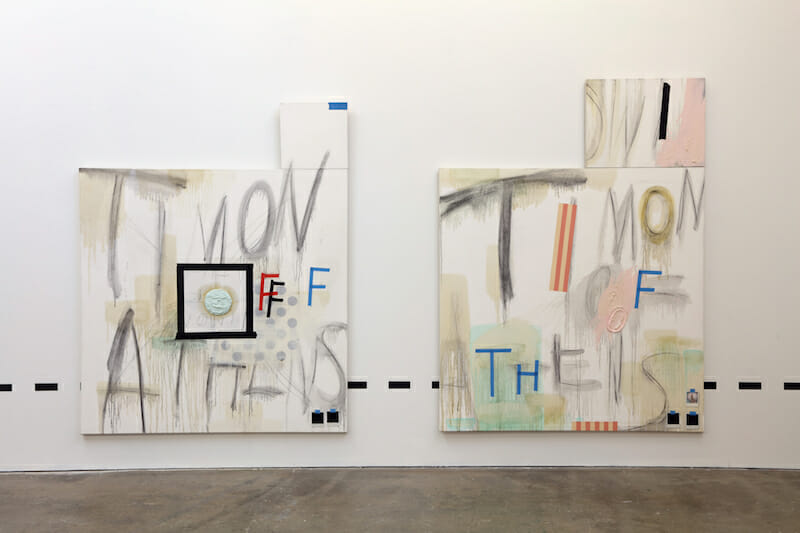
The entire exhibition is one very provocative painting installation that wraps around the gallery. It begins with a large canvas “Timon of Athens 3,” 2009, in oil and alkyd on canvas, in which the text of the title is the primary element. The palette of this work balances blue green, red, cerulean blue and grays.
The writing in the painting is a variety of scribbles and graffiti with trompe l’oeil squiggles and abstracted impasto. The “O” in Timon is a particularly lovely element composed of a double ring of ovals painted in light pinks. This painting, like many of the works in the exhibition, does not restrict itself to the square format. It is joined as a diptych with a smaller rectangular canvas, a treat for the eye that repeats many of the same hues and forms.
As we move around the gallery visually from left to right, we are guided by two-inch black latex lines the artist painted directly on the wall. These act as a framing device that draws attention to the entire wall and installation.
“First Mistress” and “Second Mistress,” both from 2008, are two small and beautifully painted works in oil on canvas; each depicts an anus. Drennen’s boyish provocation is offset by the seriousness of his delicate painting and palate of pinks, lavenders, roses, greys and umbers. The works are beautiful and call up orifices reminiscent of those in the paintings of Doubting Thomas who, in his disbelief, poked Christ’s wounds.
There are two more text paintings in the space, “Timon of Athens 1” and “Timon of Athens 2,” both from 2009. They are linked by a dashed black line on the wall. These works also use painted writing as a geometric element and have small additions that sit on top of the main canvas, expanding the composition beyond the normal rectangular format.
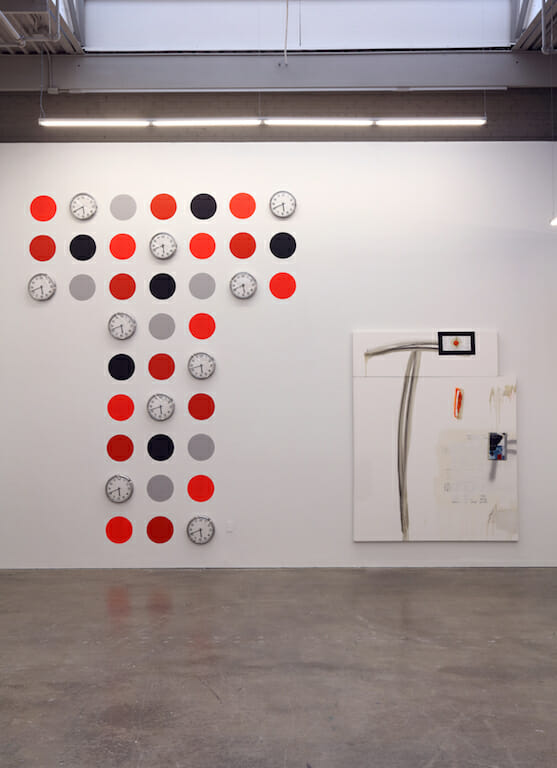
These works are extremely well painted; Drennen’s pictorial language is a symphony of mark making, color and viscosity. They lead to the newest work in the exhibition, “Chorus T,” 2022, composed of clocks and latex paint on the wall in a composition that is 14 feet high by 10 feet wide. This work includes painted circles the same size as the actual clocks that are set to the current time in Stratford-upon-Avon, the birthplace of William Shakespeare, arranged in a big “T” formation in black, red and fluorescent orange.
There are often big Ts on the wall in Drennen’s exhibitions, but this one has a new resonance due to its invocation of time. “Chorus T” has multiple references: it can be read as everything from a crucifix to a citation of Damien Hirst’s dot paintings, or just as a T for Timon. The clocks suggest a connection to Félix González-Torres’s “Untitled (Perfect Lovers),” 1987-1990 in a kind homage.
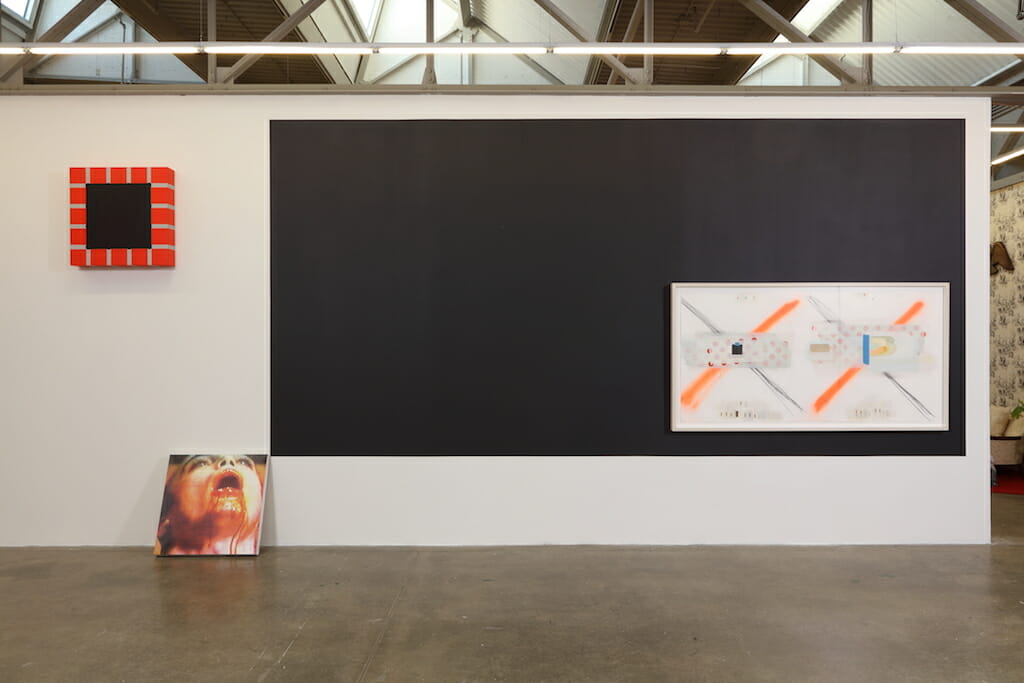
Drennen taunts the viewer again with his “Four-part Chimney Hole,” 2022, composed from the perspective of looking down into a chimney. Three of the parts are painted directly on the wall in latex paint and the fourth is a sculptural element in acrylic on wood and latex paint and acrylic on the wall, 30 by 30 by 11.25 inches. [The works are placed high on the wall so you cannot get too close.]
The illusion is very playful and directs the spectator directly down to the final chapter of the installation, “Old Athenian,” 2010-22, in ink jet on canvas, placed on the floor besides a large black latex rectangle painted directly on the wall. The top right corner of “Old Athenian” touches this rectangle’s bottom left corner, creating an interesting compositional tension. These works constitute a kind of triptych with “Double Painter 3,” 2013, the only work on paper in the exhibition, framed and hung on the black rectangle. “Double Painter 3” is composed of a double image of layers of dots and squares superimposed on a large X.
This wonderful exhibition presents visual hoops for the viewer to leap through — games and taunts all tied together by Drennen’s decade-long engagement with Shakespeare’s difficult text. The relationships of form and illusion compel one to keep looking and keep finding more connections both inside and outside the work.
Drennen will give an artist talk at Atlanta Contemporary on March 24 at 6 p.m.
::
Deanna Sirlin is an artist and writer. She is known internationally for large-scale installations that have covered the sides of buildings from Atlanta to Venice, Italy. Her book, She’s Got What It Takes: American Women Artists in Dialogue, (2013) is a critical yet intimate look at the lives and work of nine noted American women artists who have been personally important to Sirlin, based on conversations with each one.
STAY UP TO DATE ON ALL THINGS ArtsATL
Subscribe to our free weekly e-newsletter.

PLEASE SUPPORT ARTSATL
Your Gift Sustains the Coverage You Count On!
Related Posts