Cullum’s Notebook: George Floyd, Covid inform Roxane Hollosi’s exhibit “Breathe”
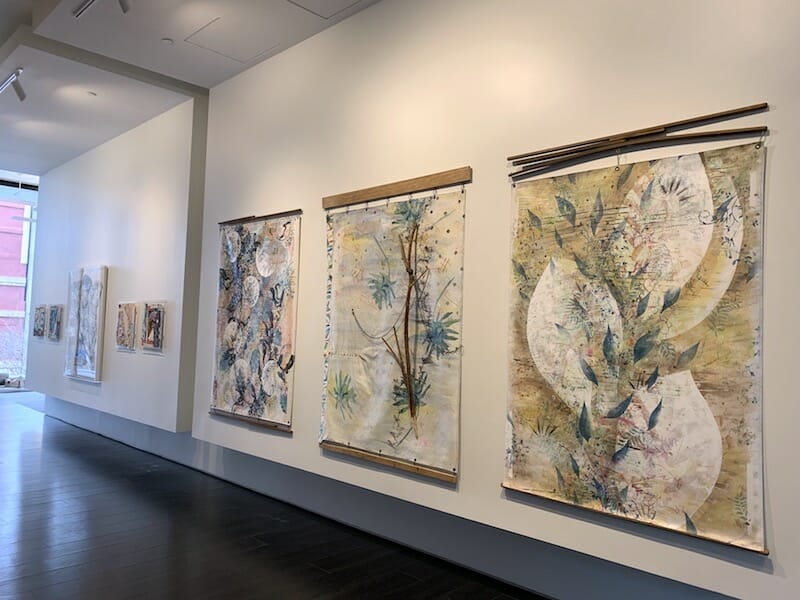
In completely different ways, two current exhibitions deal with great swaths of contemporary culture and events. Roxane Hollosi’s Breathe, at EYP’s Gallery 100 through April 7, sets the pandemic years in a larger context, while Tom Patterson’s New Lamps for Old, at 378 Gallery through March 26, presents the careers of a baker’s dozen of Atlanta artists in the context of his newly published memoir of the Atlanta scene of the 1970s and 1980s and his role in it.
Breathe is a body of work that has evolved in new directions parallel to the unforeseen course that history has taken since 2020. Originally inspired by environmental issues plus the tumultuous events surrounding George Floyd’s exclamation of “I can’t breathe,” and already infused with thoughts about the many symbolic and literal meanings of “breath,” the series began with simple collages.
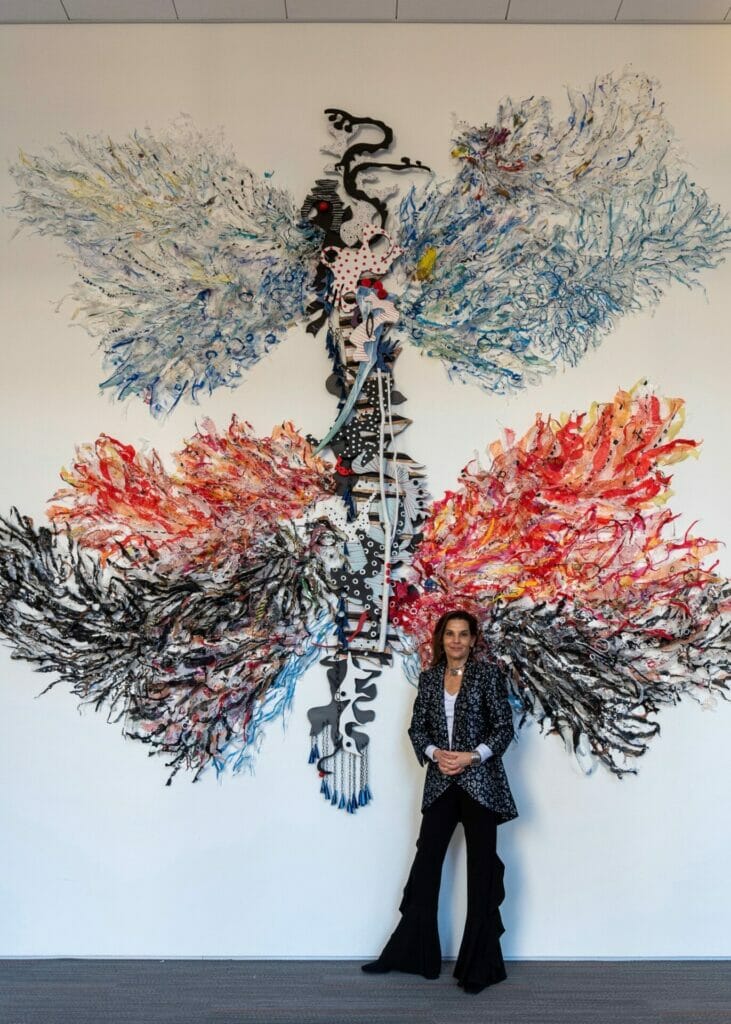
It then expanded in media and volume to reflect the coming of a respiratory-tract virus at the same time that new social collisions indicated a metaphoric and literal nationwide need for oxygen. The works made from shredded plastic waste brought in symptoms of society-wide discontent that harked back to Hollosi’s earliest concerns.
Hollosi’s overall vision, in other words, has become as expansive as the six-foot dimensions of the paintings, which are intended to remind viewers of the social distancing established as the pandemic began.
But her vision also springs from her origins in small town Minnesota in a region that was the source of the stone used in ceremonial Native American peace pipes. As such, the town of Pipestone was suffused with public celebrations of Native Americans, although not particularly local in their focus.
This was enough to lead Hollosi to study the origins of such things as the jingle cones on ceremonial dresses, objects made from recycled materials that were both ritual symbols and symbolic acts of resistance to the suppression of traditional ceremonies by the United States government.
This means that the jingle cones Hollosi herself has made for the nearly floor-to-ceiling wall piece “Searching for a New Way to Breathe” come with a complex level of symbolism that suits the phoenix-like upsurge of recycled fragments that rises above them. Much more is going on in this work than the stunning formal qualities that are apparent at first glance, and the same goes for the most recent small collages, greatly different from the works with which the series originated.
New Lamps for Old is Tom Patterson’s carefully curated, fragmentary glimpse of an Atlanta art scene of the 1970s and early 1980s that was already mythicizing its own incipient greatness. Although parts of this small exhibition — limited by choice to the artists Patterson knew personally — demonstrate the sad truth of what Xenia Zed said a few years later as editor of Art Papers, that the South’s emerging artists can spend their whole careers emerging, it also illustrates the staying power of artists who do emerge.
The show illustrates well, for example, the consistently strong aesthetic of the work of Linda Armstrong and Katherine Mitchell, in Mitchell’s case with two recent works from 2015 and 2016 that reflect a long artistic evolution.
The artist couple Elizabeth Lide and Paul Kayhart have managed to condense near-retrospectives of their respective works into the minimal space available (in Kayhart’s case, by including a sound-based piece outside that greets visitors). William Brown’s large digital collages of images from art history are the latest iteration of decades of experimentation, of which the earlier component is reflected in some of his video works in the otherwise vacant lower gallery.
Most of the artworks here, however, document a definable moment in history, even though the artists continue to create new work. Billy Howard’s extraordinary career as a photographer is sampled only by his particularly evocative documentation of the art, performance and music scene as it was lived by the participants. Scott Gilliam’s large sculpture of the time period is shown in a photo survey of outdoor installations.
There is some question in my mind as to whether New Lamps for Old adds up to a clear picture of the time and the art for those who, unlike myself, were not there. But the works definitely represent a range of the era’s locally dominant aesthetics among what people in the 1970s still called the avant-garde. The definition hereabouts was broad enough to include such sweet-tempered but edge-laden portraiture as the work of Cornel Rubino, represented here by the 1974 “Charlotte Corday” and two 2019 pieces, “Portrait of Botticelli as a Teen” and “Portrait of Giotto as an Adolescent.”
The show demonstrates that historical retrospectives are long overdue for two of the era’s deceased artists. Roger Dorset’s folk-tinged magico-mystical sensibility is represented by two remarkable drawings that will be a revelation to viewers unfamiliar with a body of work that has largely been forgotten. (His subject matter, such as the self-mutilation myth of Attis and Cybele, was outré even for the 1970s.)
Stan Sharshal’s conceptual wit, honored in the time immediately following his tragic death in 1992, has also sunk from notice in recent decades. One Sharshal piece, a model tank repainted in a muted designer-color, is described as “from an installation no one seems to recall in detail or precisely place in time, circa 1980.” If the guessed-at year is accurate, the installation was mounted shortly after Soviet tanks rolled into Afghanistan on a military operation that eventually ended in ignominious withdrawal, after a decade spent fending off an increasingly effective guerrilla resistance.
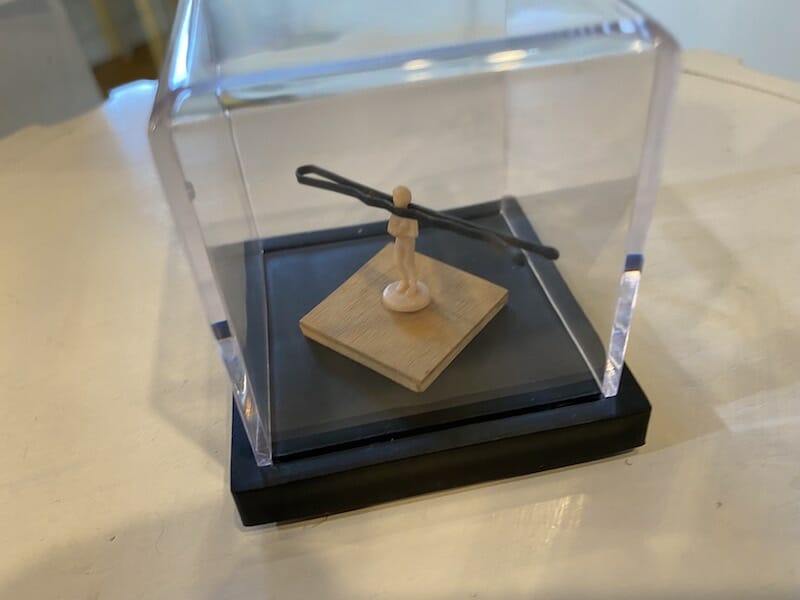
Another of his works, “State of the Arts,” is a minuscule monument consisting of a tiny plastic figure strangled by a bobby pin encircling its head. Although the confluence of federal and city money, courtesy of President Jimmy Carter and Mayor Maynard Jackson, had produced an efflorescence of the arts across the city in the late 1970s, by the time this work was created in 1982, the scene had resumed its familiar condition of operating with very nearly no financial resources and little more than fleeting and strictly local acclaim.
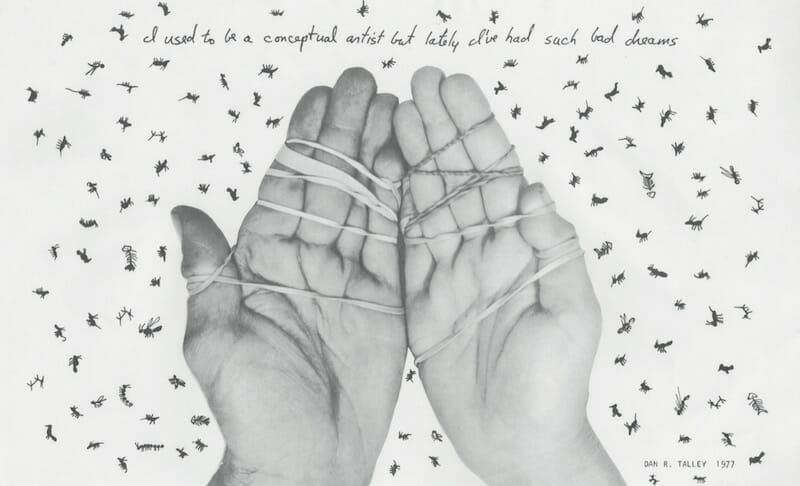
Dan R. Talley, who was one of the founding forces behind Art Papers magazine’s efforts to gain the scene more than local recognition, summed up the sense of discomfiture as early as 1977 with his “I used to be a conceptual artist, but lately I have such bad dreams.” Reformatted as a banner in 2022, the work seems truly iconic.
The lack of national notice for the city’s visual art was not true of the music scene of the Atlanta-Athens axis (albeit mostly of Athens). What was then still called regional folk art was on its way to notoriety even before Howard Finster’s appearance on Johnny Carson’s Tonight show gained him visibility beyond the Atlanta galleries of Judith Alexander and Rick Berman. And Tom Patterson was in the midst of both currents of culture, eventually writing two highly influential books about Finster and the until then little noticed St. EOM.
The incipient Atlanta phase of Patterson’s long and distinguished career has now been described memorably in the first volume of his memoirs, The Tom Patterson Years: Cultural Adventures of a Fledgling Scribe. Patterson will read from and sign copies of the book at 378 on March 19, from 4 to 6 p.m.
::
Dr. Jerry Cullum’s reviews and essays have appeared in Art Papers magazine, Raw Vision, Art in America, ARTnews, International Journal of African-American Art and many other popular and scholarly journals. In 2020 he was awarded the Rabkin Prize for his outstanding contribution to arts journalism.
STAY UP TO DATE ON ALL THINGS ArtsATL
Subscribe to our free weekly e-newsletter.

PLEASE SUPPORT ARTSATL
Your Gift Sustains the Coverage You Count On!
Related Posts