Review: Bach’s Lunch concert takes on torrid triad of Brahms and the Schumanns
With First Presbyterian Church of Atlanta rapidly becoming the go-to hot spot for chamber ensembles in the Atlanta area, it was only natural that the venue introduce a noontime concert series, the pun-intended Bach’s Lunch. On Friday, the Emory Chamber Music Society of Atlanta convened the second ever performance in the series, one that would focus on the music of Clara and Robert Schumann, Johannes Brahms, and the torrid love triangle that erupted between them.
The history of classical music is rife with great loves and erotic intrigue, from the rock-star philandering of Mozart to Beethoven’s mysterious “Immortal Beloved.” It is a world of passionate love affairs, crushing heartbreak and furious jealousy often overshadowed by the academic sterility of modern conservatories and more dignified historians. Nevertheless, the scandals and machinations are there and the story of the Schumanns and Brahms is the stuff of Hollywood drama.
Robert Schumann would study under noted piano teacher Frederick Wieck, eventually developing feelings for his teenage daughter Clara, who was already emerging as a child piano prodigy in her own right. Declaring their love for one another they sought to marry, a move staunchly opposed by Clara’s father.
They would maintain their intense love for one another under Wieck’s watchful eye, going so far as to develop a coded language in their music with certain phrases and compositional techniques bearing a personal significance between the two of them and serving as an ongoing affirmation of their love. While the specifics of that secret language are lost to history, they were nevertheless encoded into two out of three of the pieces performed at the Friday concert.
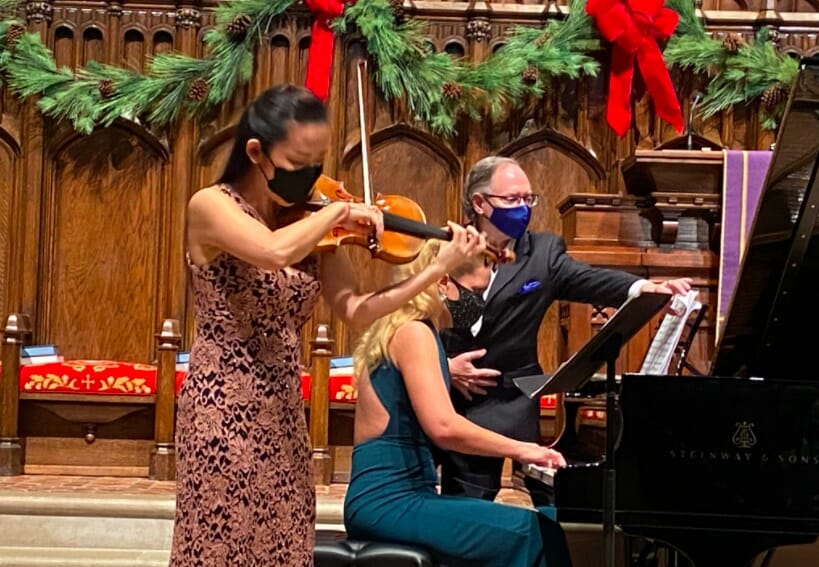
The Bach’s Lunch performance began with pianist Julie Coucheron and violinist Jessica Shuang Wu performing Clara Schumann’s “Three Romances, Op. 22.” Wu’s interpretation was particularly invigorating — Clara Schumann’s original melody is light and whimsical and Wu knows how to find an edge in the tonality, one that suggests the deeper longing that underpins the piece.
For the second composition, Julie Coucheron was joined for a duet by her brother, violinist and Atlanta Symphony Orchestra concertmaster David Coucheron. Their chemistry, the result of a lifetime of collaboration, flows naturally with an almost telepathic coherence. It was a pairing that well served their performance of Robert Schumann’s Violin Sonata No. 1 in A Minor, Op. 105. The work is considerably more intense than the preceding piece and, as such, indicates an escalating passion between the composers.
The Schumanns would live happily together, each maintaining illustrious careers while still finding time to raise no less than eight children. But it would be the arrival of Johannes Brahms in their lives, first as Robert’s close friend and later as Clara’s lover, that would cast a dark shadow across the relationship.
That dark shadow was readily apparent in Brahms’ Sonata in F Minor, Op. 120, the afternoon’s third and final piece. In this case both string and piano positions would shift to violist Yinzi Kong and pianist William Ransom. Kong’s viola was rich and textured, the sort of anguished intensity common to Brahms. Still, the most stark contrast came in the form of Ransom’s performance: Where Julie Coucheron’s playing was delicate and billowing, Ransom was hard and aggressive. It served to highlight the difference between composers — the Schumanns with their cerebral inner dialogue and Brahms with his ominous fury.
Following the death of her husband, Clara Schumann would remain active as a piano teacher and concert performer until her own passing in May of 1896. One of her students was the great-great grandmother of Julie and David Coucheron — a testament to her tremendous legacy as an educator.
The concert’s three segments served as a miniature tone-poem to elucidate the star-crossed intertwining of three musical geniuses consumed as much by their passions as their appreciation for one another’s music. In the ongoing push to keep classical music relevant to modern listeners, the importance of this sort of conceptual structuring cannot be overstated: It gives the works a sense of gravitas not otherwise apparent.
STAY UP TO DATE ON ALL THINGS ArtsATL
Subscribe to our free weekly e-newsletter.

PLEASE SUPPORT ARTSATL
Your Gift Sustains the Coverage You Count On!
Related Posts