Remembrance: Radcliffe Bailey focused on Black life, memories and narratives
Radcliffe Bailey, the acclaimed visual artist whose paintings, sculptures and mixed media highlighted the memories and narratives of Black life in dazzling imagination and detail, has died after a battle with brain cancer, according to reports. He was 54.
For the better part of the last 30 years, Bailey, who passed away on November 15, was one of the most significant visual artists in Atlanta; his works are present in many prominent permanent collections, including the Metropolitan Museum of Art in New York, the Museum of Fine Arts in Houston, the Art Institute of Chicago, the Smithsonian Institution in Washington, D.C., and the High Museum of Art in Atlanta. In 2019, his work Nommo was exhibited at the Istanbul Biennial.
His large mural Saints at Hartsfield-Jackson Atlanta International Airport was commissioned for the 1996 Olympic Games. It is still on display in Terminal E.
In 2021, Bailey appeared in the HBO documentary, Black Art: In the Absence of Light.
Within Atlanta’s arts community, Bailey’s renown became a standard by which others often aspire to, not merely because of commercial success but also because he laid the modern blueprint of choosing Atlanta as his geographical anchor while allowing his art to carry him around the world.
“Always be emerging” was wisdom he often gave younger artists following in his footsteps who sought advice. Through his process of mining memories and repeatedly returning inward to early experiences to be renewed, Bailey consistently and expertly illuminated the value of Black lives and experiences around the world — and in Atlanta.
Bailey was born in Bridgeton, New Jersey, in 1968 and moved with his parents to Atlanta when he was 4 years old. As a graduate of Benjamin E. Mays High School in Southwest Atlanta, and later Atlanta College of Art, Bailey was embraced as Atlanta’s own and vice versa. He was often cited as one of the luminaries that marked the city’s rise as a contemporary cultural capital.
The memories of the African American experiences of his parents and grandparents informed his earliest worldview and artistic practice, while he came of age in an era of Atlanta that signaled the first wave of social, economic, political and creative shifts in the post-Civil Rights era.
Bailey’s star shone bright for most of his adult life, and his relationship with Atlanta’s arts community throughout that time was robust. From garnering public art commissions to having works acquired by private collections, corporate collections and arts institutions throughout the city, he became a staple of any notable artistic endeavor. And perhaps no institution in Atlanta celebrated Bailey like the High Museum of Art.
He would often recount the importance of the High Museum during his formative years as a place where his mother would often take him for visits — but also as a site to see future versions of what he could become as an artist in his own right.

That early vision was manifested in full circle as the institution ultimately acquired several of Bailey’s works for its permanent collection and most prominently presented the 2011 exhibition, Radcliffe Bailey: Memory as Medicine, a career survey that highlighted the expanse of his artistic production.
His mixed-media canvas EW SN (2011) in the High’s permanent collection inspired the “Permanent Project,” a 2021 collaboration between the museum and a group of artists led by Dr. Fahamu Pecou, founder of the African Diaspora Art Museum of Atlanta (ADAMA.) The project was designed to foster new artistic interpretations of works by Black artists in the High’s collection.
Bailey’s magic as an artist was that he revealed spiritual connections to everyday moments and experiences, while seeing the possibilities in found materials that could help weave intimate stories.
“I really believe in making something that’s so personal that it becomes universal,” he once said.
As a sculptor and compiler of memories through objects, he often searched for ways to layer meanings into works that would allow viewers to imagine multiple interpretations.
Living in the American South, with its own, often conflicting, multiple interpretations, gave Bailey a fluency that allowed him to focus on the Black diaspora at various inflection points — past and future, rural and urban, young and old, North and South, jazz and hip-hop — and craft bodies of work that gave new life to antique objects.
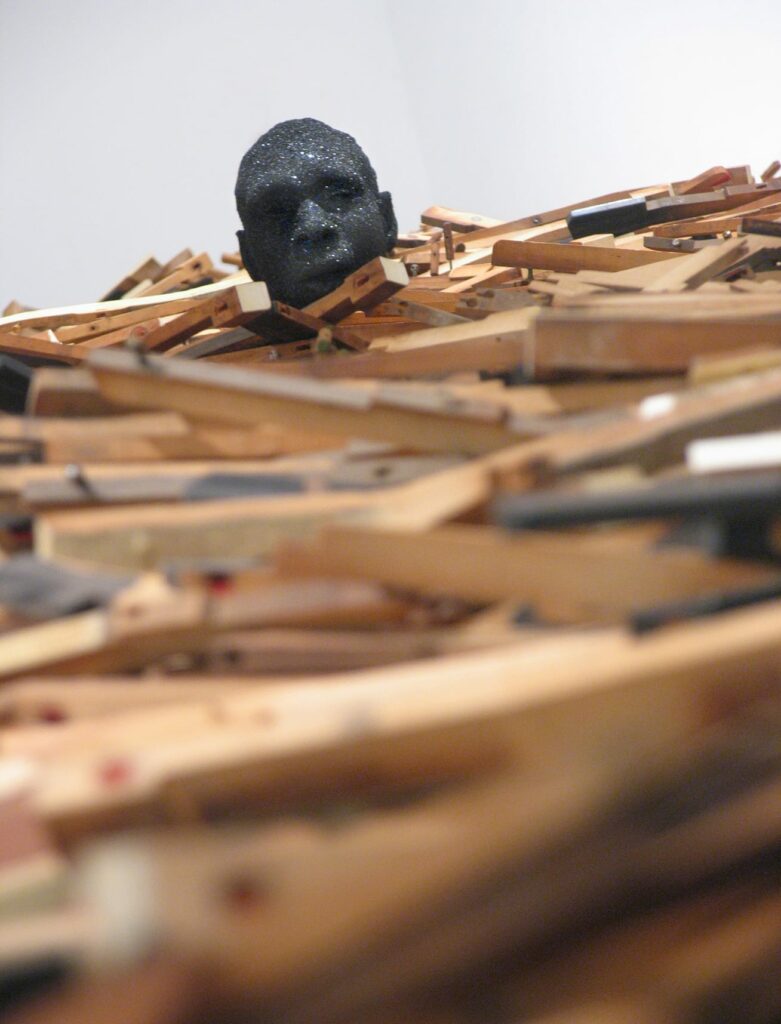
Whether incorporating nearly 400 tintypes into his medicine cabinet sculptures and other works or collecting over 400 sets of piano keys to form one of his most well-known pieces, Windward Coast, Bailey displayed an acuity in blending form and material in ways that surprised and resonated with audiences.
For a while, even Bailey’s personal life seemed to mirror his rising celebrity. In 2007, he met actress Victoria Rowell after a chance encounter when she was in Atlanta for a book tour during the National Black Arts Festival; the couple wed in 2009. It was the second marriage for both, yet it ended more quietly than it began — Bailey and Rowell divorced in 2014.
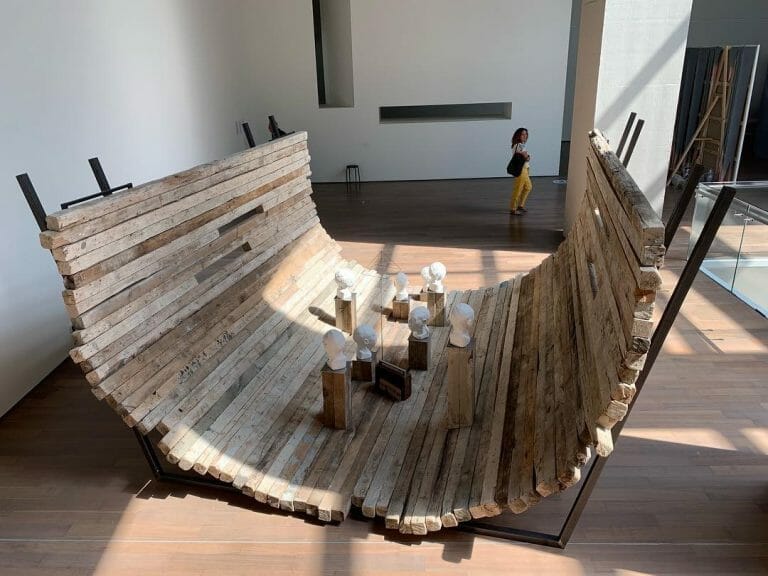
Despite — or perhaps, in addition to — his recognized talent, Bailey saw himself as somewhat of a vessel. He often reformed the phrase “art history” into “art mystery” as a way to conjure and acknowledge ancient peoples and practices that might have been omitted from the recognized art canon, all while synthesizing those memories with cultural research to present the potential for new narratives and even healing through his work.
From the Atlanta airport, the world’s busiest, to Mercedes-Benz Stadium and the Fulton County Library, Bailey’s presence as an artist is so ubiquitous that it will be easy to access the many ideas and expressions he left behind; filling the void of his absence in Atlanta’s arts community, however, will prove a more difficult, if not impossible, task.
::
Floyd Hall is a media strategist, engineer, cultural producer, writer and documentarian from Atlanta. He is a 2020 Idea Capital artist grant recipient. He also is a Hambidge Creative Residency fellow and has presented as a guest lecturer at Savannah College of Art and Design, Spelman College, Spelman College Museum of Fine Art and The Hudgens Center for Art and Learning. He is a media contributor to ArtsATL, Number: Inc., ART PAPERS and Americans for the Arts.
STAY UP TO DATE ON ALL THINGS ArtsATL
Subscribe to our free weekly e-newsletter.

PLEASE SUPPORT ARTSATL
Your Gift Sustains the Coverage You Count On!
Related Posts