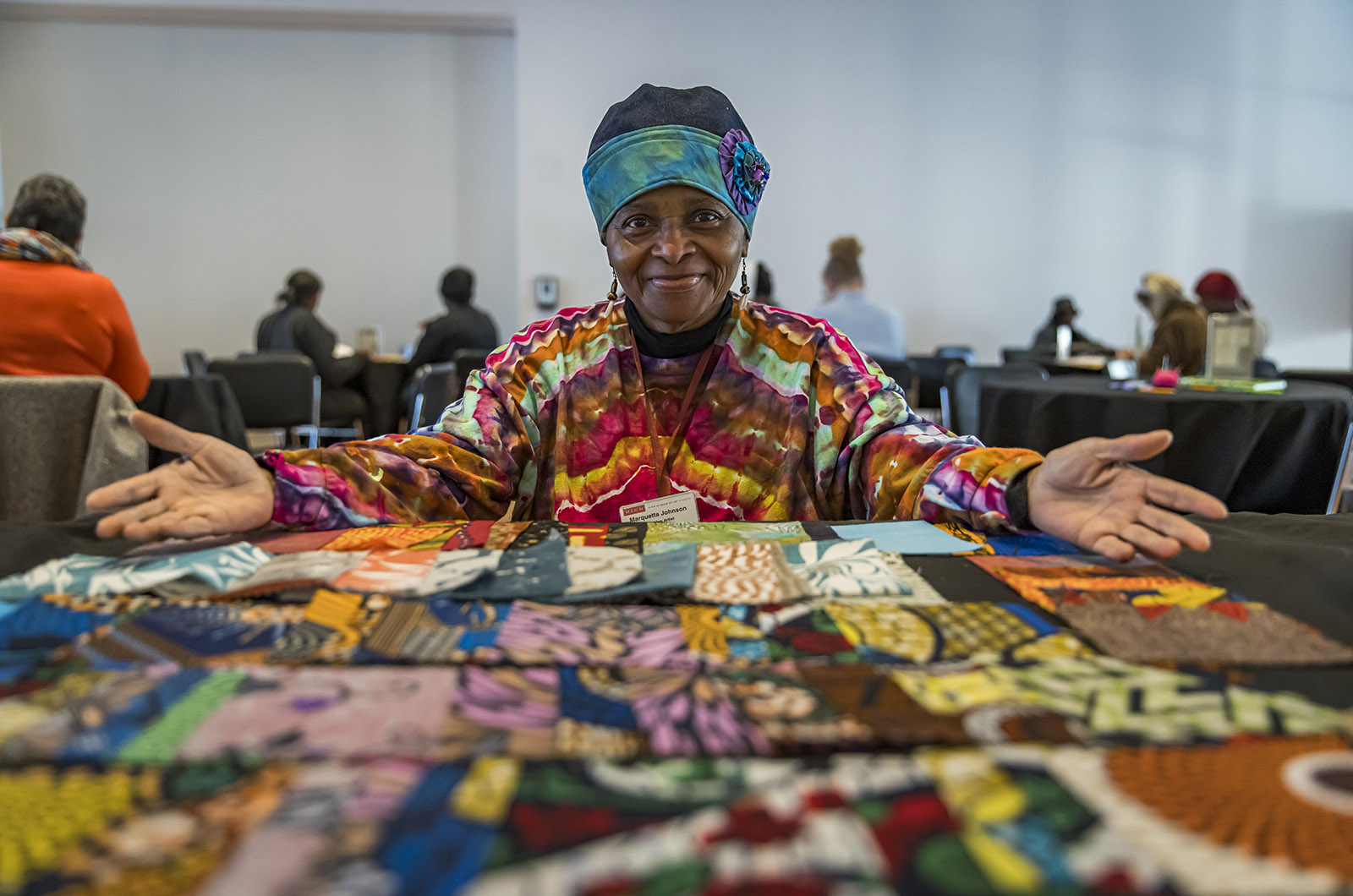
Reader’s Choice in art + design: Remembrance: Marquetta Johnson turned adversity into art
Textile artist Marquetta Johnson passed away on February 12, 2025. She leaves behind a legacy of teaching — and of learning from life.
::
Editor’s note: We’re resharing a story that was the year’s most-read from each of the disciplines we cover. The following article was exceptionally popular with our readers. Thank you for a wonderful 2025, and we look forward to bringing you more of the best arts coverage in Atlanta in 2026.
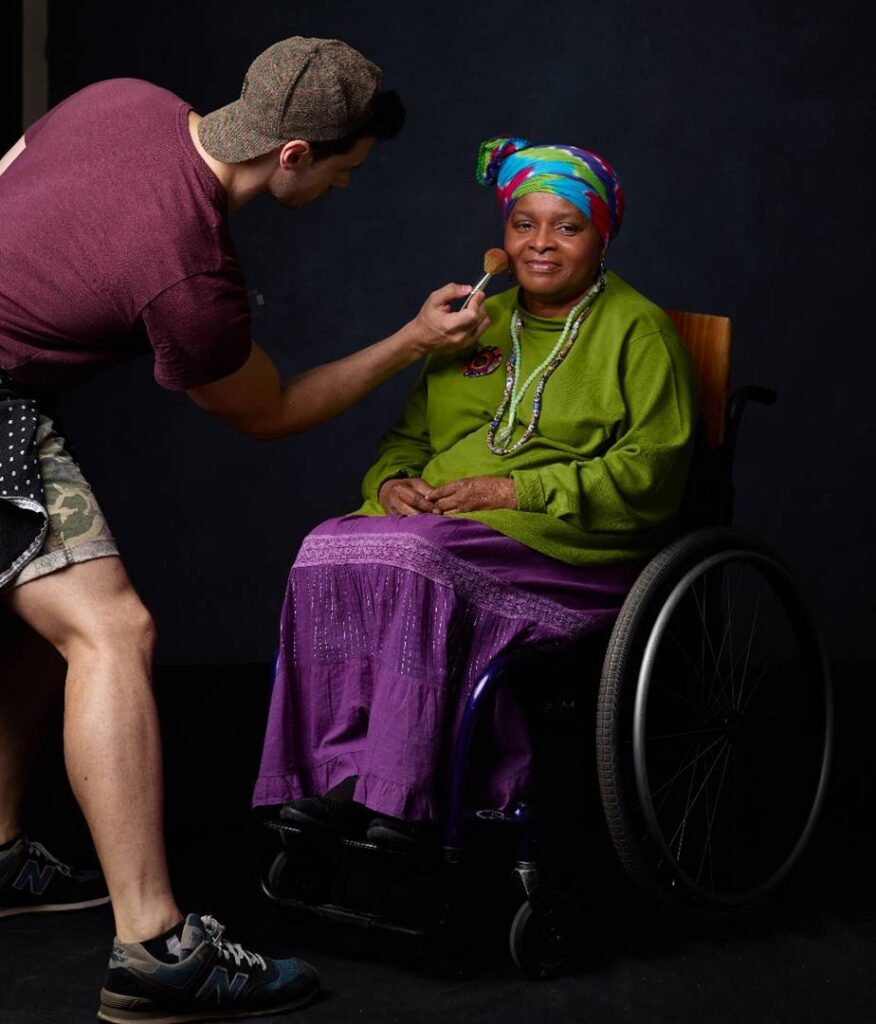
The term “folk art” conjures up images of family heirlooms and design techniques passed down from one generation to the next. For Atlanta quilt maker and teaching artist Marquetta Johnson, who passed away Wednesday, February 12, at age 69, that generational sharing of design rooted in tradition was something she spread to the whole of humanity.
“What I want to do is to encourage young people to take up needle, to take up thread and change the world with it,” reads a quote from Johnson on the program for her janazah (funeral) services, which were held Friday, February 14, at the Atlanta Masjid of Al-Islam. The Atlanta native, born in 1955, learned the craft of quilting from her grandmother but soon saw an opportunity to expand on the concept.
“She took it into a more contemporary art form in her adult years,” explains Kate McLeod, head of school and teacher services at the High Museum of Art. McLeod points out that Johnson was very experimental in her dyeing techniques and went to great lengths to create her own materials by hand.
Despite her early love of quilt making, Johnson initially worked in the corporate world. In her early 30s, by then a UPS manager, she was the victim of a shooting that left her paralyzed from the waist down. “As she was laying there and not sure she was going to live, she made a plea to God that if she survived, she would dedicate the rest of her life to teaching kids how to sew and how to be artists,” says McLeod. “And she never broke her promise.”
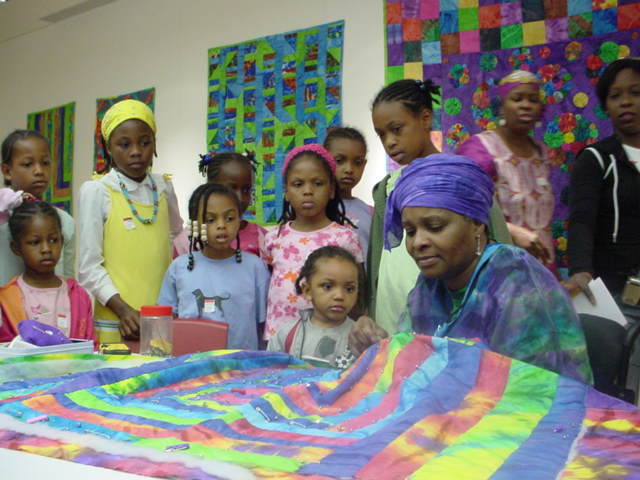
Johnson began working with the High in 2006 during its exhibit The Quilts of Gee’s Bend, where she led quilting demonstrations for the public. As one of the High’s teaching artists, she worked extensively with many of the roughly 35,000 schoolchildren who come through the museum’s educational programs each year. Johnson’s involvement led to the creation of programs for autistic and visually impaired children.
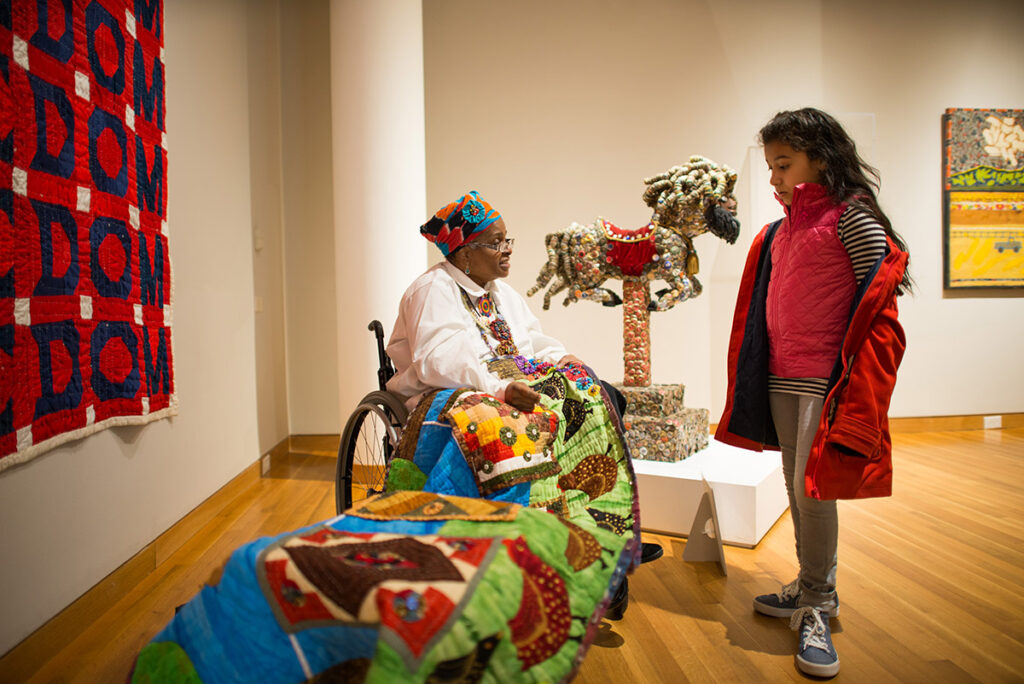
Her work as a teaching artist was not limited to the High Museum. Johnson traveled regularly to educate students throughout the country. Jeff Mather, an environmental sculptor and fellow teaching artist, became a regular collaborator. Together, the duo developed “Skin and Bones,” a cheeky name for their collaborative design residency.
“Marquetta would coach the community in creating textiles,” says Mather. “My design team would create the designs for the sculptural structures. Then we would suspend the textiles in the negative spaces of the structures and find ways to illuminate them with natural or electrical light.”
The collaboration became a creative wellspring, and the duo expanded into larger works. Notable among them was Daughter House Five (a pun on Kurt Vonnegut’s Slaughterhouse Five), which was a stage production mounted at the Alliance Theatre. Described in promotional materials as “a multimedia project about time travel that is triggered by trauma,” the work features storyteller and percussionist John Edward Doyle Jr. performing in and interacting with a set composed of Johnson’s quilts.
Johnson’s son Yusef emerged as a successful painter in his own right, only to be killed in a carjacking — a murder Johnson felt was never properly investigated by police. Johnson confronted the grief by pouring herself into her art. The quilt Nine Patch became her outlet during the healing process.
“She poured everything into that quilt,” McLeod explains. “The grief and the loss were so big she didn’t know what else to do with it but pour it into these projects.”
Nine Patch (2016-2018) was among the four Johnson quilts acquired by the High Museum in 2022, and the melding of traditional and modernist design styles is readily apparent. Two of the other works — Hattie’s Tiny House Quilt (2017) and Hope Blossoms (2009) — expand Johnson’s use of shape and color, principles which dominate in Nine Patch as well as in Small Steps.
Marquetta Johnson’s story is one of a captivating creative vision triumphing and thriving in the face of tremendous setbacks, but it is also a story of how the objects used daily — things as commonplace and utilitarian as textiles — have an artistic weight all their own.
::

Jordan Owen began writing about music professionally at the age of 16 in Oxford, Mississippi. A 2006 graduate of the Berklee College of Music, he is a professional guitarist, bandleader and composer. He is currently the lead guitarist for the jazz group Other Strangers, the power metal band Axis of Empires and the melodic death/thrash metal band Century Spawn.
STAY UP TO DATE ON ALL THINGS ArtsATL
Subscribe to our free weekly e-newsletter.

PLEASE SUPPORT ARTSATL
Your Gift Sustains the Coverage You Count On!
Related Posts