Q&A: Nellie Mae Rowe film depicts history, friendship and transcendence through art
Folk artist Nellie Mae Rowe and gallerist Judith Alexander hailed from vastly different worlds. Rowe was the daughter of a sharecropper who had been enslaved; Alexander, from one of the South’s most prominent Jewish families, grew up with a chauffeur. They both were deemed plenty “eccentric” by their respective communities, but they found sustenance, and eventually transcendence, in art — and each other.
This World Is Not My Own: The Limitless Story of Nellie Mae Rowe explores this curious sorority of two with aptly creative filmmaking techniques. It premiered at South By Southwest and was also screened at the Smithsonian Institution. The High Museum of Art will show the movie Tuesday, April 25, at 7 p.m. as part of the Atlanta Film Festival. Registration is required.
The quirky documentary offers, among many things, a fresh view of Atlanta history. Rowe came exuberantly into this world on July 4, 1900, so her life conveniently spans the century, offering a framework for events that include the race riots of 1906 to Leo Frank’s lynching to the Missing and Murdered Children of the 1980s.
Faced with so many exigencies, the self-taught Rowe single-mindedly built the world she wanted to live in, transforming her home into her “Playhouse,” a sanctuary of swirling, phantasmagoric paintings that evoke Chagall, along with eerie handmade dolls, chewing gum sculptures and numerous portraits of Thunderbolt Patterson, her favorite wrestler and muse. (The blustery Patterson, contemplating his consequent immortality, is one of the most charming commentators in the project.)
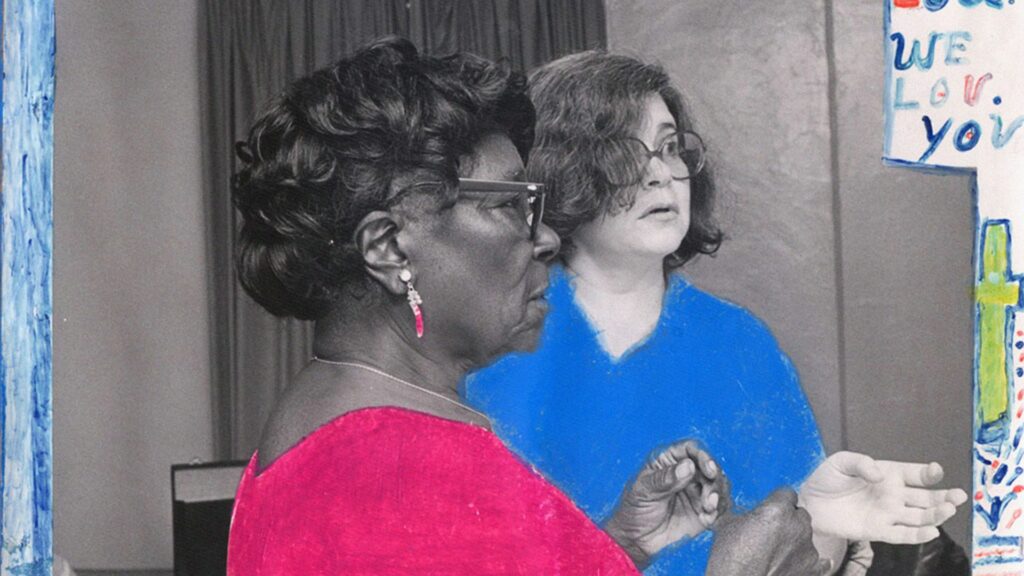
Six years before Rowe’s death in 1982, Alexander, who founded the city’s first folk art gallery, was driving by this sanctuary, no doubt did quite a double take and had to stop. Thus she “discovered” and introduced Rowe to the art world; cross-cultural adventures ensued.
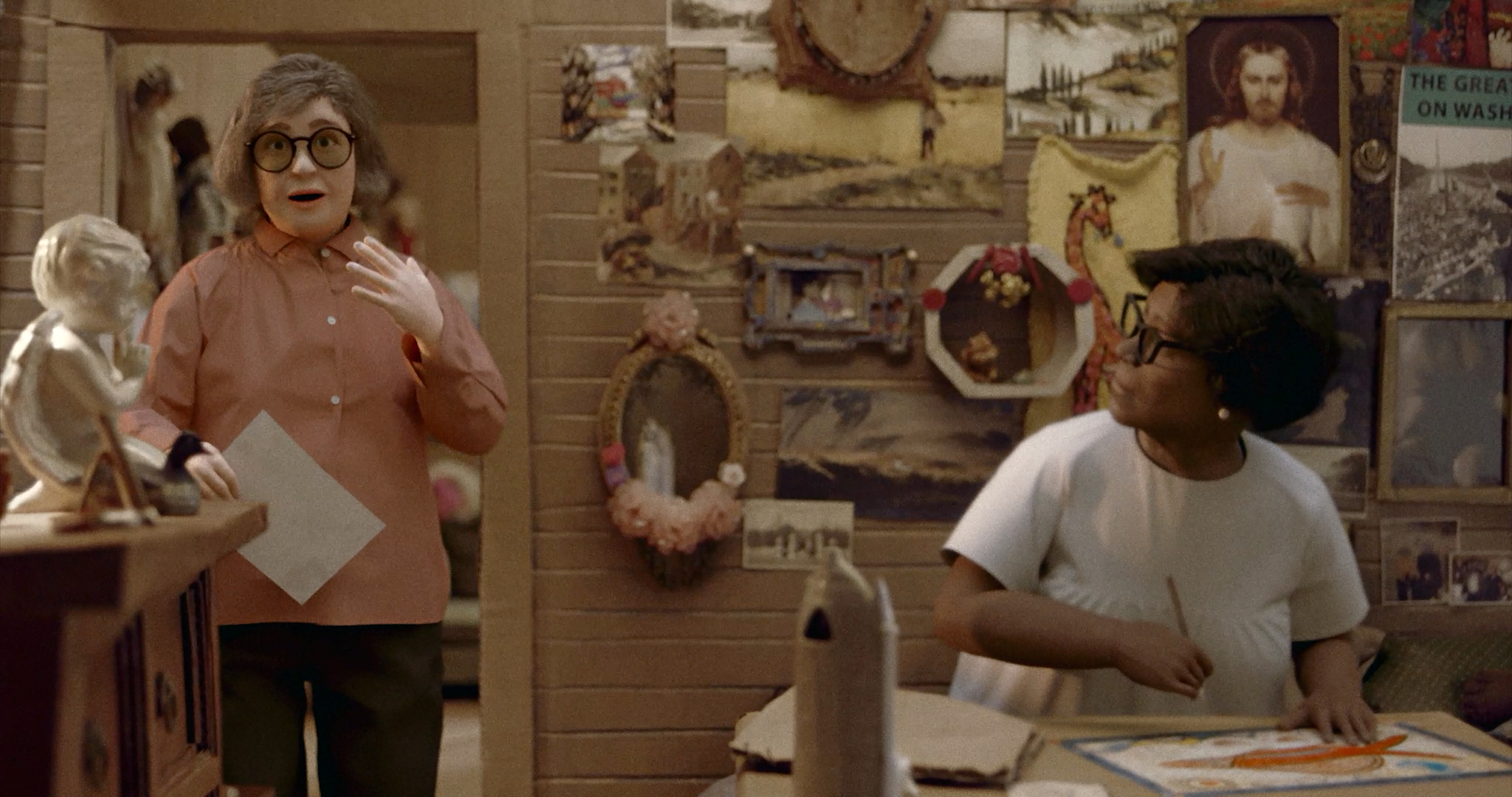
Directors Petter Ringbom and Marquise Stillwell, who collaborate as the production company Opendox, created sets that reimagine the Playhouse. They partnered with Kaktus Film to design exquisitely expressive, three-dimensional, stop-motion animated characters in the women’s likenesses. Actors Uzo Aduba and Amy Warren perform scripted scenes based on actual, recorded dialogue. The result is a whimsical meditation on friendship, genius and soul survival.
Their Directors’ Statement notes: “How does race, class, religion and gender impact our lives and relationships? What is history, how do we tell it, and who does it include? How does history reverberate through time and impact our lives today? What is art, and who gets to be a ‘real’ artist? These are all questions we ask in This World is Not My Own.”
We caught up with Ringbom and Stillwell to learn more about this bracingly original documentary:
ArtsATL: What about these two singular women made you want to make a film?
Opendox: We have made a number of films before about artists and musicians who make art in order to change or escape the world they live in. It’s something we connect with instinctively and can relate to in our own lives. Our producer and co-writer, Ruchi Mital, has dubbed them films about “creative underdogs.” When we first heard of Nellie Mae Rowe and saw her art, we quickly knew it was a story we wanted to tell. Hers is the ultimate creative underdog story, though I doubt she ever thought of herself in those terms.
ArtsATL: How would you describe this instance of unexpected sisterhood? What did each of them get out of it?
Opendox: On the surface they’re obviously very different people. Judith Alexander came from a wealthy Jewish family in Atlanta, while Nellie Mae Rowe grew up quite poor and had very little education. But as Cathi Perry, Nellie Mae Rowe’s great-great-niece, puts it in the film, “they were the same in a lot of ways; they both danced to their own music.” I think they bonded around a shared sense of being outsiders, of being different.
Early on, we were skeptical of Judith’s motives. There’s a power balance there that can’t be ignored, but it was Nellie’s family that convinced us that it was a true friendship. Nellie and Judith had a real bond. Without Judith, it’s doubtful we would know about Nellie Mae Rowe today.
ArtsATL: How many people did you interview? What are some of the challenges you faced making this movie?
Opendox: We don’t know the exact number, but certainly more than 20. Since there’s a limit of archival material or books about Nellie Mae Rowe, our research consisted of talking to people who either knew her or had studied her. We talked to general historians, as well, to get a better understanding of the time. Since we relied mainly on oral history, there’s an innate subjectivity at play. Our memories of events and people differ drastically. This could be considered a challenge, but we decided to play with the subjective memories that people have of Nellie and Judith. We let contradictions and differing opinions exist in the film. For us, that’s a true reflection of life.
ArtsATL: Please talk a bit about the stop-motion animation. Why did you take that approach, and what are its advantages and disadvantages?

Opendox: We made a film about someone who’s been dead for more than 40 years, and because of who she was and the time she lived in, there’s little archival material to work with. So, in order for an audience to connect emotionally with Nellie and feel her presence, we decided to reimagine her as an animated character and also reimagine her famous home, known as the “Playhouse.” We cast the incredible actress, Uzo Aduba, to voice our animated Nellie and did motion-capture with her that the animators used for Nellie’s movement. Uzo also sings in the film. It’s a playful approach that we think is in the spirit of Nellie Mae Rowe.
We also animated all the artwork in the film. There’s something about her art that calls out to be animated. It’s full of life, and it’s not precious. In the film, her art is telling her story as much as the character animation does. Some people might frown on animating art, but we’re making a film here, not a slideshow. That’s how we view it.
ArtsATL: What do you want viewers to take away from this film?
Opendox: It’s in the title, This World is Not My Own, which can be interpreted in different ways. Nellie Mae Rowe created a world for herself that was more interesting, beautiful and just than the world around her. We have the power to design our own lives and transform the world around us, even in difficult circumstances. You can also look at it like this: we are not alone in this world. Our actions, good or bad, affect others and reverberate through time, whether we’re aware of it or not.
::
Candice Dyer’s work has appeared in magazines such as Atlanta, Garden and Gun, Men’s Journal, Country Living, and other publications. She is the author of Street Singers, Soul Shakers, Rebels with a Cause: Music from Macon.
STAY UP TO DATE ON ALL THINGS ArtsATL
Subscribe to our free weekly e-newsletter.

PLEASE SUPPORT ARTSATL
Your Gift Sustains the Coverage You Count On!
Related Posts