Namwon Choi maps journeys from Korea to North Georgia at MOCA GA
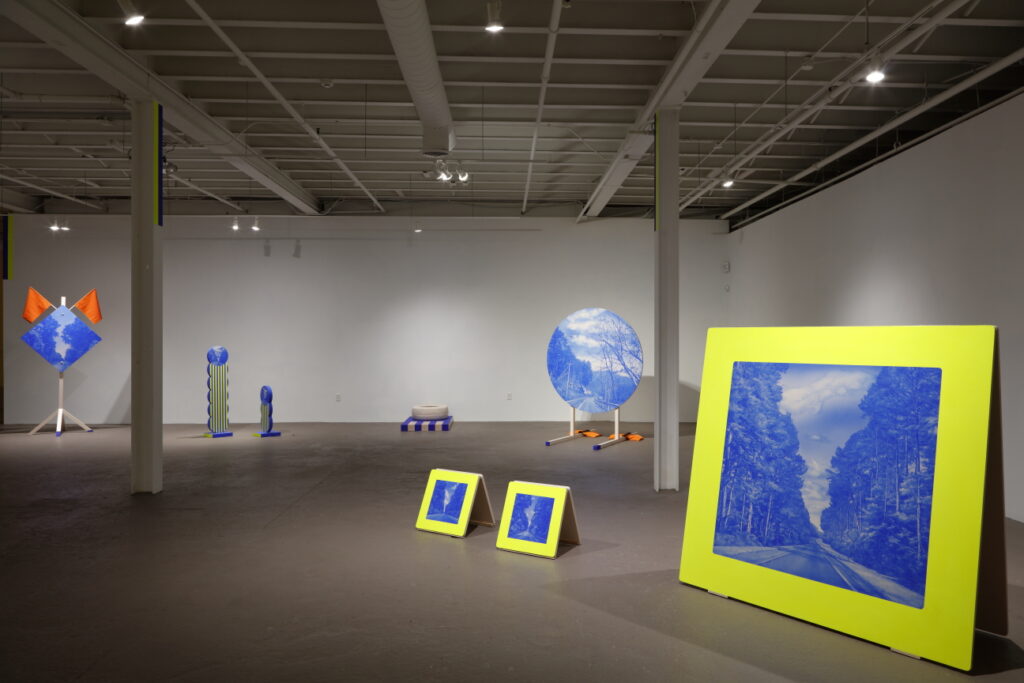
Conceptually rigorous and emotionally expansive, Namwon Choi’s 248 Miles at the Museum of Contemporary Art of Georgia through October 12 is a culminating body of work afforded by her MOCA GA Working Artist Project award. Choi is an immigrant and self-described outsider, born and schooled in Korea, where she earned an advanced degree in Oriental Painting.
Arriving in Georgia in 2002, she also operates in a thoroughly American sphere. For more than 20 years, she has absorbed American culture, especially that of the South.
Choi has immersed herself in the language of contemporary art and structured minimalist vocabularies. Accordingly, her work is both representational and abstract, as she plays with the dichotomy that characterizes her artistic and life journeys.
In 248 Miles, Choi tackles the MOCA GA space head-on, moving her work off the wall into three-dimensional space. The exhibition title refers to the 248 miles between Savannah, where she lived for many years, and Marietta, where her children, now teenagers, live. At first glance a collection of individual works, the exhibition is meant as an immersive installation that maps Choi’s personal and cultural histories by way of reckoning with contrasting art-making strategies.
Over the past several years, Choi has centered her work on rendering images of Georgia roads based on cellphone images taken through her car’s windshield. She has developed a distinct vocabulary centered around exquisite monochromatic gouache and acrylic landscape paintings that draw upon her technical training in Korea.

The paintings’ beautifully rendered ethereal marks are nostalgic on multiple levels — a reference to Choi’s Korean home and at the same time to the idyllic byways of American roads and highways. This nostalgia — a yearning for home and the past — is re-inforced by the blue hues she uses to mimic cyanotypes, one of the earliest forms of 19th-century photography.
These paintings are then integrated within highly-crafted shaped panels that reference road signs and barriers that Choi categorizes as “vernacular abstraction.” Like her cyanotype-blue landscape paintings, she has developed a precise vocabulary of minimalist abstract stripes that fill these geometric shapes, recalling the work of artists such as Frank Stella or Sol Lewitt. She distances herself from the literal through a palette that echoes — but steps away from — caution yellow or orange safety fence colors and adds additional colors, including smalt blue and peach.
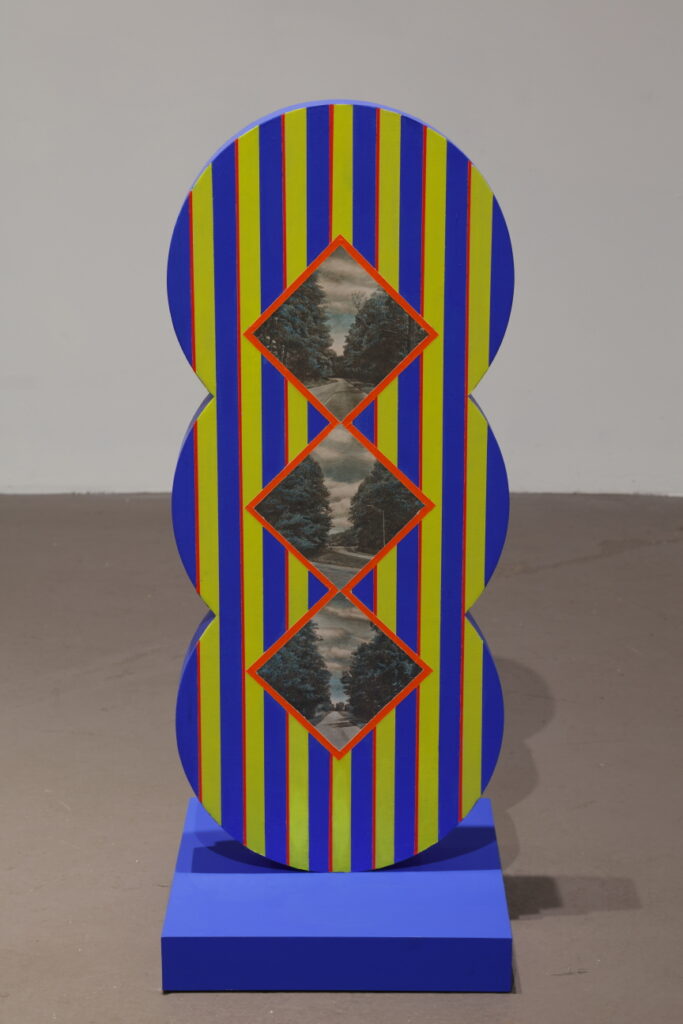


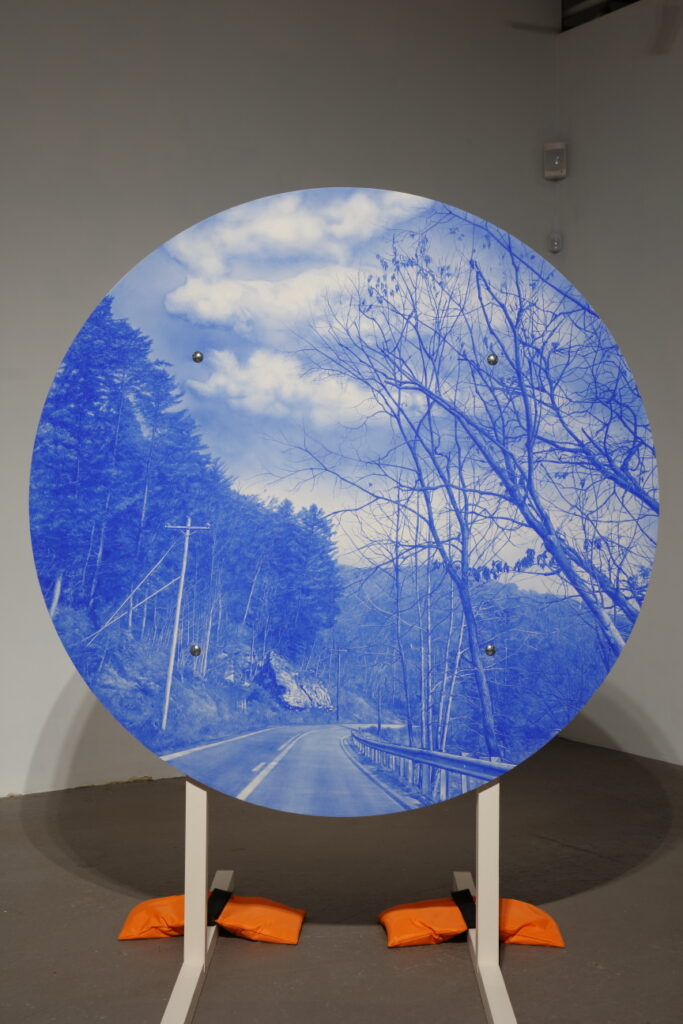
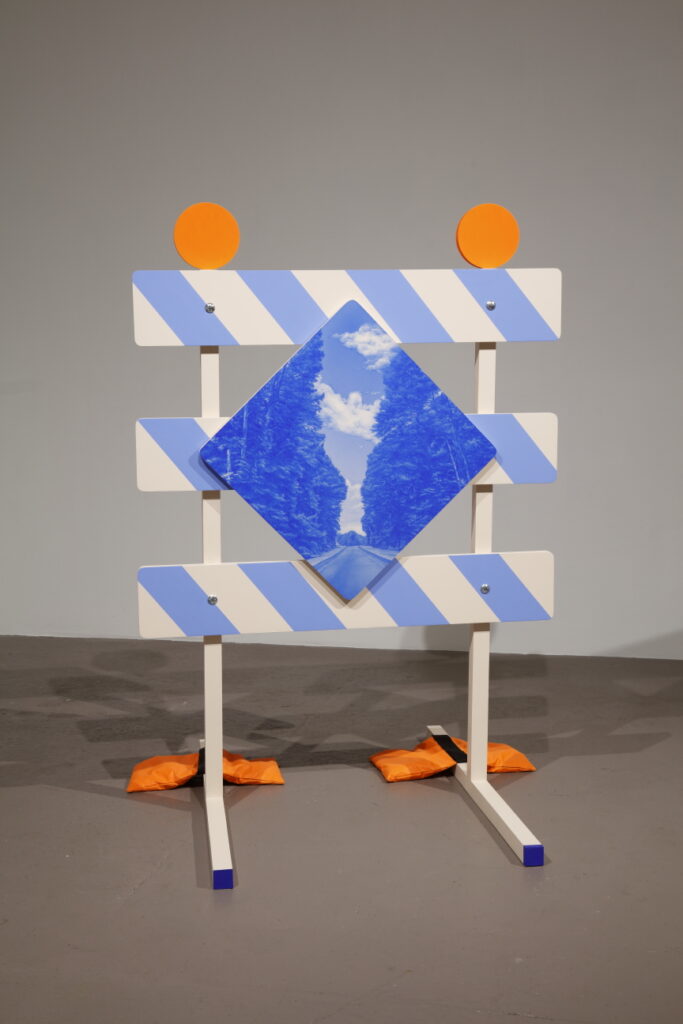
The installation maps the highway with many stops along the way. Perhaps invoking dance notation used to record choreography and human movement, 248 Miles is precise and mindful while also dreamlike. Her shapes and forms reference the symbolism of the Korean alphabet, with circular shapes representative of heaven, square shapes representative of Earth and vertical shapes representative of humans who mediate between the two realms.
248 Miles provides visitors with a “map/legend” that signifies the stations of Choi’s repetitive journeys along I-16 — although the paintings look like the winding, forested roads of north Georgia (artistic license accepted). A close reading of the legend tells us that the first three structures, one large with two small works by the side, are in fact Mom with Haley and Esoo, Choi’s children. These works are stacks of multiple circles with blue and white stripes that introduce small landscapes painted in the muted tones of early 20th-century chromolithograph postcards — again a type of nostalgia that contrasts with the vernacular abstraction of the forms and stripes.
Another element that invokes Choi’s past work is a ghostly set of white tires made of cast fiberglass and coated with resin and marble dust that are interspersed throughout 248 Miles. They represent the many tires Choi wore out on her repetitive journeys between Savannah and Marietta. She compares her tires to one of Van Gogh’s paintings of old boots, used, worn and very familiar. They also make references to contemporary artists such as Robert Gober, who has elevated the mundane by the recreations and reconceptualization of objects such as sinks, beds and cribs.
This exhibition is successful not only because of its narrative but also because of Choi’s abundant attention to detail. Choi works with highly skilled woodworkers and other craftspeople to create her meticulous forms on which she combines her representational and abstract elements. Her thoughtful installation not only creates a narrative route in the MOCA GA space but also effectively considers the negative spaces between elements.
248 Miles feels like the end of a journey. Choi now lives in downtown Atlanta and is no longer making the drive that inspired this body of work. Will there be a new story or new direction that recollides her cultures? Will she restructure her vocabulary? I’m looking forward to the next chapter of her artistic journey.
::

Louise E. Shaw has been a cultural worker in Atlanta for over 40 years. She served as executive director of Nexus Contemporary Art Center from 1983 to 1998 and was on Eyedrum’s ad hoc advisory board in the 2000s.
STAY UP TO DATE ON ALL THINGS ArtsATL
Subscribe to our free weekly e-newsletter.

PLEASE SUPPORT ARTSATL
Your Gift Sustains the Coverage You Count On!
Related Posts