
Layers of care: Devotion and detail in Emmanuelle Chammah’s ‘carescapes’
In textile art, the medium is often the heart of the message; the viewer is meant to marvel that what could have been a painting was instead rendered in fabric. Emmanuelle Chammah’s carescapes, currently on view at Echo Contemporary Art, refuses this simplification.
Chammah, an Atlanta-based artist with a background in architecture and a practice rooted in her Egyptian-Levantine heritage, has built a solo exhibition in which care is not merely a titular theme but a structural principle, operating at every level from the fabrication of the objects to the attention they demand of their viewers. The result is a show of remarkable depth and quiet conviction that rewards the patient eye and, in doing so, offers a genuinely refreshing alternative to the scale and spectacle that dominate many contemporary exhibitions.
The show combines older installations with newer garment-based pieces, unified by Chammah’s insistence on textile not simply as medium but as carrier — of family history; of material memory; of tactile intimacy. Her fabrics are not neutral substrates; they are repurposed heirlooms carrying the weight of specific lives, and the invitation to touch them is not incidental but fundamental to the work.
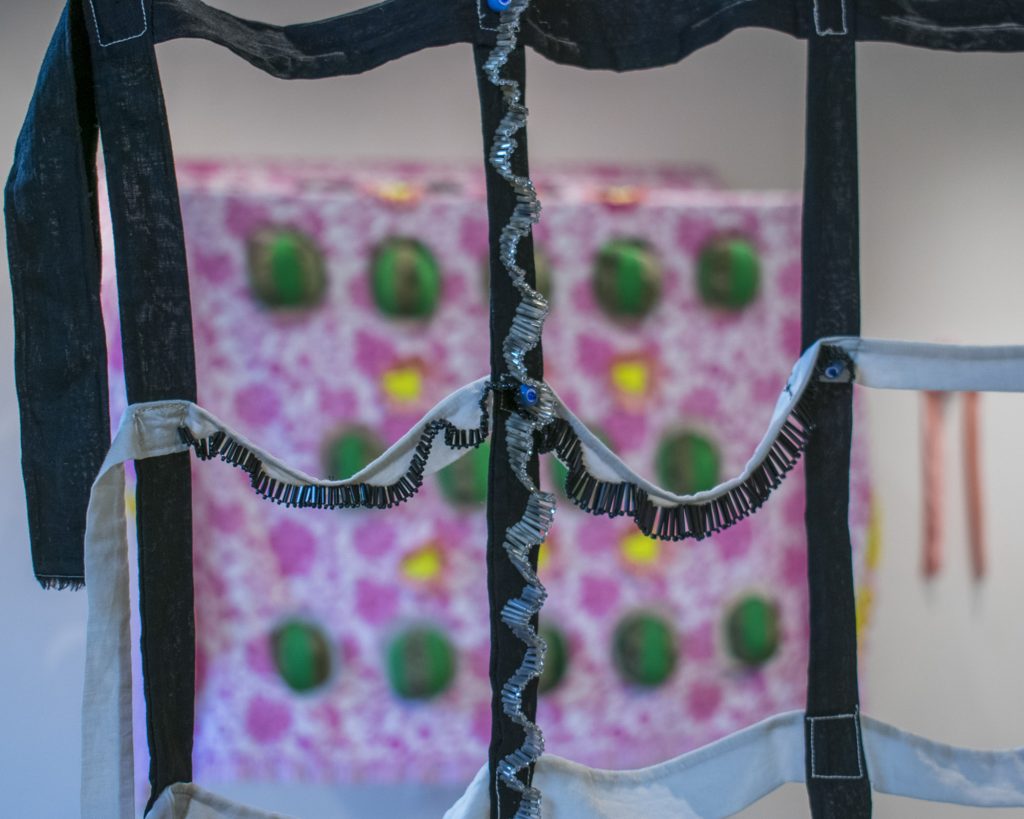
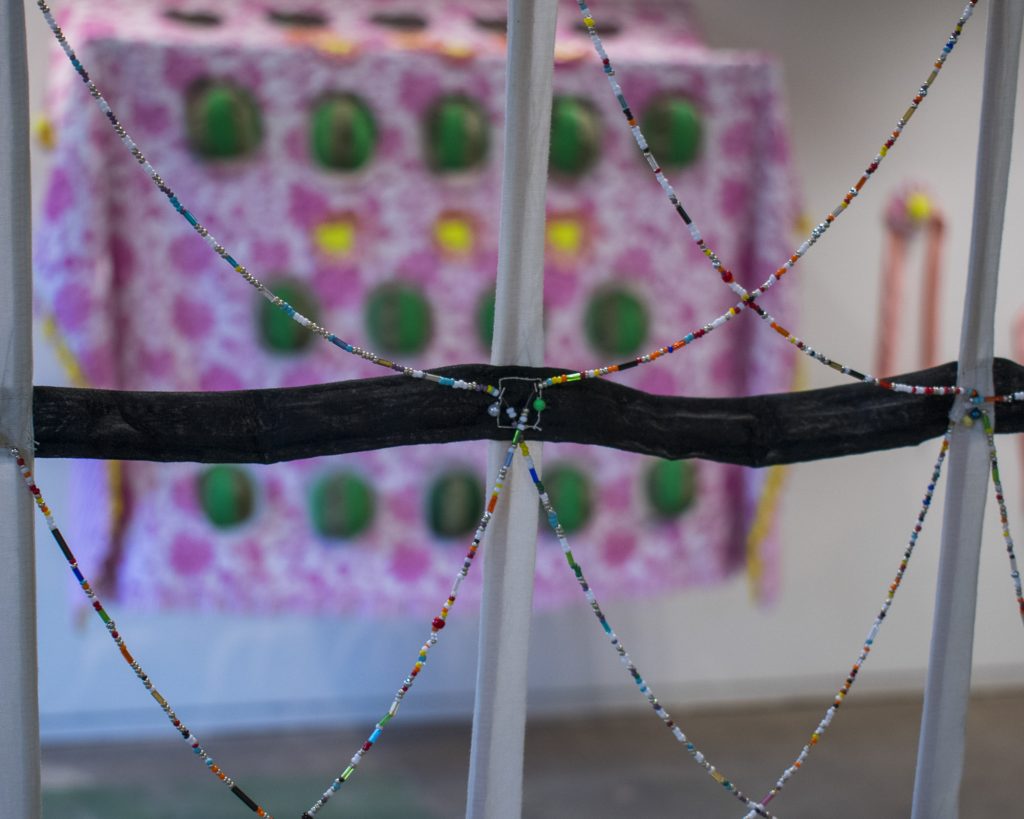
Chammah describes hers as a socially-engaged practice, and that ethos extends beyond the work’s interactive invitations to the crediting itself: In a solo exhibition, collaborators and fabricators receive full attribution on wall labels. In Concrete and Rebar, a grid-like structure is suspended from the ceiling with beading embellishing its fabric bars and spanning its gaps. The beadwork was executed by Adia Reid, Anthe Schmidt, Roshani Thakore and Chammah herself — the variation in technique across sections is not smoothed over but celebrated, each hand legible. She has even included a stained glass work by her friend Nadia Nunez, displayed here with full attribution, a gift to Chammah replicating her signature watermelon motifs. “It doesn’t take away from my time that I received help,” Chammah said. “It just adds to it that other people believed in my work.”
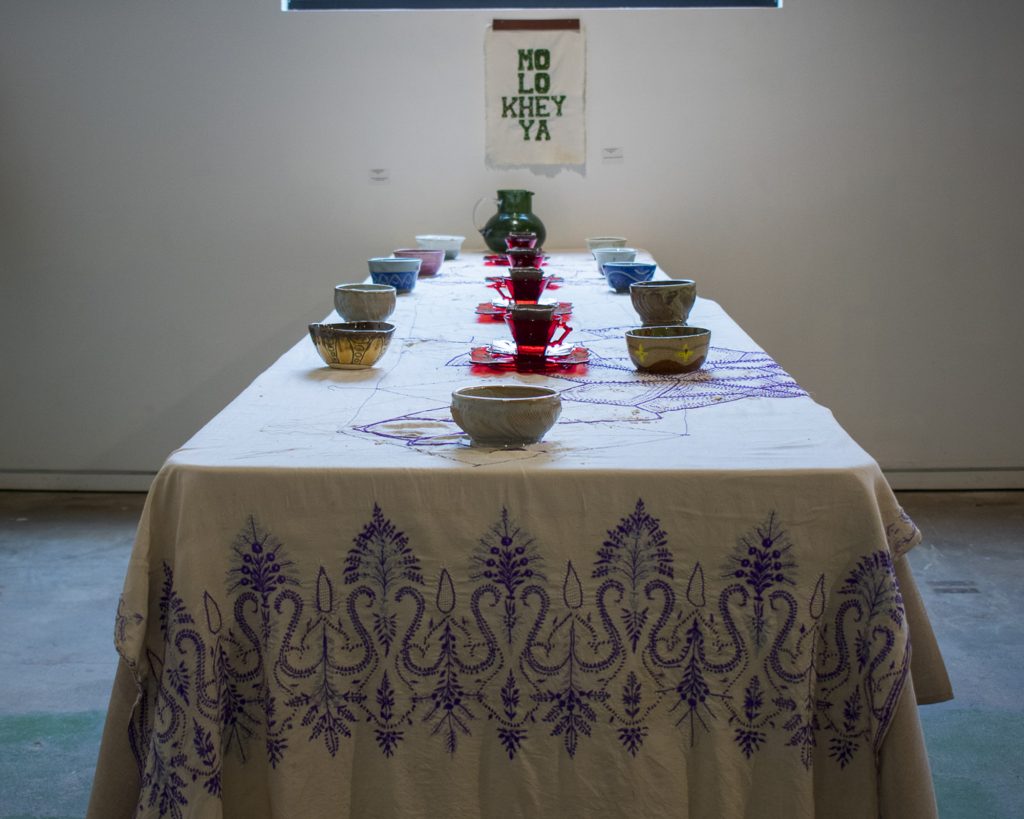
Of the many forms care takes in carescapes, the communal is the most immediately visible. A clear example is Grandma’s Table, a time-based installation in which a long dining table is positioned prominently in the gallery. Upon it, a tablescape is set atop a long repurposed family tablecloth, embroidered along the lines of its own stains, treating the marks of use not as blemishes but instead as records. During the opening reception, Chammah served attendees a meal here. She will later embroider those new stains into the cloth, folding the evening back into the work as an ongoing archive.
Nearby, Easy Mode offers a checkerboard sewn into fabric, fully playable by two people sitting together. Its foam-lemon game pieces tuck into pockets in the work itself, such that the whole piece can be wrapped around the body and carried — a nomadic object referencing Chammah’s family’s history of forced displacement.
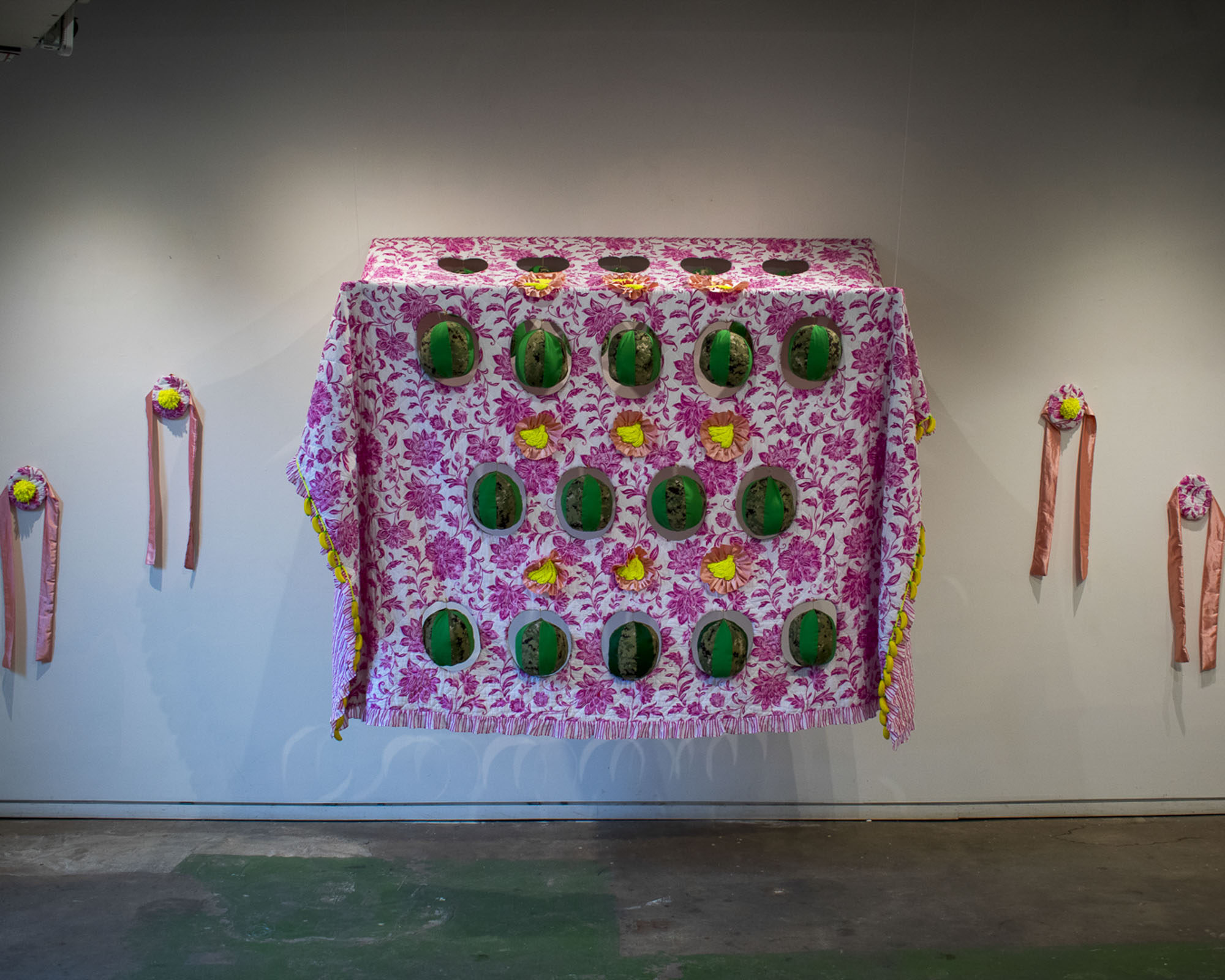
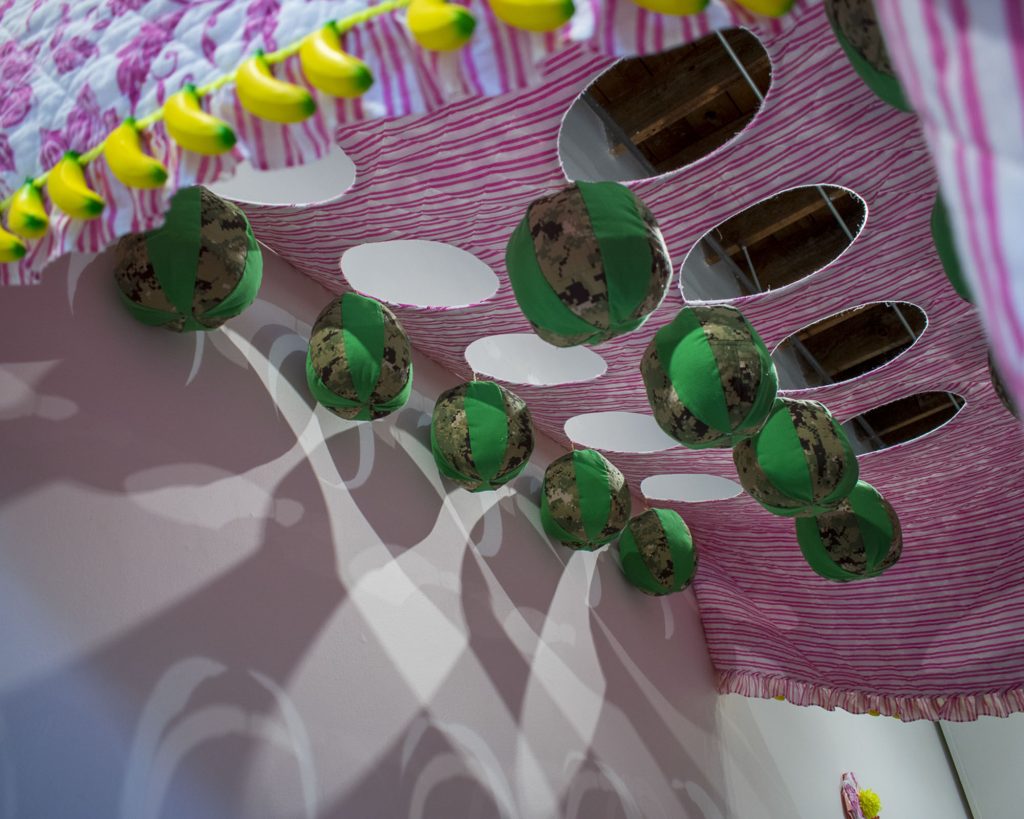
Mansoura Harvest 1958, a large pink quilted canopy dotted by three-dimensional watermelon forms made from naval fatigues, extends from the wall and invites viewers to walk beneath it. The effect is less gallery installation and more pillow fort. The effect is welcoming, enveloping and disarmingly intimate. In this way, Chammah’s visually appealing and interactive pieces are most fully understood in the opportunities they foster for engagement between viewers’ bodies, each other and with the work itself.
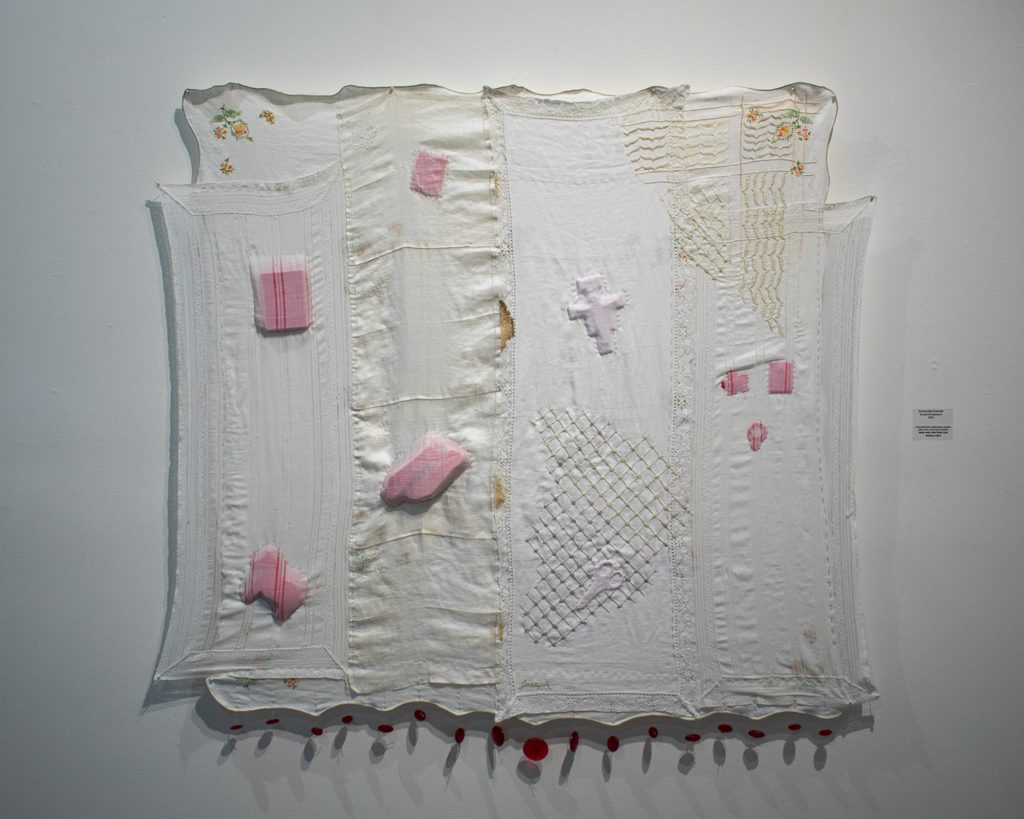
Interestingly enough, the exhibition’s most rewarding work is not interactive at all. It’s just a lot going on is a more traditionally-displayed piece, composed of white heirloom fabrics — tablecloths, handkerchiefs, napkins, a table runner — from the family of Chammah’s husband, hung on the wall with pins that stretch it slightly. Brown stains, perhaps coffee, are woven into the composition rather than concealed. The material memory of the cloth is treated as content, not blemish. Onto these repurposed textiles, which carry their original Western embroidery, she has layered a keffiyeh pattern in cream thread. The collision of Egyptian patterning and American heirloom textile is quiet but unmistakable; two family histories occupying the same fabric.
It’s just a lot going on introduces a different kind of care into the exhibition — the artist’s own, visible in the painstaking detail of its construction. The keffiyeh is traditionally a woven pattern, not an embroidered one. To render it by hand is exponentially more laborious, requiring meticulous attention to the directionality of each stitch. Sewn beneath the cloth are red, 3D-printed objects, replicas of heirloom items like those that displaced families sew into their clothing to carry what they can. Viewed through the white fabric, the red softens to pink; the objects are present but muted, visible only through gaps in the fabric. A set of Bicycle playing cards, rendered with perfect accuracy in design and lettering, is barely discernible through the cloth. Childhood ballet slippers, sewing scissors, Orthodox Christian icons and a grape leaf brooch — which Chammah, raised in Canada, long mistook for a maple leaf — are all there for the viewer willing to slow down and look.
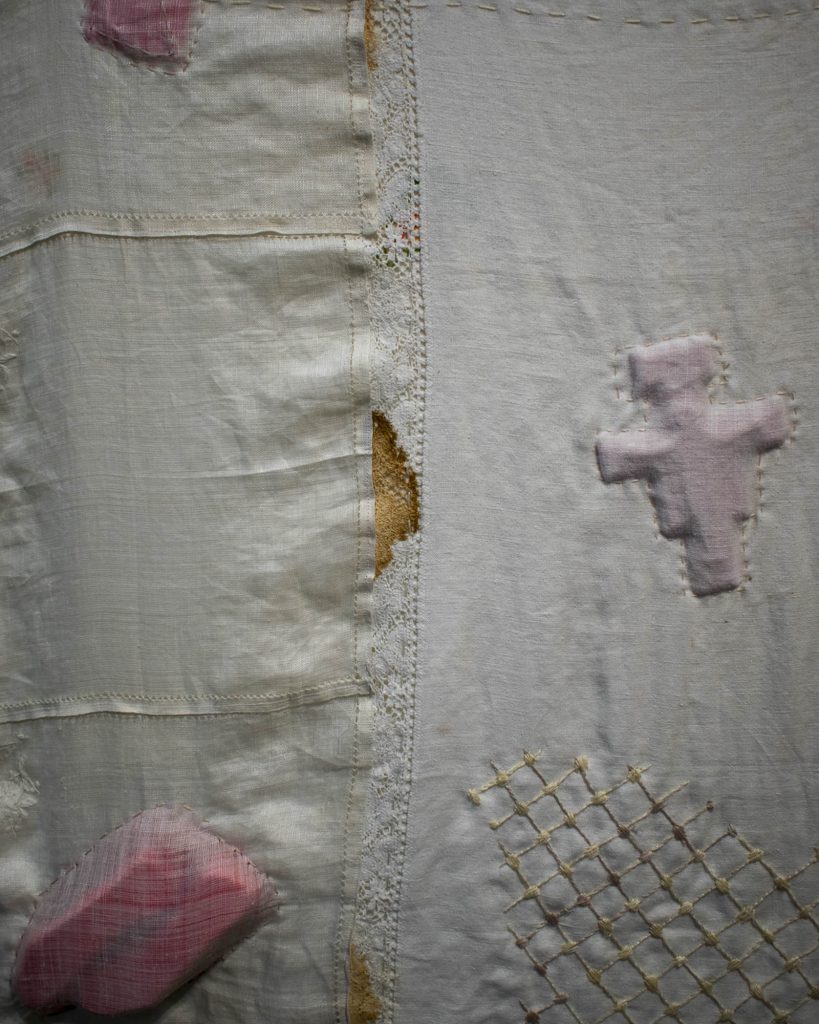
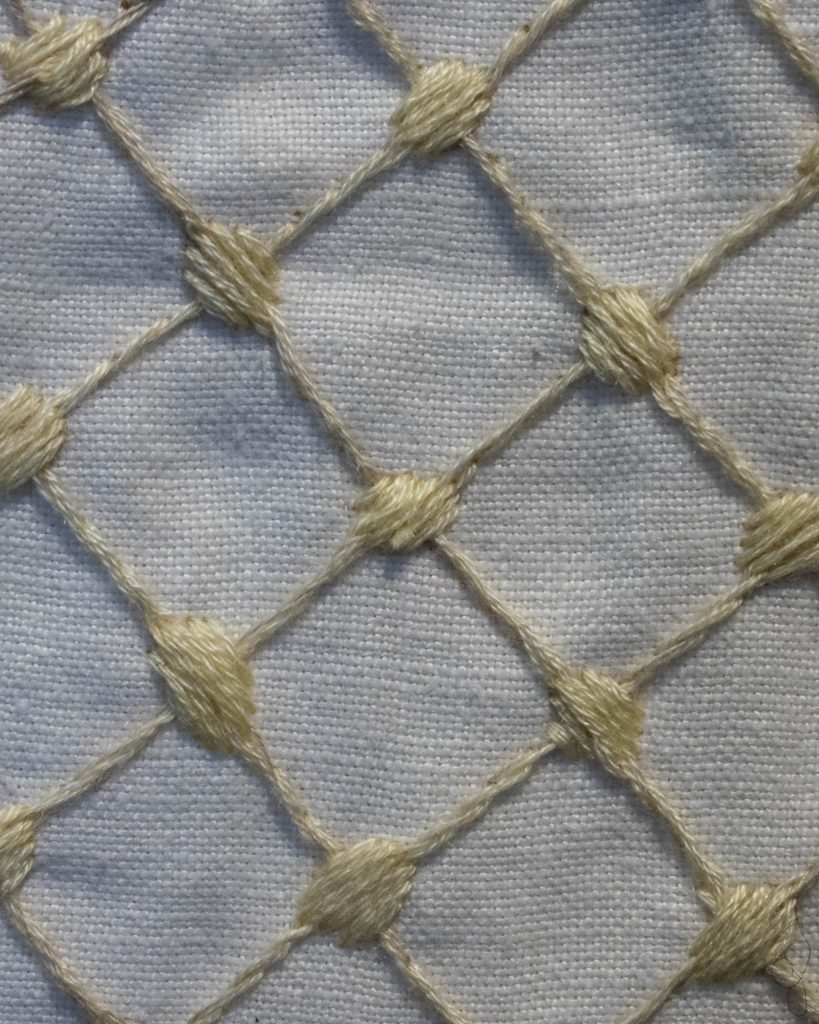
The care exercised in the making of this piece asks for a corresponding care in the looking. Through that exchange, in leaning closer, squinting, discovering what was almost invisible, the work offers something genuinely rare: It slows the viewer down. It asks for patience and repays it with intimacy.
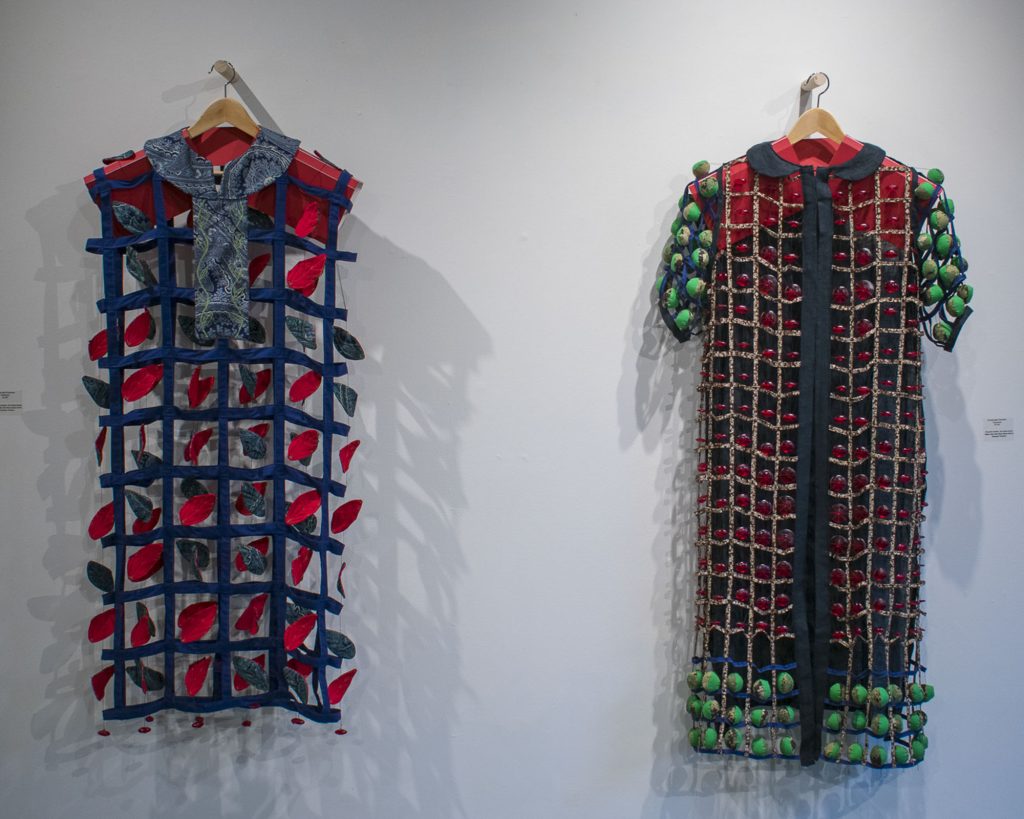
Nearby, two garment-based works, Galabeyya and Housecoat, push the exhibition’s exploration of care into a more speculative space. Both are lattice-like garments with elements suspended in the open spaces between strips of fabric: Molokhia leaves in one; 3D-printed beads in the other. Galabeyya’s leaves can be flipped to signal the wearer’s mood. Here, Chammah imagines a world in which everyone wears garments like these, offering one another legible signs of emotional state as a quiet infrastructure for empathy. Housecoat’s beads vary in size to conceal or reveal the body based on the wearer’s self-consciousness, with small pillows on the sleeves for arms exhausted by the repetitive labor of motherhood. Although they could be, neither piece is truly meant to be worn. They are high art, imagined garments that care for their wearers: protecting; communicating; attending to vulnerability.
The one small critique to be made of carescapes is found in its framing, rather than its content. Echo Contemporary has scheduled carescapes at the same time as a group show themed around textiles is on view in the front gallery. This adjacency, however well-intentioned, primes the viewer to engage with Chammah’s work primarily through the lens of medium. This is an inappropriate reduction of her practice.
Chammah’s art is not defined by its materials. It uses textile’s specific qualities — its touchability; its drape; its capacity to carry material history — in service of a rigorously-conceived, culturally-grounded, contemporary practice. The intellectual depth and meticulousness of carescapes is more obvious when consumed as a stand-alone exhibition. For this reason, the viewer would benefit from a moment to pause and mentally reset before stepping into the back gallery. Fortunately, this type of slowness and reflection is the very mind-set Chammah’s work invites.
What carescapes ultimately achieves is gravitas earned, not through volume but through attention, tenderness and intimacy. In an art world that often rewards the immediate and the spectacular, Chammah has constructed a show that insists on devotion in the making, in the looking and in the gathering. Here, care is not a sentiment. It is a practice, an ethic and a structural principle — and it is legible in every stitch.
carescapes by Emmanuelle Chammah will remain on view at Echo Contemporary Art through March 28.
::

Dr. Kevin M. Storer is a multidisciplinary computing researcher living, working and collecting art in Atlanta. His approach to art criticism and collecting prioritizes the discursive power of artistic practice over purely aesthetic qualities. This perspective is informed by his internationally-awarded scholarship on the complex relationships between people and the objects we create — especially as they shape our identities and social realities. Kevin earned his Ph.D. in informatics from the University of California, Irvine.
STAY UP TO DATE ON ALL THINGS ArtsATL
Subscribe to our free weekly e-newsletter.

