In ‘Phoenix City,’ a collaborative trio performs the cycle of queer loss and renewal
In 1864, after they captured the city of Atlanta, Union military forces enacted a scorched earth campaign, destroying all infrastructure of possible use to Confederate forces. Including railroads, factories and commercial buildings, this intentional demolition reduced about 40% of the city to rubble. But Atlanta rebuilt, growing to become the international city of today and inspiring the phoenix as the unofficial symbol of the city and the performance Phoenix City by artists Jimmy Joyner, Sean Nguyen-Hilton and Mingyong Cheng. Presented in the cavernous Goodson Yard at the Goat Farm Art Center, this collaborative, improvisational, multimedia performance carries the through lines of destruction and reconstruction.
As seen in the promotional text, Phoenix City, which was performed in Goodson Yard on October 29 and October 30, “draws on Atlanta’s former queer spaces, including the Atlanta Eagle on Ponce, Charlie Brown’s Cabaret, Outwrite Bookstore and the Ansley Mall movie theater.” These venues, unofficial queer community centers, left a hole when closed, and, although the community has migrated to new spaces, Joyner cites longing and lamentation as impetuses for this performance.
“I want Cheshire Bridge Road in 1991 Atlanta,” says Joyner, who has lived in Atlanta on-and-off throughout their life. They express that these venues were important, in part, because they were places queer people could pass — i.e., display outwardly non-normative characteristics without fear of retaliation. “Where do queer folks get to pass? How can we create a sense of passing, and what are those places? A lot of them are closed now.”
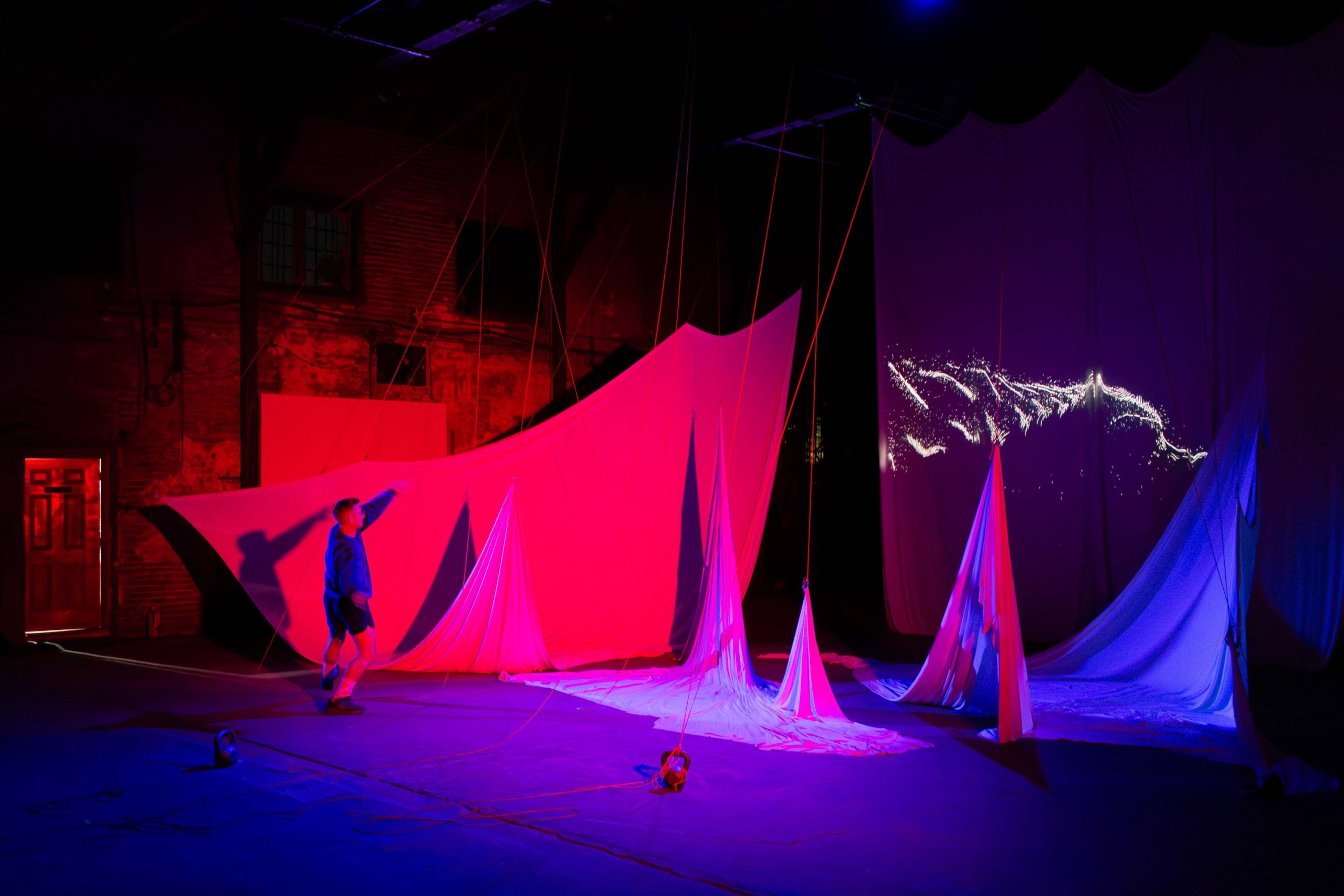
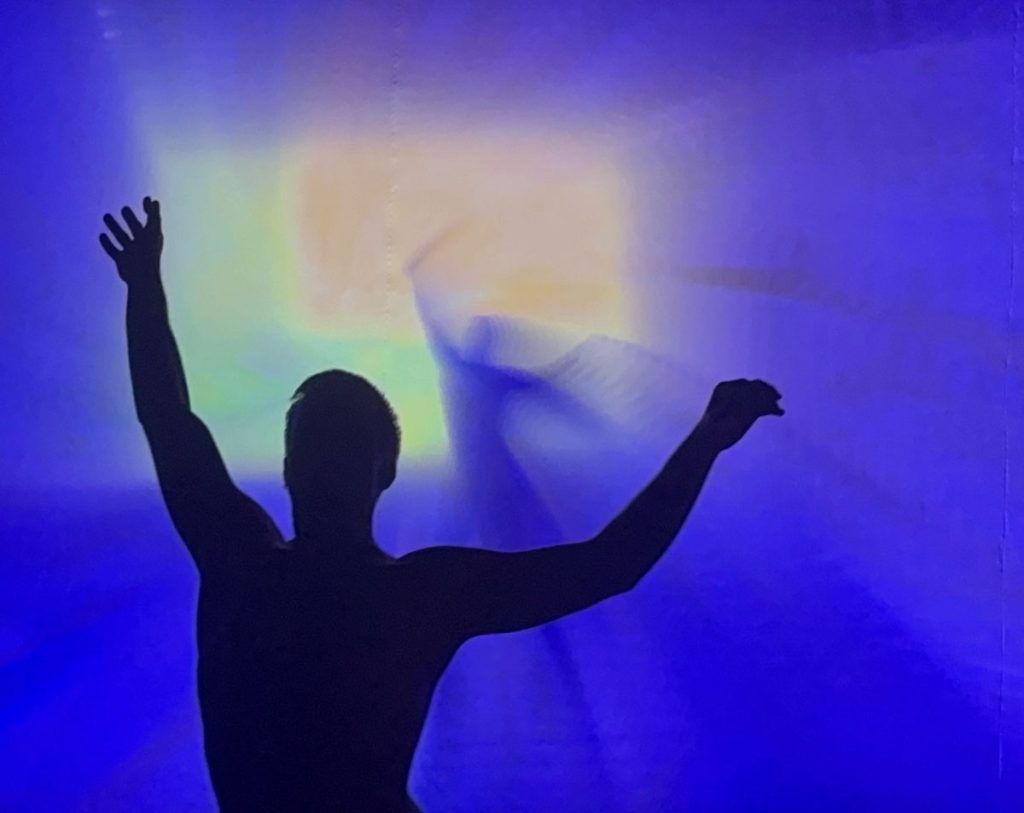
While providing relevant context, this performance isn’t entirely historical. Cheng is a first-time collaborator — while Joyner and Hilton have collaborated since 2010 — and her arrival brings many technological components. Using motion- and face-tracking software and multiple cameras, Cheng mimics contemporary surveillance techniques. The inputs from these cameras are filtered, stylized, warped and multiplied before entering the performance space as projected video feeds, adding kinetic visuals to the multiple LED theater lights.
When asked how surveillance pertains to queerness, Joyner explained, “[If we] think of the body as something that’s constantly organizing, reforming and quite queer, it’s sort of always unlanded. That unlanded quality can slip through and pass through these ideas of capture and surveillance.”
Eliding surveillance is furthered by the set design and choreography. Four sheets of beige Lycra, each some 15 feet wide and 25e feet tall, hang from the ceiling and brush the floor. Suspended by hooks and pulleys tethered to kettle weights, as the performance progresses, Joyner, the only dancer, constantly manipulates the sheets — raising, lowering, reshaping and enshrouding themself. The continually changing environment and frequently anonymized movements disrupt and sidestep the tracking software.
The performance is loosely divided into multiple acts, largely shaped by Hilton’s audio compositions. Using loops and found audio, Hilton establishes an overarching tone for each act — at times robust, musical and energizing; at others ambient, echoey and heartening. It concludes when Joyner exits through the curtain covering the venue entrance.
In 2025, Joyner, Hilton and Fly on a Wall founder Nicole Johnson presented DreamBody — a spontaneously composed piece made through movement and sound generation. Since then, the trio has presented more DreamBody performances, turning it into a performance series. With the arrival of Cheng and her more advanced technological prowess, the trio will become a quartet as they continue to use extemporaneity to build and rebuild spaces where queerness lives.
::

Leia Genis is a trans artist and writer currently based in Atlanta. Her writing has been published in Hyperallergic, Frieze, Burnaway, Art Papers and Number: Inc. magazine. Genis is a graduate of the Savannah College of Art and Design and is also an avid cyclist with a competition history at the national level.
STAY UP TO DATE ON ALL THINGS ArtsATL
Subscribe to our free weekly e-newsletter.

PLEASE SUPPORT ARTSATL
Your Gift Sustains the Coverage You Count On!
Related Posts