
In Lilburn, a family made a movie; you may only get one chance to see it
Adam Pinney’s Mudville — a handmade, family-built feature premiering April 30 at the Atlanta Film Festival — embodies the DIY promise of filmmaking. It’s also a time capsule his children will carry for life.
::
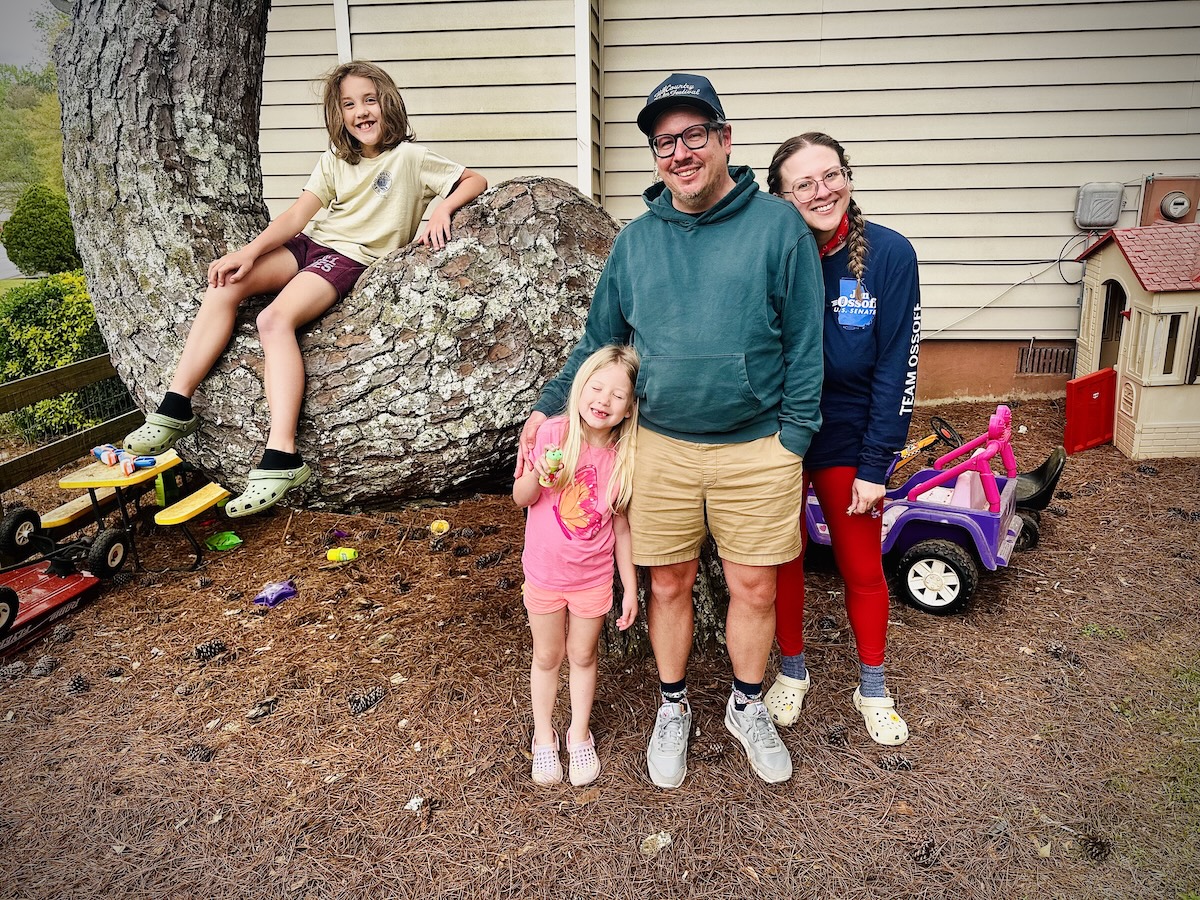
On a quiet street in Lilburn, where Atlanta gives way to Gwinnett County on the drive toward Stone Mountain, a crooked pine tree rises from a backyard scattered with toys and the everyday debris of childhood. The tree bends low and sideways, its trunk curved just enough that a child can climb on and ride it like a horse.
The tree is also, improbably, at the center of a feature film.
Inside the nearby house — a remodeled 1970s suburban home filled with books, posters, graphic novels and art made by both adults and children — filmmaker Adam Pinney has spent the better part of seven years bringing that backyard, that tree and that life into Mudville, his latest feature. The film premieres Thursday, April 30, at 7 p.m. at the Atlanta Film Festival — and it may be one of the only chances you ever get to see it. You should go, because Mudville is not just a movie. It’s a Southern baseball story, a family drama and a work of quiet magical realism, one that feels both handmade and deeply personal.
If the title Mudville sounds familiar, it should. Yes, it nods to the poem Casey at the Bat — and yes, this is a baseball story. But not in the way you expect. At its center is Ray Patterson, a 47-year-old unemployed father who spends his days alone at a community park, hitting baseballs off a tee in a desperate attempt to make it back onto the Atlanta Apaches, a major league team he was signed to decades earlier. His drinking — what got him kicked off the team in his early 20s — still shadows his daily life.
Around him, the world begins to shift. Ray is haunted by dreams and visions he interprets as Native American ghosts, supernatural forces that seem intent on burying him — his body, his past and his unrealized future — back into the earth. What begins as a story of obsession and failure slowly transforms into something stranger: a metaphysical unraveling that his family can only watch, powerless to stop.
His wife, Holly, played by Amanda Pinney, turns elsewhere for answers — toward tarot, ritual and what she calls a kind of “suburban witchery.” The film moves between these registers: the grounded and the cosmic; the domestic and the unknowable. It is, as Pinney describes it, more drama than comedy. It is also distinctly Southern, engaging with the region’s inherited tensions — especially race — not through overt confrontation but as something ambient, embedded in the environment itself.
Pinney is not new to acclaim. His earlier feature, The Arbalest (2016), premiered at South by Southwest and won the Grand Jury Prize for Narrative Feature — an unlikely victory for a micro-budget, highly stylized film made with a small creative collective.
That film established him as a filmmaker capable of building an entire world within tight constraints. But instead of using that success as a springboard into the traditional industry, Pinney found himself pulling away from it.
Attempts to develop projects through more conventional channels proved frustrating to Pinney. Too many notes. Too many compromises. Too much distance between the idea and the finished work. So with Mudville, he chose a different path: complete creative control.
“I wanted to own every mistake,” he says. “Everything that feels wrong as well as right.”
To understand Mudville, you have to understand where it was made. The Pinney home doesn’t present itself as a film set. It’s lived-in, layered, full of evidence of creative life: art on the walls, stacks of books, movie posters, graphic novels, creative works in process from the kids and adults that live there. It’s the kind of place where making something is not an event — it’s a constant condition. This is where the film was shot.
With a budget of roughly $500, much of it spent on fake plants and vines, Pinney relied almost entirely on what he already owned: a Blackmagic camera, a few lights, a self-assembled audio setup and a production kit originally built for freelance work. Scenes were lit primarily with natural light. Rooms became locations. The backyard became a landscape.
“We should be making art where we live,” he says. “Our life is here. Our families are here.”
Amanda, who works professionally at Georgia State University, describes the process as both immersive and transformative. Though she came from a theater background, her understanding of film grew through their collaboration — what she jokingly calls an “informal film school.”
Over time, the two became creative partners.
“He’s a designer, as well as a cinematographer, as well as a director and storyteller,” she says.
That sensibility carries into Mudville, where domestic spaces are overtaken by organic growth — plants, vines, textures that feel alive and encroaching.
The most radical element of Mudville isn’t its aesthetic. It’s who’s in it. Pinney’s children — Max, 9 and Mavis, 6 — play central roles. They are not performing in the traditional sense; they are inhabiting a world shaped around their real personalities and rhythms. Their memories of the film are telling.
Max talks about lying on a couch covered in fake leaves, submerged in a surreal environment. Mavis remembers eating mac and cheese on camera, how exciting it was that her favorite food became part of the movie. But there are deeper moments, too.
In one scene that was ultimately cut, Max recalls being yelled at during filming and reacting as if it were real, retreating to his room in tears. For him, the emotional stakes blurred in a way that reveals both the power and the risk of working this close to life. Pinney didn’t smooth those edges out. He built the film around them.
“I wrote to my family’s strengths,” he says. “It’s more seeing how people are interacting.”
In the Pinney household, creativity is a guiding force. There are attempts at structure to teach the kids creative taste. Family movie nights, for instance, are meant to introduce the kids to important films. But those plans tend to meet resistance.
“Can we just do that once a month?” the kids ask. “And can we just watch The Simpsons?”
Even so, something is clearly taking hold. Max casually references “weirdcore,” a niche, surreal aesthetic movement. When asked what he wants to be, he answers without hesitation: an artist. No one corrects him. No one redirects him toward something more practical. It’s a subtle but powerful environment — one where creativity is not a phase, but a way of being.
At a certain point, Mudville stops looking like a film project and starts looking like something else. Some families pass down photo albums. Others leave behind home videos. The Pinneys are leaving behind a feature film. The house is in it. The yard is in it. The crooked tree — climbed across generations — is in it.
“It’s like a big family photograph,” Amanda says.
For the children, the experience extends beyond making it. Soon, they’ll see themselves on a theater screen, surrounded by family and strangers alike.
“How many kids get to see themselves on a giant screen with their family?” Pinney asks.
For years, digital filmmaking has promised democratization — the idea that anyone, with the right tools, could create meaningful work outside traditional systems. Pinney is one of the rare cases where that promise feels fully realized. He’s not building toward scale. He’s not chasing distribution. He’s not optimizing for platforms. He’s making films with what he has, where he lives, with the people closest to him — and doing it at a level of craft that holds up on a festival screen.
There is no guarantee Mudville will have a life beyond this moment. Pinney is clear about that. Distribution would be welcome, but it isn’t the goal. The film already exists in its intended form — as a finished work, shared among the people who made it. That makes its public screening something rare.
On Thursday, April 30, at 7 p.m. at the Plaza Theatre, audiences at the Atlanta Film Festival will have the chance to experience it in the way it was meant to be seen. To step into that backyard. To see that crooked tree. To watch a family’s life transformed into something cinematic, strange and deeply human. And maybe — just maybe — that will be the only time.
Which is why you should be there.
::

Matthew Terrell works as a writer, artist, filmmaker and educator in Atlanta.
STAY UP TO DATE ON ALL THINGS ArtsATL
Subscribe to our free weekly e-newsletter.

