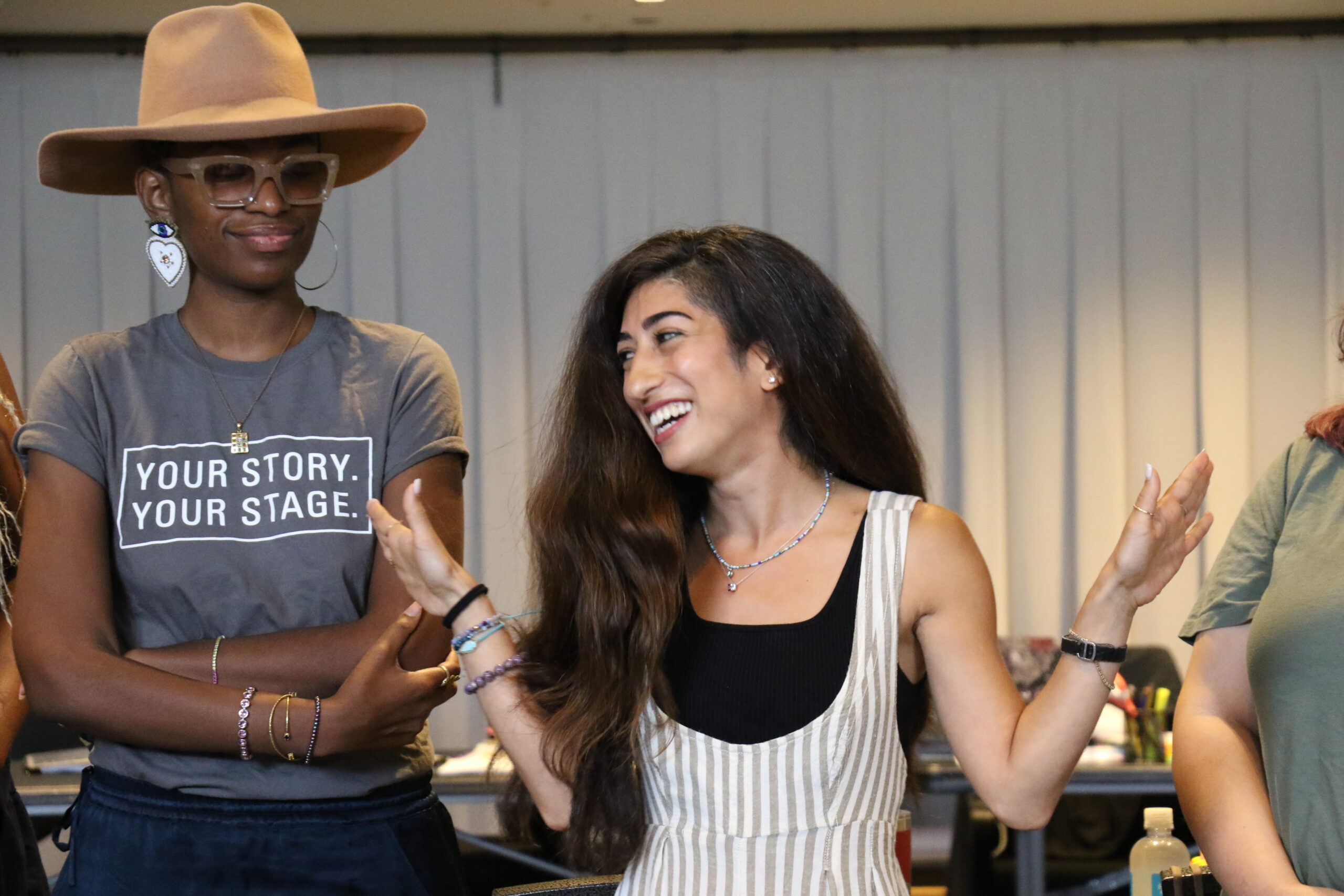
Director Shadi Ghaheri on the first day of rehearsal for the
Alliance's production of
"English." (Photo by Aniska Tonge)
In Alliance’s “English,” a different language opens the door to a different life
By
Benjamin Carr
Sanaz Toossi’s Pulitzer-winning play English, running August 16 through September 17 on the Alliance Theatre Hertz Stage, tells the story of four Iranian students as they prepare to take the Test of English as a Foreign Language, which they hope will unlock a world of new possibilities for them.
For director Shadi Ghaheri, the play echoes aspects of her own experience.
“I had to take TOEFL,” she said. “I took it twice, and the second time I got a 97. It was a requirement for the schools where I was applying.”
Originally from Tehran, Ghaheri now holds an Master of Fine Arts in directing from the Yale School of Drama and lives in New York.
“Many of us — the set designer, the costume designer, the sound designer, the dramaturg — we have all taken TOEFL and classes,” she said. “Part of our moving out of that country was getting admissions. This story, specifically, we have gone through it.”
Ghaheri and members of the production team enhanced the show’s realistic details by including costume elements purchased in Tehran and four hours of noises they recorded off the streets there and in Karaj.
“Those are things we couldn’t find; they weren’t here in America,” she said. “The authenticity and how we use it was very important to me.”
For instance, elements of the costumes reflect not just that the characters are practicing their religion but also that the law requires them to dress that way to enter the building they are in, she said.
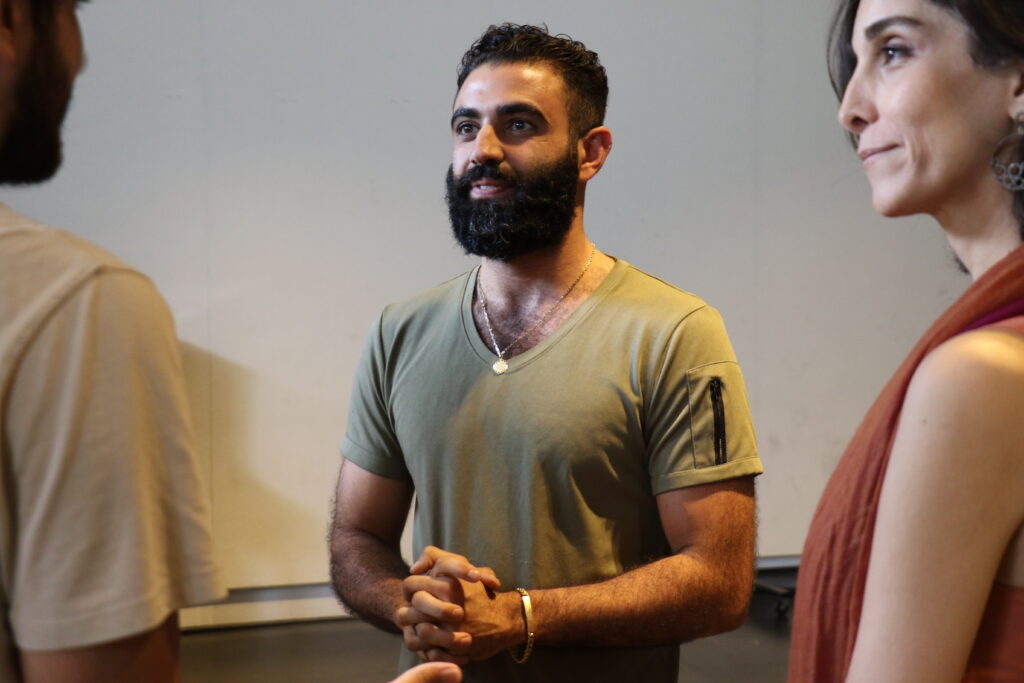
Actor Ash Kahn is among the cast members in “English” whose character hopes for a different life.
Ghaheri admired Toossi’s script because it portrays the immigrant experience with profound sympathy, allowing the audience to connect with characters raised in more oppressive cultures.
The structure of the play, which is presented entirely in English, allows the performers to speak in quick, natural English when the characters are using Farsi and in heavily accented, broken, difficult English when the characters are attempting to learn.
In the play, four Iranian students of different ages and backgrounds enter a classroom where they are expected to speak “English only,” as instructed on the whiteboard.
Their instructor, Marjan, played by Pooya Mohseni, lived for many years in Manchester, England, but has now returned to Iran, where she still feels out of place.
The director understands that emotional conflict.
“When I went back to Iran after a couple years, it took me a couple weeks to understand that my body feels different” Ghaheri said. “My body walks and breathes differently there and here. Here, I walk in the street with a different sense of safety. How I hold myself is very different. I think Marjan has that experience.”
The other characters view the new language as a key to a different life and new world. One of them seeks to learn it so she can spend time with her grandchildren in Canada. Another is a prospective medical student who needs to pass TOEFL to study.
“I hope that audiences see how people are figuring out a new life and a new opportunity to be the person they want to be through a different language — therefore a different world,” the director said.
In her opinion, the idea that others want a better life should not be politicized.
“Every single one of us throughout the world should have equal access to fulfillment and dreaming — wanting to be something,” she said. “The fact that there is a limitation to dreaming for these characters because of where they live is tragic. We talk about immigration as a political thing constantly,
Ghaheri hopes “English” can help audiences understand immigration outside of politics.
but here you can — just for a second — see it not separated from politics, but you can see a person wanting to be happy, thinking they can be happy in a different culture and language. They are attempting and trying to make that a reality.”
The experience of immigration deserves understanding, she said.
“For immigrants, this decision of a new life means truly to create a new person out of yourself,” Ghaheri said. “I hope the audience can [understand and feel] that without effort, without being spoon fed. There can be limits to dreaming and growth for some people because of dictatorship and oppression. Here, you can see people trying so hard with a new tool named English to find something better than what they’ve been forced to live in.”
The play has a profound emotional impact, she said.
“I read somewhere that the trauma of immigration is something comparable to the trauma of war,” the director said. “I chose to leave my parents, my home, my grandmother, my city, my food, my language, my TV, my everything. The fact that you make that decision, you make that cut — it doesn’t happen in your body, your memory or your psychology. It just happens physically. And for years and years, you have a constantly different understanding about it. When you arrive, you think the feeling will go away or fix itself, but, when you live here a long time, you know that the feeling stays but keeps changing.”
Because so many of the creative team have lived the experience of the characters, the show is deeply personal.
“There’s very beautiful, detailed work from so many people involved,” Ghaheri said.
::
Benjamin Carr, a member of the American Theatre Critics Association, is an arts journalist and critic who has contributed to ArtsATL since 2019. His plays have been produced at the Vineyard Theatre in Manhattan, as part of the Samuel French Off-Off Broadway Short Play Festival and at the Center for Puppetry Arts. His novel, Impacted, was published by The Story Plant in 2021.