Fabian Williams shows how imagination is a dress rehearsal in ‘What It Is, What It Was, and What It’s Gon’ Be’
There is something wonderfully disorienting about leaving an exhibition about surveillance, segregation, xenophobia, artificial intelligence and societal control feeling lighter than when you walked in.
That is the unexpected gift of Atlanta artist Fabian Williams’ Mothership Sirius B: What It Is, What It Was, and What It’s Gon’Be, an immersive, three-level exhibition that moves through the past, present and future while examining a deceptively simple question: Who gets to decide what is possible?

Williams, also known as Occasional Superstar, describes the exhibition as what imagination does to the physical world. A lifelong science-fiction fan, he looks back at the movies and television shows that helped generations imagine the future and considers what those stories may have been teaching us all along. Self-driving cars, humanoid robots and artificial intelligence once belonged comfortably to fiction. Now they occupy our everyday lives. If imagination can shape the physical world, Williams proposes, then controlling what people are encouraged to imagine becomes its own form of power.
The exhibition begins in the 1950s amid mint greens, warm yellows and the polished optimism associated with midcentury America. But Williams has little interest in nostalgia. The supposedly idyllic era he invokes was also one of legal segregation, white supremacy and rigid definitions of who belonged within the American dream. Science fiction becomes his evidence.
Williams remixes the 1953 film It Came From Outer Space as It Came From Outside the Border, using the extraterrestrial “alien” to interrogate the language applied to undocumented immigrants and the enduring American fear of outsiders arriving to disrupt an established way of life.
Elsewhere, he interprets Star Trek’s Klingons as an analogy for Indigenous people: Inhabitants portrayed as hostile obstacles to explorers entering territory that was already occupied. Williams flips the familiar perspective. Who is invading whom? Who gets called dangerous? And who gets the authority to tell the story?
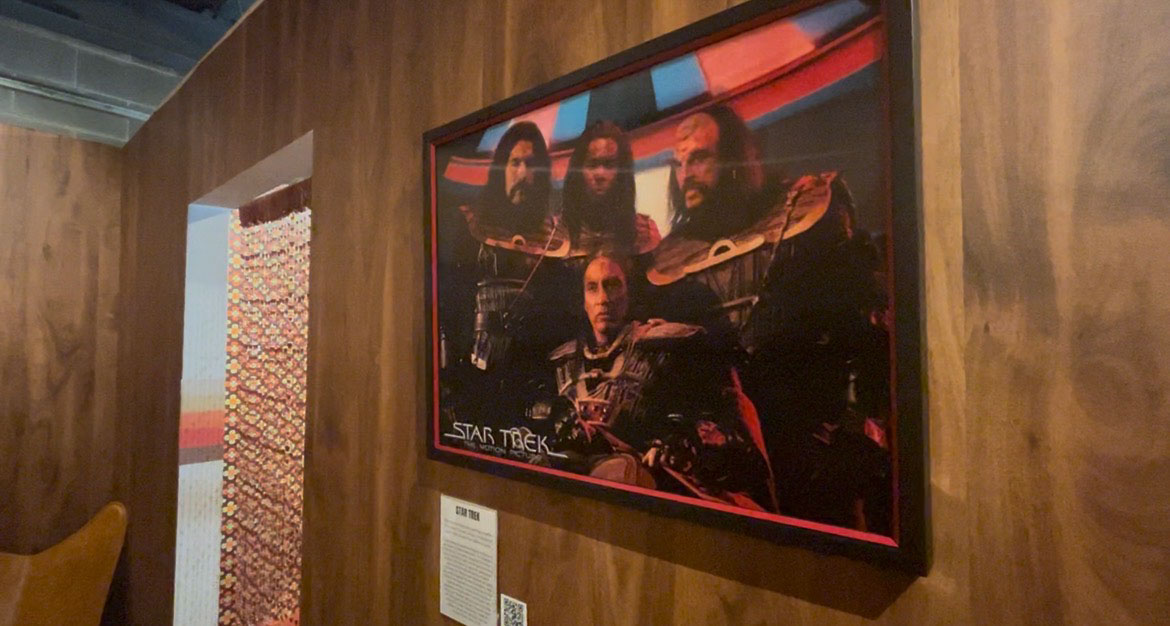
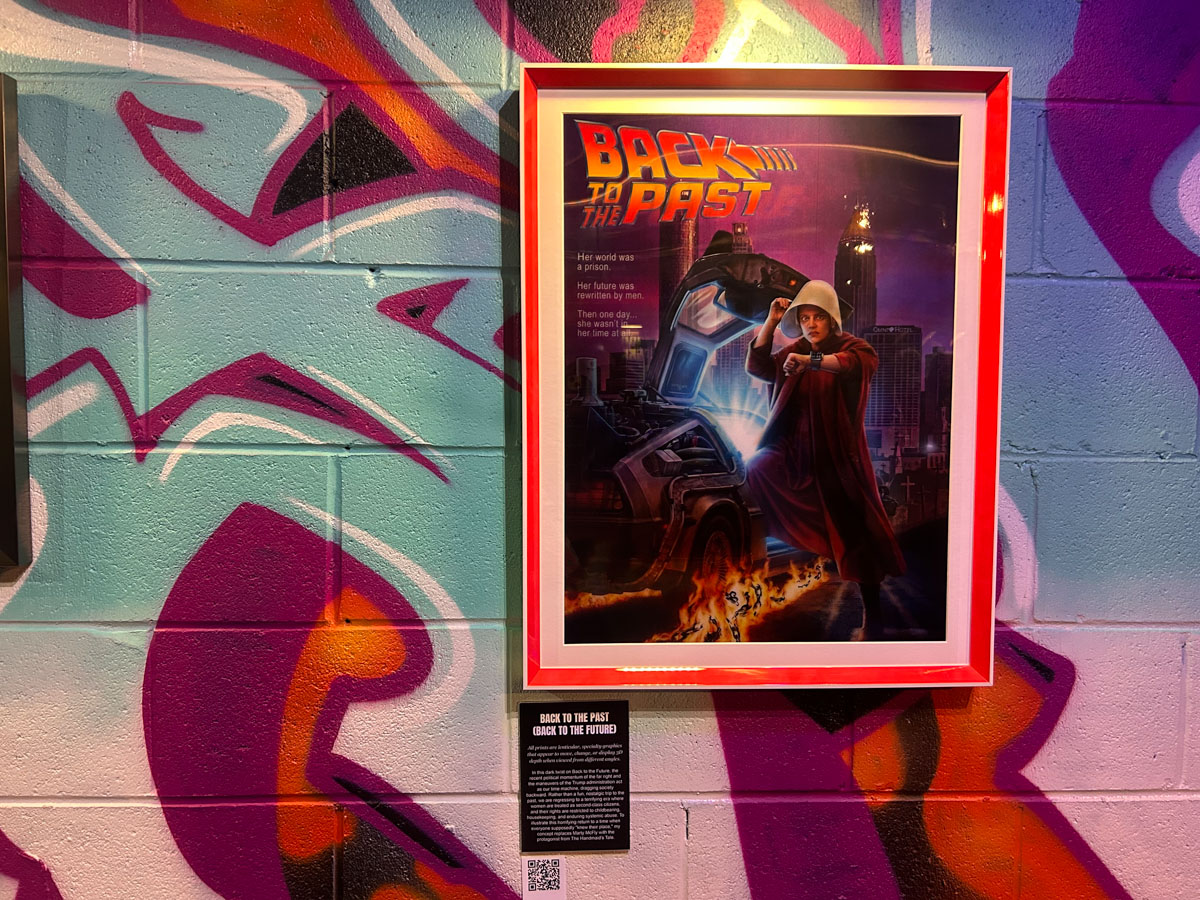
Many works on the first and second floors are lenticular prints, images that shift as the viewer moves past them. Stand in one place and you see one thing. Move and another image appears.
“You got to move,” Williams says. “You get the whole picture.”
It is difficult not to read that instruction metaphorically.
Moving upstairs means literally ascending through science fiction. Titles including RoboCop, Minority Report, The Matrix, Terminator and Westworld cover the staircase, collapsing decades of fictional dystopias beneath visitors’ feet.
By the second floor, the pastel optimism is gone. Graffiti glows beneath black light. A surveillance camera watches over panels declaring, “EVERY STEP YOU TAKE / EVERY MOVE YOU MAKE / I’LL BE WATCHING YOU.” A kitchen installation surrounds familiar processed foods with oversized lists of their ingredients. The effect is less science-fiction fantasy than uncomfortable recognition. This is “what it is.”
Williams asks whether repeated visions of surveillance, artificial intelligence, environmental devastation, corporate domination and social control merely predicted our future or if it helped narrow our expectations of what the future could become. Perhaps dystopia becomes easier to accept once we have rehearsed it often enough.
His fascination with The Matrix becomes personal as Williams replaces its streams of computer code with his own “Fabioglyphs,” a visual language based loosely on Egyptian hieroglyphics that he has incorporated into his murals. One repeated message reads: “Think while it’s still legal.”
Then there is another staircase. And upstairs, everything changes. The third floor belongs to the future. Not Hollywood’s future. Not Silicon Valley’s future. Ours.

Williams collaborated with children to imagine a better world. Their requests were remarkably practical: affordable housing, edible gardens, freedom, equity, inclusion and racial harmony. In one imagined community, housing costs $40 a month and residents collect food from rooftop gardens.
After two floors filled with elaborate technological visions of humanity’s future, the simplicity is striking. The adults spent decades imagining technology. The children imagined humanity.
In Meditation for Manifestations, children quiet their minds to envision the future they want to inhabit. The Future Lab turns part of the exhibition into a think tank where visitors can sit alone or gather with others to imagine and design the world they want.
Williams also imagines what that world might mean for those who fought before us. In Just Cruisin’, Martin Luther King Jr. and Coretta Scott King, Fred and Akua Hampton, Malcolm X and Betty Shabazz, Jimmy and Rosalynn Carter and Ted Turner cruise through an alternate reality in levitating vehicles above vibrant flower fields. There are no marches to lead. No podiums. No assassinations waiting around the corner. They get to enjoy themselves. Williams allows them something history rarely does: rest inside the world they helped create.
But Your Turn, featuring King, Coretta Scott King and John Lewis, turns the responsibility back toward the viewer. Their work has become history. Ours has not.
What are we going to do with our turn? That question continues in The First Cookout, Williams’ antithesis of the Last Supper. Instead of a final meal preceding betrayal and death, the gathering takes place after the old society falls. Jza, Williams’ female version of Jesus from another dimension, hosts activists committed to building something better.
The Last Supper becomes the First Cookout, death becomes beginning and the viewer is invited to take a seat at the table.
That spirit of rebirth runs throughout the final floor, from It’s Spring Again, with its symbolism of renewal and creation, to Breathe Again, inspired by Williams’ recovery from a collapsed lung after contracting Covid-19. Again and again, the message is that what already exists does not have to determine what comes next.
What It Is, What It Was, and What It’s Gon’ Be left me wanting to make something. I walked out lighter, more joyful and full of ideas. That response surprised me after spending so much of the exhibition confronting the mechanisms Williams believes have been used to restrict imagination, but perhaps that is precisely the point.
The most radical thing Williams does isn’t expose the limitations placed upon us. Most of us already know something about limitation. Williams is interested in what happens after we recognize the architecture of the box.
The final floor suggests that imagination is not frivolous. It is rehearsal. Before a different society can exist, someone has to be capable of imagining one. And children, Williams seems to understand, haven’t yet learned to call all the best possibilities unrealistic. Maybe the boundaries around possibility aren’t as permanent as we have been taught to believe.
Early in the exhibition, Williams gives viewers the instructions without announcing that they are instructions. His lenticular images refuse to reveal themselves completely from a single position.
You have to shift. You have to look again. You have to move. By the third floor, the artwork is no longer the thing Williams is asking to move. We are.
Mothership Sirius B: What It Is, What It Was, and What It’s Gon’ Be will host its launch tonight, August 13, from 6 p.m. to 10 p.m. The exhibition will be on view indefinitely — located at 12 Jackson St. SE. sawmothership.com/
::

Brittany Mackins is an Atlanta-based writer and creative with a deep love for the intersections of art, healing and community. Blending her background in journalism, brand storytelling, creative writing and event production, she writes to honor the stories behind the art, the lived experiences, emotions and cultural roots that shape creative expression. Her lens centers diverse artistry in all its expansive forms.
STAY UP TO DATE ON ALL THINGS ArtsATL
Subscribe to our free weekly e-newsletter.

PLEASE SUPPORT ARTSATL
Your Gift Sustains the Coverage You Count On!
Related Posts