Educator spotlight: Angelita Itzanami Reyes unites dance and Latin culture with SOMOS Niños dance classes
Caught in Friday’s late-afternoon traffic, I was running late in spite of my best intentions. When I opened the studio door and entered as quietly as possible, the five students in Angelita Itzanami Reyes’ SOMOS Niños dance program had already finished pliés and were transitioning to tendus.
“Is this our visitor?” the girl standing closest to the door asked Reyes. She then turned to me and said, “Are you going to write about us? A little bird — a little bird named Miss Mimi — told me that you like to write.”
Reyes, who is “Mimi” to her friends and “Miss Mimi” to the students in her class, told them that yes, this is the person she told them would be visiting. She then quickly redirected their attention back to ballet warm-up at the barre. “Can anyone tell me what the next step is?” she asked.
One of the girls, the one standing next in line at the barre from the one who initially addressed me, stood in first position, facing Reyes and the mirror at the front of the studio, and tentatively extended her right leg until her right foot was pointed at a spot just in front of her left heel. “Yes, that’s right!” said Reyes encouragingly. “Can you tell me what the step is called?”
Four eager hands shot into the air. One of the students, standing last in line at the barre, watched quietly and attentively from her spot near the corner. While she was reserved, she was also clearly engaged, executing each step with care and an ability remarkable for her age. Reyes selected one of the other girls to answer. “Tendu!” she said proudly. “Exactly!” responded Reyes, who then went on to review and explain the combination they were about to execute: four tendues in each direction — to the front, to the side, to the back and to the side again, or “en croix,” working the right leg first and then the left.
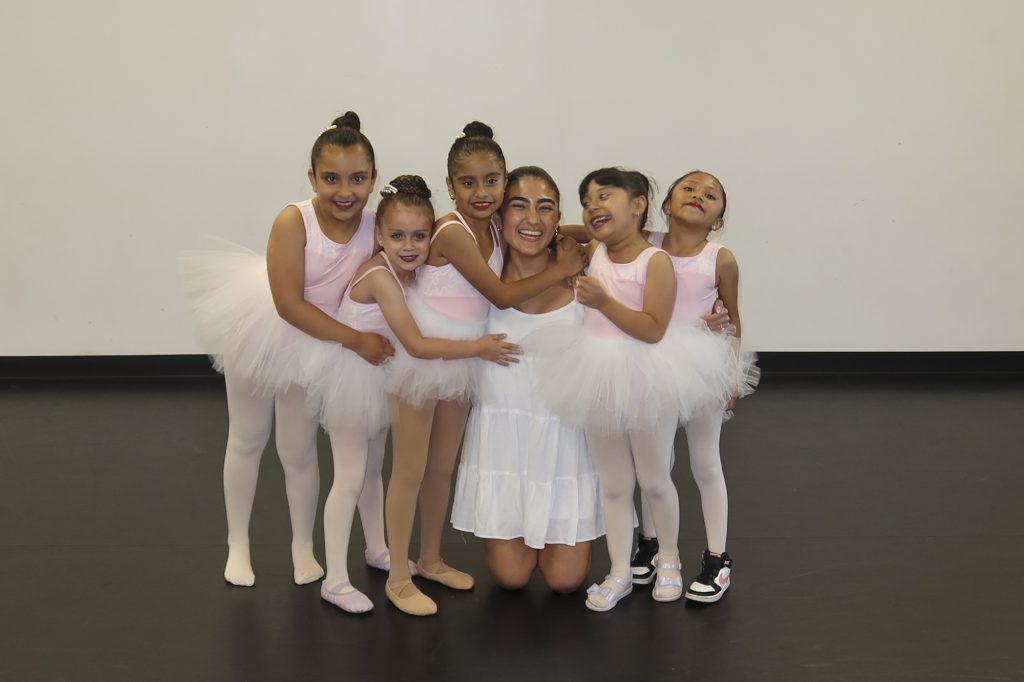
Reyes and the students — 7- and 8-year-olds — spoke in a mix of English and Spanish and, of course, French, when referring to the ballet steps. The girls were dressed in black leotards, pink tights and pink ballet shoes, their hair pulled back from their faces and secured in a bun.
The class progressed through a standard sequence at the barre and into jazz and stretching in the center. The girls — “young girls, not little girls,” as one of them corrected me — sometimes have trouble remembering which side is left and which is right, but they never forget to ask permission to use the bathroom or get a sip of water from one of the brightly colored bottles that Reyes allowed them to set on a shelf at the side of the studio.
Explaining how the work of SOMOS Niños relates to the work of SOMOS, the contemporary dance company that she founded in 2023, Reyes said, “SOMOS Niños has been my dream since the beginning. SOMOS the dance company was a dream that kind of popped up out of an opportunity, and I thought, ‘Let’s just ride this wave.’ But since I was a little girl, building a program like SOMOS Niños has been my goal.”
Reyes trained in ballet and later other dance forms at a competition dance school, where, in addition to the occasional recitals and holiday shows, students performed ensemble and solo pieces in local, regional, national and even international competitions. While the experience was positive overall, she said, “There was a sense of cultural belonging or connection that was missing and that I longed for.”
Growing up, Reyes initially thought she might teach in a traditional academic setting. In high school, she participated in a program that allowed her the opportunity to be a student teacher in a science class at the local middle school. In the course of that student teaching, however, she realized that while she liked science and she liked teaching science, it was not drawing on everything she had to give. Something was still missing.
So, when she enrolled at Kennesaw State University, she decided to follow her passion and declared a dance major.
In the dance program at KSU, Reyes said that independent research projects allowed her to explore the dance history of Latin America, and she discovered how European forms like ballet had been embedded and interwoven within Hispanic cultural traditions. She also had opportunities to teach dance, and, for her senior project, she spent a year working with a group of her 5- and 6-year-old cousins and their friends, teaching them to dance in her living room.
“Their final show was at Studio 23, where I trained for about six years,” Reyes recalled. “It was so amazing, and, since that moment, I knew I wanted to have my own school.”
She started SOMOS Niños in March of last year with support from Los Niños Primero, an organization that provides lifelong learning programs to enrich the lives of Latino children and their families. Reyes taught recreational dance classes for Los Niños Primero for several years.
Elite Studios, where Reyes also teaches in the performance and competitive division programs, donates the studio space where she holds SOMOS Niños classes. Ali P. Blanchard, the owner and director of Elite Studios, also helped connect Reyes with a young dancer who is fulfilling a mitzvah as Reyes’ teaching assistant for the program.
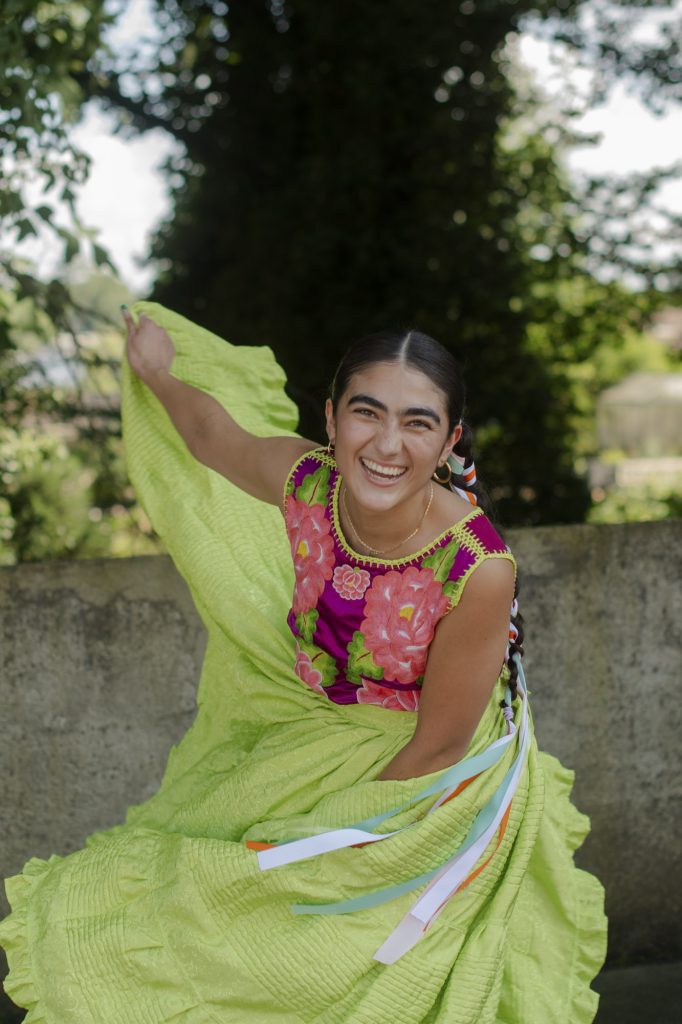
In class, Reyes embodies the nexus between her own Mexican American heritage — and the Latina identities of her students — and the rarified world of ballet and concert dance. “I am very mindful, in any class that I teach, of the way that we speak about our bodies and the way we look at ourselves in the mirror,” she explained. “When the students look at me, they see themselves, and just that in itself helps them see their culture reflected in a ballet class.”
By offering a bilingual class, Reyes says she is helping students build and maintain bridges between the different communities to which they belong. “I find it so valuable to be able to speak both English and Spanish, and I would love to preserve that for future generations.”
The primary focus of SOMOS Niños, though, is to introduce students to the serious work of studying dance. “This is intentional training, not a recreational class,” Reyes said. “Eventually, I want these students to understand how to find the space for creativity in the discipline and to learn that they are capable of doing hard things if they push themselves a little bit.”
With care and patience, Reyes deftly channels the girls’ obvious exuberance and delight through numerous transitions — from one step to the next, from barre to center, ballet to jazz — keeping them focused without quashing an ounce of the joy they find in being present in the studio. “These dancers come in so hungry to learn,” Reyes reflected. “They’re so excited to work hard, and it’s just so precious, because they never stop asking questions, and they soak up all of the knowledge you give them access to.”

Robin Wharton studied dance at the School of American Ballet and the Pacific Northwest Ballet School. As an undergraduate at Tulane University in New Orleans, she was a member of the Newcomb Dance Company. In addition to a bachelor of arts in English from Tulane, Robin holds a law degree and a Ph.D. in English, both from the University of Georgia.
STAY UP TO DATE ON ALL THINGS ArtsATL
Subscribe to our free weekly e-newsletter.

PLEASE SUPPORT ARTSATL
Your Gift Sustains the Coverage You Count On!
Related Posts