DanceStoriesATL produces documentary about two Black dance pioneers
The annals of dance history tend to skim over regional cities like Atlanta, favoring larger cultural centers such as New York. What’s often overlooked, even more, is the rich history of concert dance and teaching in Atlanta’s African American community.
A few years ago, Atlantans Shoccara Marcus and Tamara Irving decided to change that. Curious to learn more about the history of Atlanta’s Black dance community, they posted a call for information on social media.
“The response was amazing,” said Marcus, who is also a prominent dance photographer. Marcus and Irving, a professional dance artist and educator, began a series of documentary films about this history under the auspices of their production company DanceStoriesATL.

The premiere screening of Reverence: The Axam Dance Legacy, the film series’ second installment, will take place at 4 p.m. January 14 at Terminus Modern Ballet Theatre.
“It was a challenge to make it happen,” said Marcus, “but we felt that the history of Black dance pioneers needed to be told, so we made it happen with limited funds and volunteer efforts.”
In 2022, she and Irving debuted their first film, Five Stories. The documentary featured Spelman College’s children’s theater as well as Atlanta dance teachers Barbara Sullivan, Billie Gaither, Norma B. Mitchell and Valjean Grigsby — all of whom provided safe spaces for young Black dancers to develop personal and technical skills at a time when they were seldom welcome in predominantly White dance schools.
Reverence focuses on Terrie Ajile Axam (who goes by Ajile) and Dawn Axam, sisters who were part of the generation of dance artists and teachers who followed these original four. Both have played seminal roles in the lives and careers of numerous artists. Actor Danielle Deadwyler and dance artist Juel D. Lane are two of their students who went on to successful careers in dance, film and theater.
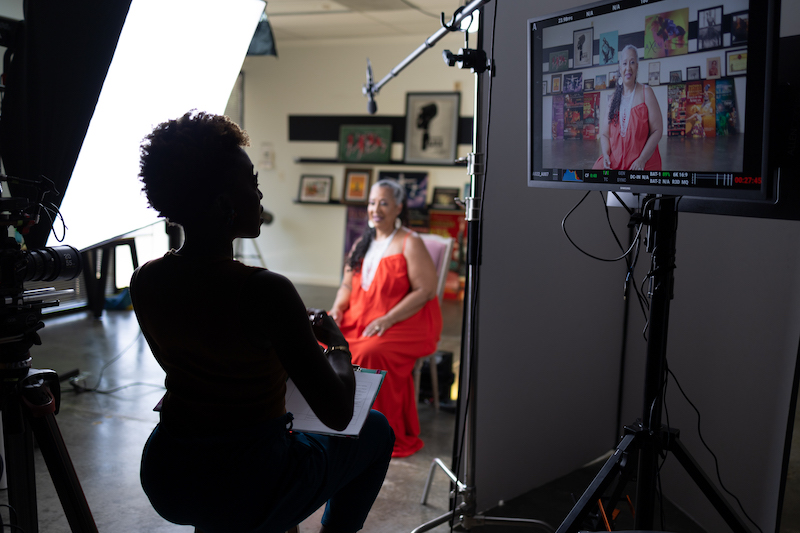
The documentary features interviews with Dawn and Ajile as well as their daughters, students and former students who are artists and teachers in their own right. Ajile’s daughter, Aquila Kikora Franklin (known as Kikora), joined Irving and Marcus as co-producer and creative collaborator.
The filming was a reunion for its many contributors, who were honored and excited about the project, Marcus said. “Before we started filming, we broke out in a circle, dancing and reminiscing on the choreography and movements they remembered from Ajile and Dawn.”
Many of them contributed archival footage, such as old VHS recordings of Dawn and Ajile dancing, of Ajile’s company, Total Dance, and of a performance of Ajile’s Free My Soul, filmed at Howard University in the mid 1990s.
In their interviews, Ajile and Dawn tell stories of building a family legacy of teaching, creativity and innovation in dance.
Both sisters say they owe their love of dance — and drive to pursue it — to their mother, Dorimell Axam, who, as a child, had danced for milk and meals on the boardwalk at Daytona Beach, Florida. Ajile went to Barnard College in New York and attended graduate school at Princeton University. There, in 1973, she created Mojah, a unique fusion of modern dance and West African dance with influences from Katherine Dunham subsequently blended in.
Ajile brought Mojah back home and started Total Dance Studio (now Total Dance/Dancical Productions, Inc.) It became a dance hub that provided a haven and a platform for members of the African American community to develop their art free from the discomfort of training in White-run organizations.

Irving danced alongside Ajile’s daughter, Kikora, when both were students at Howard University. While there, Ajile staged on their dance group “Free My Soul,” a piece she had choreographed after performing at Nelson Mandela’s inauguration as president of South Africa in 1994.
That was Irving’s first experience with Mojah. “It helped to bring out anything we wanted to express,” said Irving. Ajile insisted that Irving individualize her character and draw out emotions associated with struggle — whether it was the struggle of South Africans or, closer to home, the struggle of African Americans to secure an education at a historically Black university like Howard.
“I really wasn’t as deep until I learned from her,” Irving said.
When Dorimell first took her younger daughter Dawn to a local dance school, she was told that the child was “not the right color,” Dawn says in an interview for the film. She studied gymnastics instead and practiced Mojah with Ajile. Four years at Northside High School’s performing arts program inspired Dawn’s love of choreography, a

craft she honed at New York University.
Dawn eventually formed the Atlanta-based Axam Dance Theatre Experience, based on a model that emphasized opportunities for its members to choreograph works on each other.
Marcus studied with Dawn at Tri-Cities High School and after school danced at Ajile’s studio. Before that, Marcus had experienced dance as an activity that was “just fun.”
But Dawn took it up a notch. Marcus described how Dawn made the dancers reflect on what was happening in the world and produce it inside their work.
“We were learning in the history books about slavery, about what has happened to our people — so many things that made you cry but made you understand who you were as a Black female, as a Black dancer,” she said.
“When you got on that stage, you represented everyone in your family. And every time you did it, you felt prideful. That gave me all the confidence I ever needed — that I didn’t even know I needed.”
Now, when Marcus photographs dancers, she asks them to dig deeper, too. “I’m telling a story. I’m asking who are you,” she says, “and why are you doing this.”
She says it’s more than just coming in for a photo shoot: “That goes back to my training with these amazing dance teachers who pushed me to redefine who I was.”
::
Cynthia Bond Perry has covered dance for ArtsATL since the website was founded in 2009. One of the most respected dance writers in the Southeast, she also contributes to Dance Magazine, Dance International and The Atlanta Journal-Constitution. She has an M.F.A. in narrative media writing from the University of Georgia.
STAY UP TO DATE ON ALL THINGS ArtsATL
Subscribe to our free weekly e-newsletter.

PLEASE SUPPORT ARTSATL
Your Gift Sustains the Coverage You Count On!
Related Posts