
Cullum’s Notebook: Everything is connected, in ceramics, collage, more
By a happy coincidence, an extraordinary number of shows in September have illustrated the truth of my favorite of Gillian Wearing’s Signs That Say What You Want Them to Say and Not Signs That Say What Somebody Else Wants You to Say: “Everything is connected in life; the point is to know it and to understand it.”
Michelle Laxalt’s the split of our being at Whitespec gallery is notable for its extraordinary biomorphic ceramics, sliding between animal and plant forms, alongside other artworks devoted to “the fascinating and dreadful realization that everything is connected and nothing lasts.” It, alongside Melissa Huang’s A Person Shaped Daydream in Whitespace and Emmanuelle Chammah’s Nomad Space in Shedspace, continues through September 24.

Two other exhibitions closing on September 27 that require some effort to view (one isn’t open on the weekend, the other only then) have a curious thematic overlap in their focus on the fact that in nature, “everything is connected,” as Laxalt’s aforementioned show puts it.
Although Norman Wagner is best-known as a printmaker, in Images Discovered (at Georgia State University Art Gallery, Perimeter College, Clarkston, through September 27) he presents, in his words, “drawings, prints, frottage mixed media, assemblage, and assemblage sculpture” that “assume a premise that I stated in 1963: There exists in life an inevitable interrelationship between all things.”
One of his former students, Holly B. Powell, describes the work as “a visual representation of what nature would say if it could speak our language.”
Steven L. Anderson’s Thinking Like a Mountain, at Gallery 1740 through September 27, marks a significant departure from his tree-ring abstractions, although it’s a logical extension of them, based on Aldo Leopold’s perspective that “humans are but one part of our ecosystem.”
The works consist of collaged burlap in which “lines drawn with paint and rope connect the dots into constellations, which are symbols of an ineffable experience.” It’s because of the show’s spiritual dimensions that it is presented in a church-operated gallery open only from 9 a.m. to 12 p.m. on Sunday and by appointment Tuesday-Friday.

There are also fascinating unintended connections among the works and artists at 378 Gallery’s September Show, closing September 24.
Brinda Cockburn’s fascinating representations in textile format of scenes and local institutions of the African diaspora relate in their material dimension with Europe Is Burning, the latest iteration of Cindy Zarrilli’s startlingly topical transformations of found tapestries depicting an outwardly content aristocratic society visited at last by the fire this time.
The narrative impulse is carried forward by the premiere showing of a substantial number of Paige Prier’s combination of mythically resonant prose poems with atmospherically figurative works on paper, alongside ceramics by Rose M. Barron that also incorporate mythological narratives and imagery.
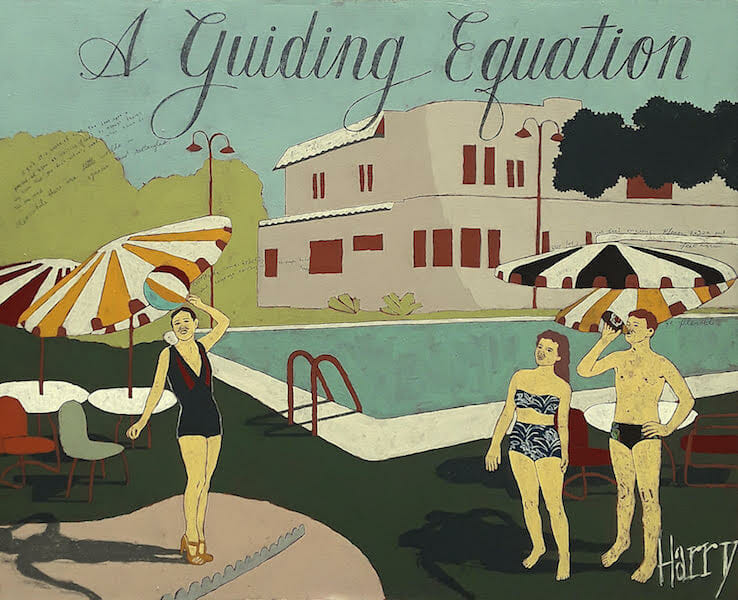
Like Prier’s work, Harry Underwood’s Outdoor Worship, at the WADDI through October 29, combines image with narrative. The self-taught Tennessee artist sometimes incorporates titles as headline-size words in singular portrayals of scenarios enacted against the backdrop of (mostly) Florida architecture, with a hedge maze as one of the exceptions.
More often, the main verbal attraction is a series of observations in inconspicuous cursive handwriting, sometimes almost invisible even in high-resolution photographs but well worth seeking out in person for their remarkable perspective on the world and its vicissitudes. One example: In Solitude, the solitary reclining character is accompanied by a swirling line of commentary, “Alone to remove words and live only in thought / Never to answer or be interrupted by a question.”
These shows deserve exactly that type of quiet reflection after, ideally, their combined viewing.
::
Dr. Jerry Cullum’s reviews and essays have appeared in Art Papers magazine, Raw Vision, Art in America, ARTnews, International Journal of African-American Art and many other popular and scholarly journals. In 2020 he was awarded the Rabkin Prize for his outstanding contribution to arts journalism.
STAY UP TO DATE ON ALL THINGS ArtsATL
Subscribe to our free weekly e-newsletter.

