

Review: Atlanta Ballet season opener delights with poetry and pure geometry
On Friday, September 16, at the Cobb Energy Performing Arts Centre, the Atlanta Ballet opened its first full season since the pandemic began with Balanchine Inspired, a two-hour program that took the audience from the avant garde poetry of George Balanchine’s Serenade, through the canny post-modern homage of Kiyon Ross’ Sum Stravinsky, to the pure geometry of Justin Peck’s In Creases. It was a big evening of ambitious, technically challenging ballet that showcased a strong company in top form and explored what has kept neoclassical vocabulary relevant in the rapidly evolving landscape of 21st-century dance.
With its swirling, dynamic use of space, Serenade, choreographed in 1934, still felt thoroughly modern. The five lead dancers — Jacob Bush, Emily Carrico, Airi Igarashi, Jessica He and Patric Palkens — confidently led a particularly adept, cohesive corps de ballet through a beautiful series of living tableaux that awakened the audience’s collective imagination. Serenade’s aesthetics have aged well, at least in part because Balanchine’s style and technique continue to exert a strong influence in American dance training.
Serenade also continues to be a quintessential expression of the various creative forces at work when it premiered. For example, even though Balanchine deliberately eschewed linear narrative, his choreography activated a Surrealist proliferation of allusion and symbolism.
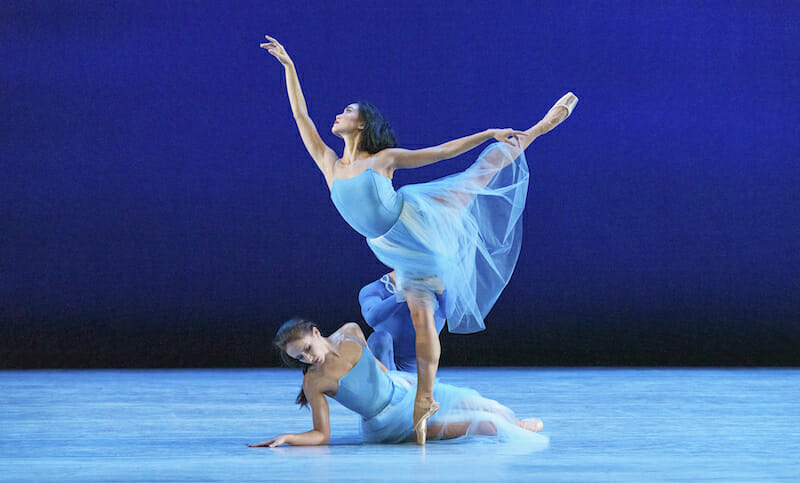
The dancers gliding, running and soaring across the stage, weaving into and out of complex formations, at times resembled graceful figures from the Elgin Marbles come to life, nymphs and satyrs out of a 16th-century tapestry, or elegant attendees at a moonlit garden party.
The images in the haunting, evocative final section hinted at an archetypal plot of lovers’ jealousy and betrayal: the “Waltz Girl” lying on the ground after a staged collapse, her unbound hair spread around her; the “Dark Angel” pressing her torso against the back of her male companion, covering his eyes with one hand and pointing the way with the other as she guided him across the stage.
The ballet concluded with three men carrying the Waltz Girl from downstage right to upstage left through two diagonal rows of dancers. Slowly, she shifted her weight into her hips and thighs, arching her back and thrusting her sternum forward. In these final moments, the ensemble became a ship sailing into the sunset, a soul ascending into the hereafter, or the effigy of an ancient goddess carried on parade.
As soon as the curtain came down and the lights came up for intermission, patrons seated nearby began searching for vocabulary to describe and discuss what they had just experienced.
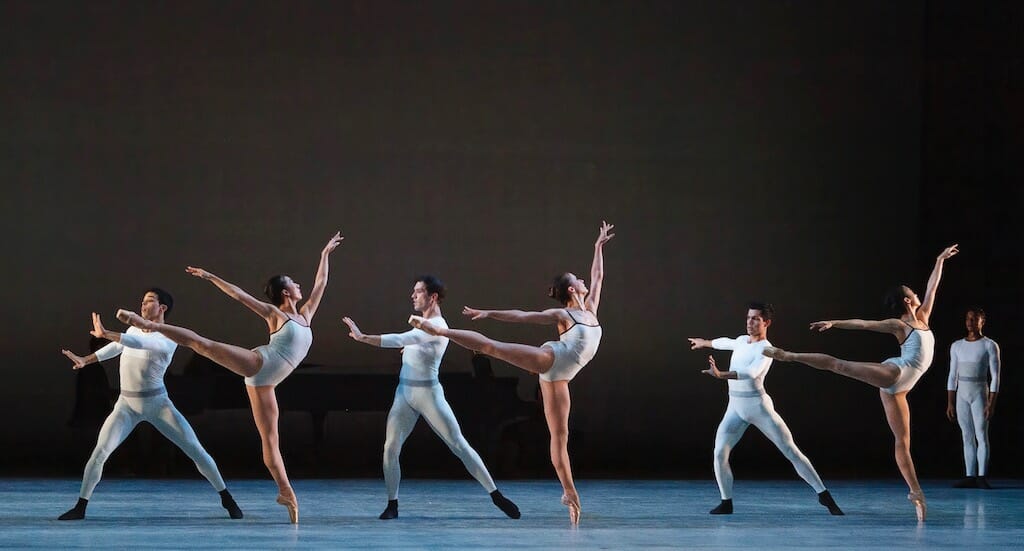
The evening closed with the Atlanta premiere of Justin Peck’s 14-minute In Creases, which was commissioned for New York City Ballet’s summer residency at the Saratoga Performing Arts Center in 2012. In that piece, the dancers’ supple upper bodies, fluid ports de bras, clean pointe work and petit allegro (small, fast jumps), and precise spatial awareness were equally on display. Here, though, the multivalent symbols and allusions from Serenade gave way to the fractal and kaleidoscopic symmetries of intricately engineered clockwork.
Set to a live performance of Philip Glass’ Four Movements for Two Pianos, Movements I and III, performed by Western-Li Summerton and Dr. Hyunjung Rachel Chung, In Creases featured an ensemble of eight soloists, the women dressed in white camisole leotards with black piping, the men dressed in white tights and tight-fitting white shirts along with black ballet shoes and socks. The two pianists and their black grand pianos shared the stage with the dancers.
The tempo of In Creases constantly picked up speed until the final seconds, yet moments like the full blackout during the pause between movements punctuated its driving physicality with stillness and negative space. Similarly, flowing transitions into and out of ruler-straight rows and razor sharp poses softened what might otherwise have been jarring angularity into well-oiled motion.
The eight dancers — Carrico, He and Palkens, joined by Sujin Han, Fuki Takahashi, Sergio Masero, Miguel Angel Montoya and Ángel Ramírez, turned in gorgeous performances. Palkens was a standout in a series of allegro combinations.
The ballet ended with the ensemble grouped center stage, the dancers bent forward at the waist with hands touching the floor. As it often did throughout the work, the dancing seemed to mirror the internal workings of the pianos. When the sparse notes of the final measures sounded, one or two of the dancers rose, completing an arabesque or extension before returning to a folded rest position. This was repeated through the group until at last all was still.
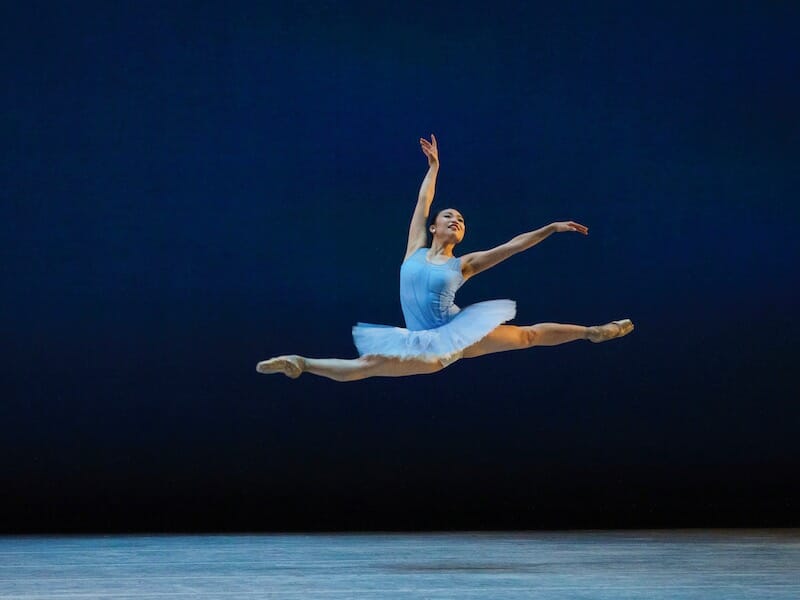
Bookended by Serenade and In Creases, Kiyon Ross’ smart, delightful Sum Stravinsky literally and figuratively filled in the gaps. At artistic director Peter Boal’s request, Ross created the work on the Pacific Northwest Ballet for a Stravinsky festival in 2012, and it had its Atlanta Ballet premiere in 2019.
Ross set the work to the three movements of Dumbarton Oaks, each section with distinct costuming and lighting. Ross’ vocabulary drew primarily from ballet, but consistently integrated recurring shapes and steps drawn from modern dance, jazz and swing. Bent front legs en pointe, prancing runs with turned-in knees and hips, low step-ball-change transitions on high demi pointe in a deep parallel fourth position plié nodded to how neoclassical choreographers since Jerome Robbins have hybridized ballet with other traditions to revitalize the form.
The streamlined “pancake”-style classical tutus, tender glances shared between adagio partners, and even an occasional triumphant smile and gaze directed to the audience, rather than into the middle distance, provided reminders that the neoclassical canon includes more than just abstract, plotless ballets. It also comprises many works that, like Sum Stravinsky, draw attention to ballet both as dance, emotionally expressive and social, and as theatrical performance.
The male dancers in Sum Stravinsky shone in Ross’ soaring allegro sections. Jessica Assef was sinuously lovely in the second movement pas de deux, and Darian Kane’s polished strength sparkled in the finalé.
Balanchine Inspired offered a well-crafted introduction to the neoclassical ballet tradition, including detailed program notes and a pre-show video before each piece that provided historical and artistic background. The videos, which are becoming a regular feature of Atlanta Ballet performances, were useful and well-produced, but they interrupted the flow of and focus on live performance and might be better integrated as purely online content that could be accessed via a QR code in the program.
Nonetheless, overall Balanchine Inspired delivered a promising first look at the 2022-23 company and a fitting opening to a season that includes two more mixed bills (one in February, another in May) featuring new and canonical neoclassical works.
::
Robin Wharton studied dance at the School of American Ballet and the Pacific Northwest Ballet School. As an undergraduate at Tulane University in New Orleans, she was a member of the Newcomb Dance Company. In addition to a Bachelor of Arts in English from Tulane, Robin holds a law degree and a Ph.D. in English, both from the University of Georgia.
STAY UP TO DATE ON ALL THINGS ArtsATL
Subscribe to our free weekly e-newsletter.

