Crux Collective gives contemporary circus a new spin
Cirque du Soleil transformed circus in the 1980s with dazzling acts by acrobats and aerialists, clowns, contortionists and more. Now an Atlanta company is putting its own spin on the evolving art form.
During the 40 years since Cirque du Soleil began in Montreal and transformed contemporary circus into a global phenomenon, the so-called “circus arts” — including aerial, acrobatics, juggling, sleight of hand, illusion, clowning and contortion — have emerged from big top tents pitched at the edge of town to take center stage in downtown theaters large and small.
In Atlanta recently, audiences have enjoyed that migration in a range of performances — Cirque Kalabanté’s Afrique en Cirque at the Rialto Center for the Arts earlier this month; Emory artist-in-residence Annalee Traylor’s This Thing Is Real in May; and Ghost from Cirque du Soleil veterans Tentacle Tribe in February of 2022.
Circus aesthetics and technique have even informed Terminus Modern Ballet Theatre productions, notably Long Ago and Only Once by guest choreographer Ana Maria Lucaciu and Marley Was Dead, to Begin With: A Christmas Carol Told Again by Terminus co-founder Heath Gill. Both choreographers have acknowledged that their work draws on physical theater and clowning.

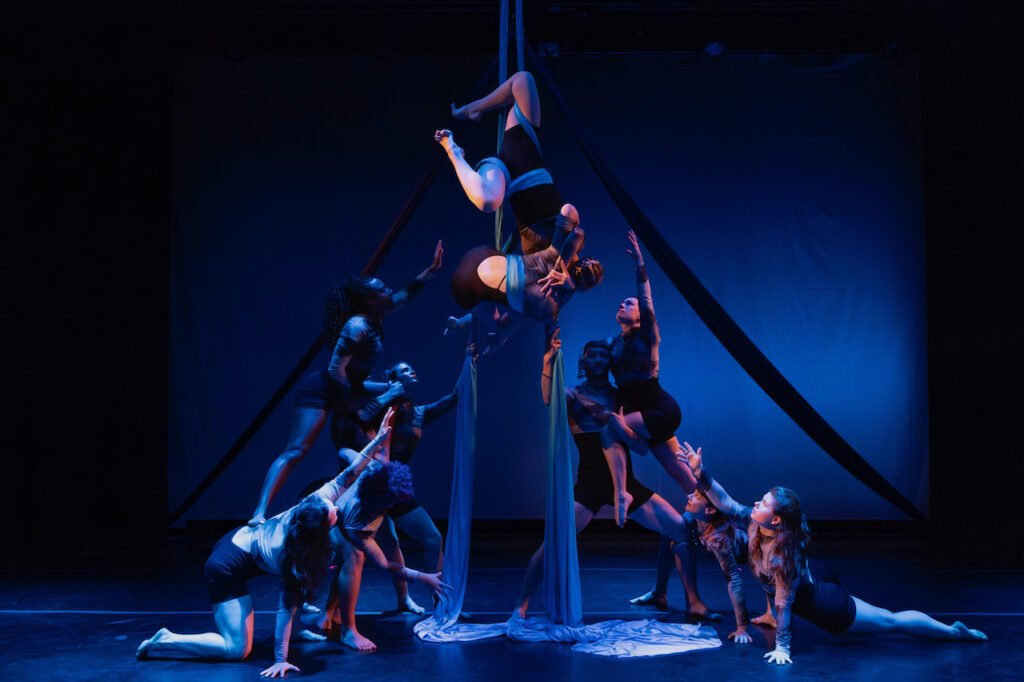
This weekend, October 11 through October 13, Crux Collective will bring its own vision of contemporary circus to life in Parallel at the Windmill Arts Center. While the organization is in its second season, artistic directors and Parallel co-choreographers Hayley Adamson, Kat Saxon, Emma Johnson, Beth Del Nero and Hilary Riall boast decades of collective experience performing and teaching the circus arts in Atlanta and throughout the Southeast.
The choreographers described Parallel as a spooky, psychological journey into a dreamlike narrative where the main character encounters different aspects of their psyche without recognizing them. “We, the artists, are masked a lot of the time, because the main character can’t recognize who we are, so we don’t want the audience to recognize us either,” said Adamson. Parallel begins with a dancer stepping through a door. Throughout the work, each door she encounters leads her deeper into the mind’s maze as the narrative progresses.
“It is an all-ages show, no drugs or sex or violence,” Riall added, “but it’s definitely very, very creepy and kind of dark and nightmarish.”
Crux Collective commissioned the original score from Atlanta-based composer Chris Childs. The sound design includes live performers: Artie Mondollo on theremin (an electronic instrument), Jennifer Betzer on the harp and flutist Priscilla Smith. The costume and stage design combine bold, bright colors with uncanny elements like shadow puppetry and masks.
Del Nero put her training and experience as a professional architect to use in designing a scaffold and other movable apparatus on which the ensemble will perform the full scope of aerial techniques. Dancers will perch upon and dangle from the trapeze. They will wind themselves in silks and slings, long pieces of fabric that drape from the ceiling, taking up and slackening tension to climb to the heights above the stage and then drop in seeming freefall, only to catch themselves in the fabric once again at the last moment to end in balletic and acrobatic poses. They will swing and spin on the lyra, or aerial hoop, which looks like a hula hoop suspended vertically above the stage, and the hand loop.
Adamson came up with the overarching narrative concept for Parallel and says the movement fuses the athleticism of aerial with contortionism and contemporary dance. In some contemporary circus shows, she told ArtsATL, discrete and otherwise unrelated circus acts by jugglers, acrobats or illusionists punctuate a narrative loosely sketched by clowns or physical actors. For Parallel, in contrast, Crux Collective wanted to create a more cohesive audience experience in which the sections flow together as they would in a more traditional theatrical dance work — the stunts are an integral part of the gestural vocabulary rather than divertissements.
The backgrounds of the Crux Collective co-founders provide useful signposts for mapping the evolution of the circus arts community in Atlanta, as well as its connections to larger networks in the Southeast and nationally. About 25 years ago, when she was 5 years old, Riall began training as an aerialist with Carrie Heller, a professional trapeze artist and founder and executive director of the Circus Arts Institute in Atlanta. At the time, Riall explained, the Institute was one of the only places in the region providing recreational classes for children and teens, and she became a teacher herself at 14.
Saxon also began her performing arts career as an aerialist, at Canopy Studio in Athens, Georgia, which opened in 2002 under the direction of Susan Murphy, who, along with her trapeze expertise, holds a master’s degree in modern dance from Mills College in Oakland, California, and is a certified movement analyst through the Laban Institute of Movement Studies in New York City. Saxon said training at Canopy is grounded in both circus and contemporary dance, which allowed her to “morph into a contemporary dancer” when professional opportunities for circus performance were scarce.
Adamson began her career in Syracuse, New York, studying classical ballet and contemporary theatrical dance. She found the circus arts in 2013 through performance opportunities in Asheville, North Carolina. “I was actually really good at the hula hoop,” she said, laughing. “And a couple of circus artists asked me if I could hula hoop like that while standing on their hands.” Because of the lack of training in the area, however, she was mostly self-taught until attending the San Francisco Circus Center, where she honed her skills in aerial and contortion.
While Circus Arts Institute and Canopy are still thriving, even after the pandemic disruption, some of the other local institutions that incubated the careers of Crux Collective’s artistic directors as well as the circus arts in Atlanta have not been as fortunate.
Del Nero took her first ballet class at 28, and, after falling in love with aerial and burlesque, she quit architecture to dance full time and spent several years performing with the now-defunct troupe D’Air Aerial Dance Theater under the direction of aerial dancer Nicole Mermans. Similarly, The Space, a multidisciplinary movement arts studio where Johnson, who also had a professional career in theatrical dance, found her passion for aerial and teaching, has permanently closed. The Imperial OPA Circus, founded in 2009 by Timothy Mack, who started his circus career as a photographer with Cirque du Soleil, provided a home for other prominent Atlanta aerialists like Rose Shields, named as one of ArtsATL’s 30 under 30 in 2013, shuttered in 2020.
Even at the more established Atlanta and Atlanta-adjacent institutions like the CAI and Canopy, the Crux Collective artists said they have observed a passing of the torch in which mentors and leaders are starting to retire or move on. Suzanne Lee Zigler, a longtime fixture in the Atlanta aerial scene who helped open Challenge Aerial where several Crux Collective members teach currently, passed away suddenly and tragically in 2019. Murphy, founder of Canopy, moved to coastal Georgia where she and her partner have plans to establish a new studio.
They also noted a post-pandemic shift within the Atlanta circus arts community, away from evening-length immersive shows and toward student “showcases,” akin to recitals in other performing arts, and gig work, where circus arts performers provide “ambience” at corporate events or occasionally in film and television. “When D’Air closed,” said Riall, “they left a big hole.”
Crux Collective emerged to fill the void and push back against that shift. While showcases and gig work can help create an audience for circus and pay the bills, Del Nero said, they don’t facilitate artistic exploration or technical innovation the way spending time in a stable home base does, where artists can create repertory for an ensemble. “It took a lot of complaining and conversations about what we wished was happening,” said Saxon.
“We realized that if we wanted to make something unique, a little more contemporary and a little more weird, we would have to do it ourselves,” added Riall.
After more than a year of solo performances during the height of the Covid pandemic, and masks and social distancing in the studio, the co-founders were hungry for close collaboration. As Saxon noted: “We could perform individually very easily, with less time to prepare, but the energy you get from other people that trust your vision and want to make the same kind of stuff as you is just unmatched.”
The company found its home base at the Windmill Arts Center in East Point. The long-term access to a stable rehearsal and performance venue has moved the company closer to the goal of creating “expansive” multidisciplinary performance art through collaboration among dancers, aerialists, musicians, circus performers, actors and visual artists. Parallel, the artistic directors say, is a bigger production than their 2023 debut, Catalyst. In addition to the artistic directors, the cast of Parallel includes four more aerialists — Layla Heather Pendley in the lead role, with Rebecca Oyler, Mattie Weeks and Emily Stratton.
::

STAY UP TO DATE ON ALL THINGS ArtsATL
Subscribe to our free weekly e-newsletter.

PLEASE SUPPORT ARTSATL
Your Gift Sustains the Coverage You Count On!
Related Posts