

Chamber Cartel speaks contemporary classical music’s special language
The ensemble will perform Morton Feldman’s daunting four-hour-plus trio For Philip Guston at the Goat Farm on September 27.
::
It is time once again to give thanks to and for the rich, vital community of musicians and composers in Atlanta who are making post-classical or new classical or whatever label one chooses to identify contemporary music rooted in the formal Western tradition dating back to Medieval Europe around the 11th century CE (think chanting monks and singing nuns).
The special occasion for this acknowledgement is a performance by Chamber Cartel of For Philip Guston, a four-hour-plus work for flute, piano and percussion composed by Morton Feldman in 1984. Feldman’s tribute to his friend, painter Philip Guston, who died in 1980, is a quiet, delicate, meditative work that calls for sustained discipline and muted passion by the musicians and a receptive spirit and extended attention span from the listeners.
“Chamber Cartel is one of the anchor professional ensembles in Atlanta’s burgeoning contemporary classical music scene,” says Nickitas Demos, professor of music composition at Georgia State University. “I can’t think of a better ensemble to tackle For Philip Guston or have the courage to program it. For one thing, consider the fact that there are no bathroom breaks!”
The concert will take place on September 27 as part of SITE 2025, a one-night-only arts festival at the 12-acre Goat Farm Arts Center adjacent to the Atlanta Waterworks. In addition to Chamber Cartel’s rendering of For Philip Guston, this year’s edition of SITE includes a cornucopia of installations, static and performance art and open artist studios.
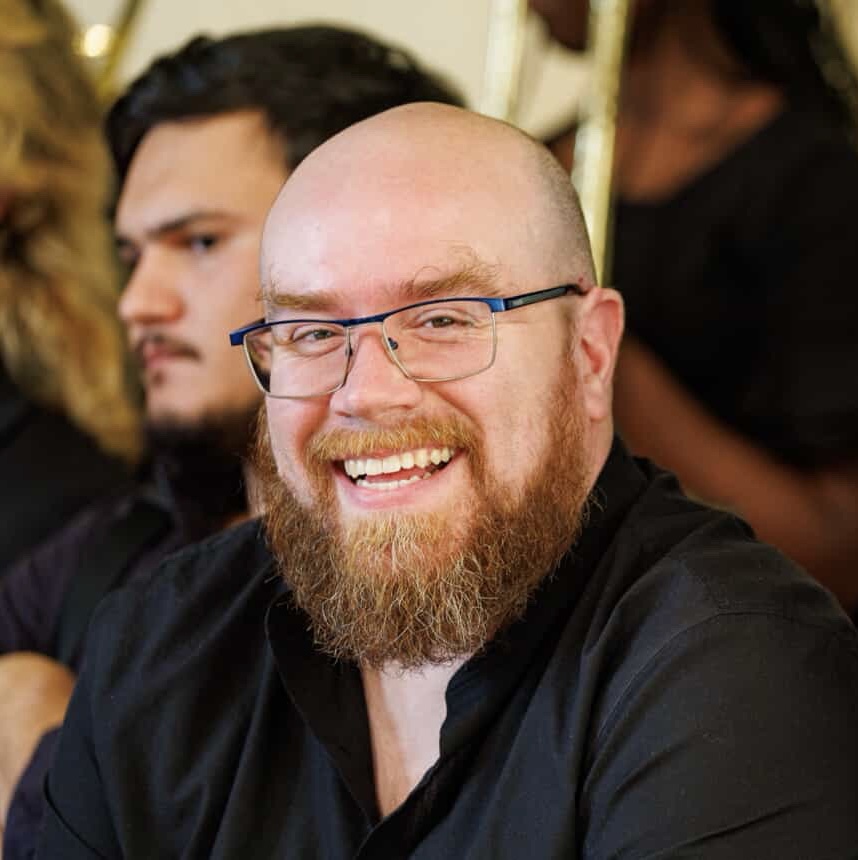
“I told the Goat Farm folks that I wanted to create a space where people could take refuge, to get away from the wonderful but hectic craziness that SITE is going to generate,” said Caleb Herron, founder and director of Chamber Cartel.
A seasoned post-classical specialist, Herron studied at Georgia State University under Stuart Gerber, earning a bachelor’s degree in percussion performance in 2007. While studying at GSU, Herron formed a trio with Ellery Trafford and Isaac Anderson called Cerberus Percussion Trio, which performed concerts in Atlanta. He then earned a master’s degree in performance percussion at the University of Alaska Fairbanks under Morris Palter. In Alaska, he founded a mixed chamber ensemble called Ensemble Kunst, which served as a precursor to Chamber Cartel.
“It was a variable instrumentation chamber ensemble,” Herron says. “I wanted a group capable of performing chamber music of all shapes and sizes.”
During 2010 and 2011, Herron gave solo recitals, attended concerts and participated in offbeat experiments in Atlanta, including Invent Room Pop, an improvisational fandango organized by Robby Kee at Beep Beep Gallery, which closed in 2015. In late 2011, Kee asked Herron to produce a monthly contemporary classical concert series — thus was born Chamber Cartel. During its inaugural season, the ensemble performed a dozen concerts, mostly at the Goat Farm and at Poem88 gallery. Currently, Herron teaches at GSU Perimeter College and Morehouse College, sits on the faculty of the Summer Music Academy at UAF and is principal timpanist with the Lagrange Symphony Orchestra. Recently, he was named principal percussionist of the Johns Creek Symphony for the 2025-26 season.
True to its mission, over the years, Chamber Cartel has performed works of all shapes and sizes, requiring musicians in varying numbers playing instruments of all sorts, including some exclusive to the work itself. For a 2015 performance of Iannis Xenakis’ Pléïades, Herron, his father and some friends constructed six percussion instruments based on the composer’s instructions, using metal bars, wood and other materials from a hardware store. Individually and collectively called a “sixxen,” the instruments are capable of producing a ringing, shimmering sound similar to an Indonesian gamelan.
Among Chamber Cartel’s stated imperatives is commissioning work by emerging contemporary classical composers. The effort has produced music by Demos, Aaron Jay Myers, Nicole Chamberlain and Olivia Kieffer. Another priority is premiering music never performed in Atlanta or the Southeast region, examples of which include Le Marteau sans maître (Pierre Boulez), Vexations (Erik Satie) and Pléïades, along with works by John Luther Adams, Giacinto Scelsi, George Crumb and Marc Yeats.

Chamber Cartel first performed For Philip Guston during the ensemble’s inaugural season (2015). For the SITE concert, Herron will play percussion (marimba, vibraphone, glockenspiel, chimes) with Teresa Feliciano on flutes and Laura Gordy on piano (substituting for the celesta originally specified by the composer). The solemnly paced, darkly quiescent, deeply melancholic nature of the piece stems from its fraught inspiration.
“For Philip Guston is a meditation in slow motion,” says Gerber, professor of music-percussion at GSU and co-artistic director of Bent Frequency, another Atlanta-based contemporary chamber ensemble. “It stretches time to the edge of perception, unfolding as an exploration of memory and texture. I’m sure Chamber Cartel won’t merely perform the piece. They’ll inhabit the silence and space between notes, transforming Feldman’s quiet monument into something almost sacred.”
In the 1950s and 1960s, when abstract expressionism dominated the elite painting world and avant-garde experimentation raged in the realm of contemporary classical music, Canadian-American painter Philip Guston (1913-1980) and Feldman (1926-1987), who was born in the New York borough of Queens, forged a bond based on shared aesthetic values. In the late 1960s, Guston abruptly abandoned abstraction in favor of recognizable — albeit wildly distorted, grotesque and cartoonish — depictions of human figures, objects and settings.
Shocked and aggrieved by his friend’s turnabout, Feldman withdrew. “One day, he went to Italy, then he came back and something happened,” the composer reportedly said. “His work started to change, and, when he came to me and asked, ‘So, what do you think?’, I remained silent for 30 seconds, and that half-minute cost us our friendship.” The two men never spoke to each other again. Nevertheless, when Guston died, Feldman honored his estranged friend’s request to recite the Kaddish at his funeral. Four years later, the composer completed For Philip Guston, which premiered in Buffalo, New York, in 1985.
“There’s this feeling of remorse in the piece,” Herron says. “It’s a very personal piece, and I know that it’s abstract, but it still speaks to me on that level. You can hear the confusion and regret and the lost opportunity to reconcile things.”
Following the performance of For Philip Guston during SITE, the final Chamber Cartel concert of 2025 is a reprise of Xenakis’ Pléïades at Goodson Yard at the Goat Farm in November. Looking ahead to 2026, the ensemble will be performing new commissions from composers including Christopher Adler, Jordan Benator and Demos. Additionally, plans are in motion to record an album of music by Thomas DeLio.
Forty years after the premiere of For Philip Guston, new/post/contemporary classical chamber and symphonic music still struggles to connect with general audiences. Feldman and his like-minded colleagues of the New York School, girded by the foundational labors of 20th-century revolutionaries such as Schoenberg, Berg, Webern, Ligeti, Nono and Messiaen, have succeeded in shuffling off the binding coil of canonical history.
Today, it’s fair to ask, “At what cost?” But the better question might be, “So what”?
Loosely speaking, Western classical music has never been popular in the vernacular sense of the word. It’s always been challenging, elitist and forever trying to outwit itself. That’s what makes classical music interesting, special, confounding and, yes, entertaining and fun. But, wait, there’s more.
“For me, contemporary classical music or whatever you want to call it breaches a barrier to a unique and almost mystical sound world,” says Herron. “It’s a special language which gets to something that is otherwise not readily available — and I think the audience for it in Atlanta is expanding.”
Buoyed by special events and supported by venues such as eyedrum, The Supermarket and Kopleff Recital Hall (through the GSU School of Music), it’s reasonable to think that Chamber Cartel and the new classical community in Atlanta are looking at a promising future.
Where & when
Chamber Cartel: For Philip Guston. Part of SITE, which takes place from 5 p.m. until 11 p.m. on September 27 at the Goat Farm, 1200 Foster St. NW.
::

An Atlanta native, Doug DeLoach has been covering music, performing and static arts in his hometown and beyond for five decades. Doug is a regular contributor to Songlines, a world music magazine based in London, and his ruminations on arts and culture have appeared in publications such as Creative Loafing, Georgia Music, ArtsGeorgia, The Atlanta-Journal Constitution, High Performance and Art Papers.
STAY UP TO DATE ON ALL THINGS ArtsATL
Subscribe to our free weekly e-newsletter.

