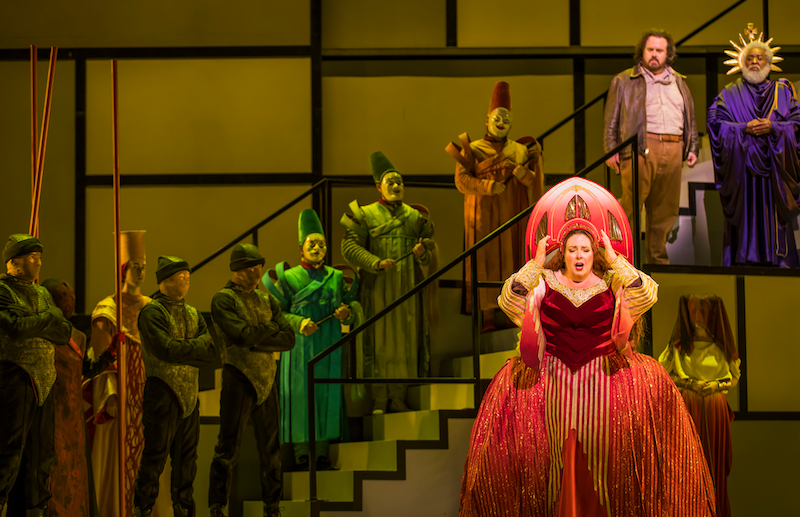
Atlanta Opera’s ‘Turandot’ thrills in spectacular production
Atlanta Opera’s Turandot arrived magnificently on April 25 at the Cobb Energy Performing Arts Centre, exactly 100 years to the day after the very first performance of Giacomo Puccini’s last and grandest opera in Milan, Italy.
This superb must-see production spotlights glorious singing, electrifying conducting and eye-popping stage and costume designs.
Musically, the beginning of the opera is explosive: Conductor Iván López Reynoso sets a fierce tempo, and the sizable chorus and orchestra respond with slashing force and breathtaking precision as the scene opens in ancient China.
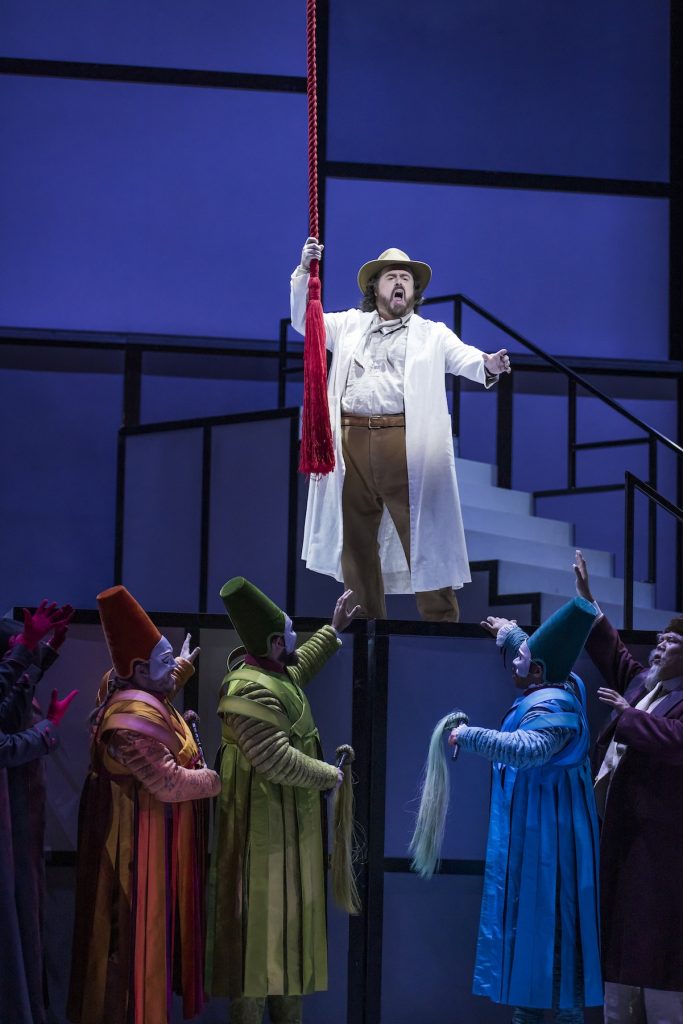
Turandot was Puccini’s only foray into the surreal world of fairy tales, and Production Director Tomer Zvulun and his creative team emphasize the nightmarish violence of the story. Act I opens on a bleak terror regime, with the populace reduced to faceless and brutalized pawns.
One of the first images we see is an executioner marching across stage with a severed head. Some productions of Turandot may downplay the gory aspects of the narrative — it’s a love story, after all, although a bizarre one — but this staging emphasizes the bloody details at the outset.
The production’s Bauhaus geometric abstractions and Mondrian aesthetics by scenic designer Erhard Rom help to connect a 12th-century tale to a violent modern era.
The severed heads are what’s left of Princess Turandot’s would-be suitors. The princess has decreed that any man of high birth who can answer three riddles may have Turandot’s hand in marriage.
But those who fail the test are executed — yet many are willing to accept this high-stakes challenge.
Among the willing, of course, is Prince Calaf, who is besotted with Turandot at first sight.
This production uniquely places Turandot’s aria “In questa reggia” toward the end of the opera instead of in Act II and eliminates some concluding music composed by Franco Alfano. It’s a different way of looking at a beloved opera, but what matters most is Puccini’s music, and that is beautifully rendered.
The two leading roles of Turandot and Calaf are notable for requiring rare voices powerful enough to soar over Puccini’s lush orchestrations while also negotiating the opera’s considerable lyrical demands.
Angela Meade brings a lustrous soprano to the role of Turandot. On opening night, she delivered “In questa reggia” with fiery passion.
Tenor Jonathan Burton, as Calaf, is Meade’s equal in vocal power. He dispatched “Nessun dorma,” the opera’s best-known aria, with lyrical aplomb and a long-held B-natural — much to the roaring delight of the audience.
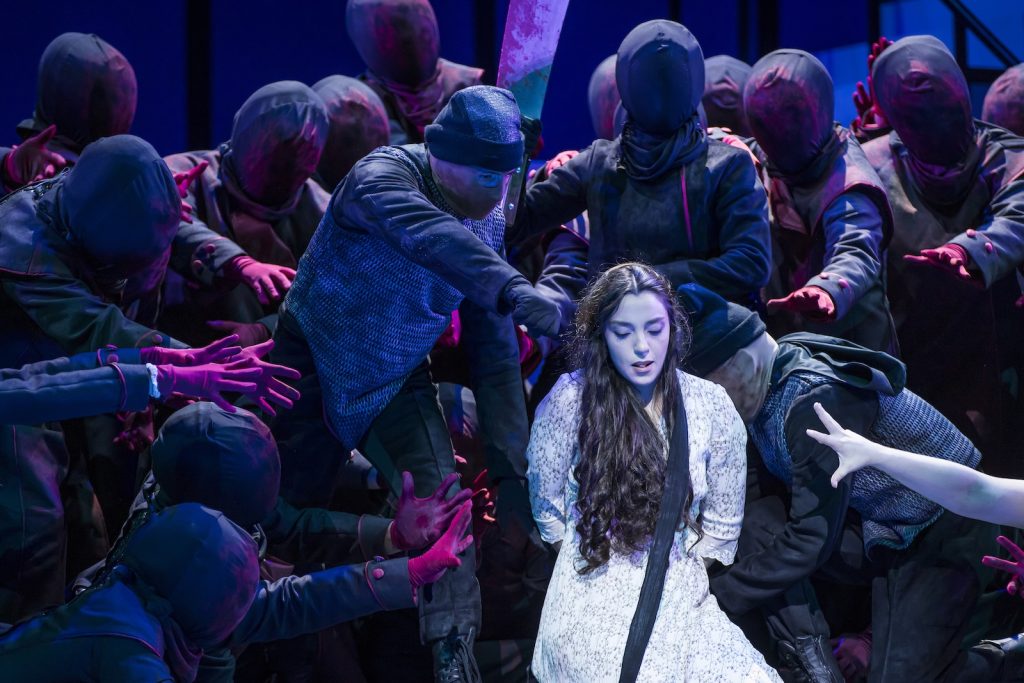
A famous irony of Turandot is that some of Puccini’s most beautiful music in this opera is reserved for another soprano role, that of the slave girl Liu. Juliana Grigoryan, as the long-suffering Liu, is simply divine, tugging mightily at the heartstrings with a luminous voice and graceful stage presence. Her high B-flats, sung ever so softly, are exquisite. (Opera fans, in an antic mood, have long wondered why Calaf doesn’t run off with Liu and live happily ever after.)
Peixin Chin brings a rich-voiced bass to Timur, Calaf’s father.
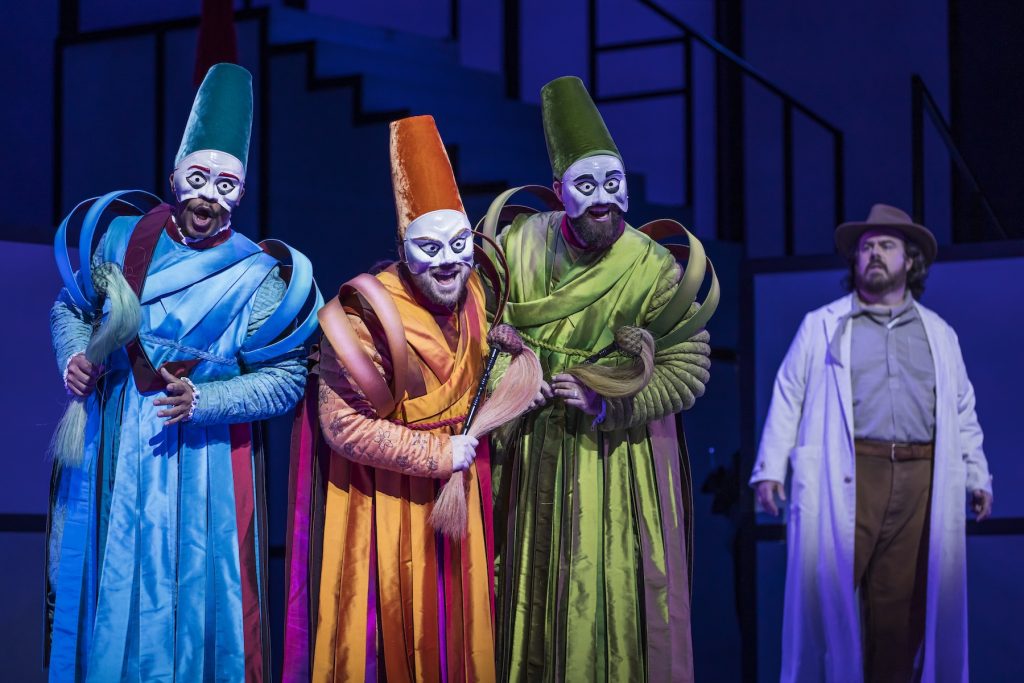
The much-needed comic roles of Ping, Pang and Pong are played by, respectively, Eleomar Cuello, Wayd Odle and Terrance Chin-Loy. The trio negotiated some of the opera’s most difficult music with finesse and focused vocalism. Cuello boasted a warm-voiced baritone while Odle and Chin-Loy were ringing-voiced tenors.
Kyle White is a commanding Mandarin, and it’s a pleasure to see the veteran tenor Steven Cole in the role of the Emperor Altoum.
Opera fans may disagree on whether Turandot is Puccini’s greatest opera, but it’s certainly his largest and most spectacular opera.
The chorus serves as a central dramatic force, and, under the leadership of Chorus Master Lisa Hasson, the 50-member Atlanta Opera Chorus is dynamite — both musically sensitive and stentorian, filling the Cobb Centre with robust sound.
A children’s chorus, meanwhile, sounds ethereal, singing high above the audience. It’s an effective dramatic device, as the otherworldly voices evoke a vision of serenity far away from the violence of the story.
Reynoso, beginning his tenure as principal conductor, is a dynamic orchestral leader, drawing detailed and vigorous playing from the Atlanta Opera Orchestra.
The production features choreography that seems a mix of break dancing and martial arts styles. It’s a bit odd to my eye, but it’s certainly executed with precision.
Ana Kuzmanic’s costume designs are striking, featuring a prominent chess motif, and motley for Ping, Pang and Pong. There’s an appealing mix of influences in the costumes, with Calaf clothed like Puccini’s Dick Johnson early in the opera and later as a sort of Indiana Jones. Liu, meanwhile, with her beret, brings to mind Eponine (a similarly tragic and lovelorn figure) in Les Misérables.
The Atlanta Opera is concluding its 2025-26 season in monumental style with Turandot, to be followed by the culmination of the opera’s four-year-long Ring cycle with Wagner’s Twilight of the Gods in May and June.
In scale, imagination and musical opulence, Atlanta Opera honors the centennial of Turandot with thrilling grandeur.
Where & when
Atlanta Opera: Turandot. Three more performances remain on April 28, May 1 and May 3.
::

Paul Hyde is a longtime arts journalist and English instructor in Upstate South Carolina. He writes frequently for the Greenville Journal, the South Carolina Daily Gazette and Classical Voice North America.
STAY UP TO DATE ON ALL THINGS ArtsATL
Subscribe to our free weekly e-newsletter.

PLEASE SUPPORT ARTSATL
Your Gift Sustains the Coverage You Count On!
Related Posts