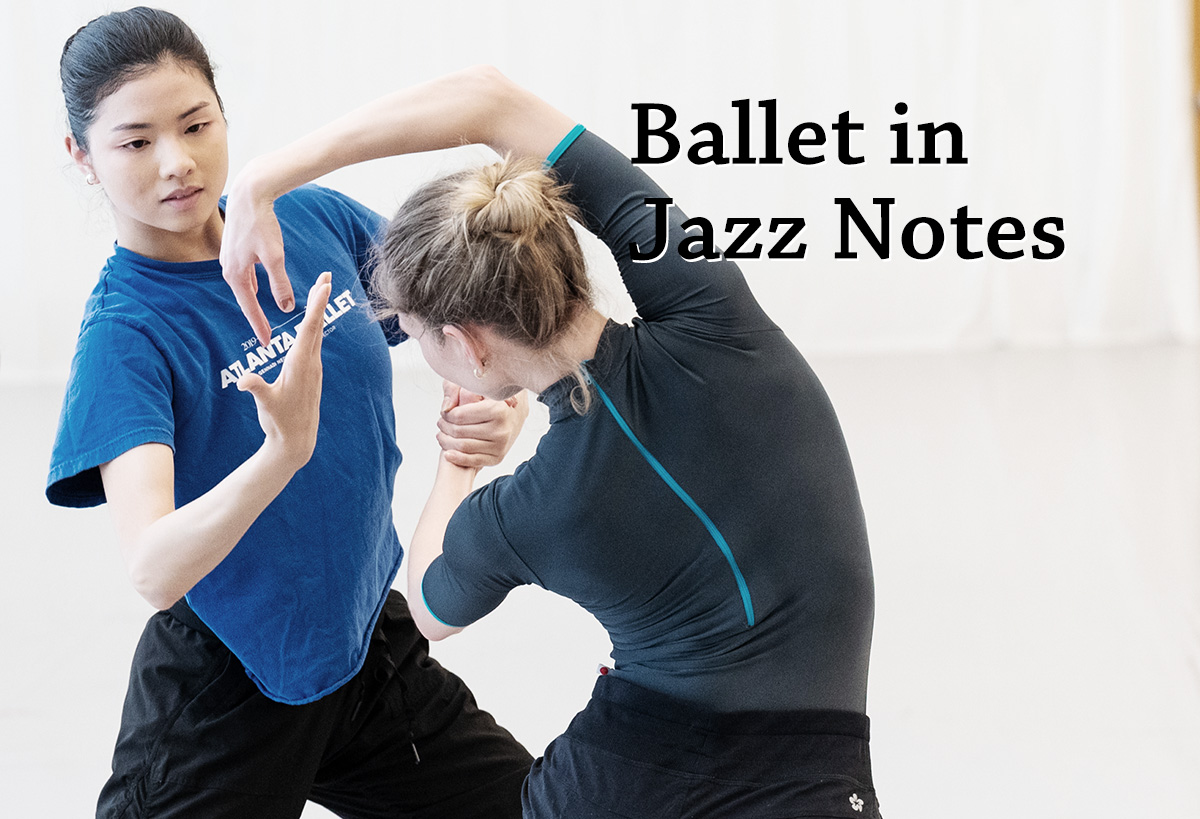
Atlanta Ballet’s ‘Nighthawks’ sets Wynton Marsalis to movement
Atlanta Ballet’s choreographer in residence, Claudia Schreier, loves the energy of big cities. Her new work for the company celebrates that energy with music by another city-dweller, composer and bandleader Wynton Marsalis.
Quick, who’s your favorite ballet composer? Tchaikovsky maybe? Prokofiev? Stravinsky?
Wynton Marsalis?
The jazz composer’s name doesn’t immediately spring to mind, even though world-renowned choreographers Peter Martins and Twyla Tharp once commissioned him to compose works for their dances.
Now Marsalis’ 2016 composition The Jungle (Symphony No. 4) is coming to the ballet stage for the first time, thanks to Atlanta Ballet’s Choreographer in Residence Claudia Schreier. The work is for orchestra and big band, with hints of blues and gospel, a plethora of jazz inflections and allusions to city sounds such as the wail of sirens and car horns, the clatter of the subway — the cacophony of a city in full swing.
It’s the musical canvas for Schreier’s new ballet, Nighthawks, set to premiere May 10 through May 12 at Cobb Energy Performing Arts Centre. Also on the program is Yellow, a new work by Brazilian choreographer Juliano Nunes.
Schreier is a supremely musical choreographer with an adventurous spirit when it comes to choosing scores for her ballets. She set Pleiades Dances to the challenging tonal and rhythmic shifts of Takashi Yoshimatsu’s impressionistic piano compositions. Her 2019 First Impulse was a response to the “fast-changing moods, meters and timbres of Eino Tamberg’s Concerto Grosso No. 5.”
Atlanta Ballet Artistic Director Gennadi Nedvigin encouraged Schreier to use a jazz score for this ballet — her fifth for the company — and describes the The Jungle as “Stravinsky in jazz.”
The company has too few ballets set to jazz, he said, and he enjoys seeing how Schreier’s vision and movement vocabulary change and develop relative to her choice of music. “Each of her works is unique,” he said, based on the breadth of her musical choices and the way she shapes music and movement together.
Schreier spent many months listening to music by various composers before deciding on The Jungle. “It is a vibrant, energetic playground in which to work,” she told ArtsATL recently. “It also has a form similar to the classical form of a symphony, a structural style that works well for creating a jazz-inspired [ballet].” A typical symphony contains multiple movements of varying tempos and colors. “This composition takes full advantage of that variation.”
The Jungle is more than an hour long, however, and is divided into six sections. Schreier chose the first, third and sixth movements for the ballet.
“I read quite a bit about [Marsalis’] original intent,” she said. “It’s an urban work. He was inspired by the concrete jungle of New York City.” Schreier can relate. She grew up in cities and enjoys the pace and energy. Like Marsalis, she lives in New York.
Nedvigin asked Schreier to make Nighthawks a 40-minute work, twice as long as her previous ballets for the company. A work of that length, Nedvigin says, needs to be more substantial, and he encouraged her to include scenic elements. “When choreographers become more experienced, these elements deepen the meaning of the ballets.” He was also eager for the work to have an Atlanta personality.

That was soon accomplished: Schreier and her frequent collaborator, costume designer Abigail Dupree-Polston, reached out to Atlanta muralist and tattoo artist Charity Hamidullah to collaborate on the set and costumes.
Hamidullah had never worked in ballet before or designed for the stage, but she was eager to be part of the team. Schreier asked her to illustrate the “vibrancy and insanity of a city” and to focus on the idea of a city dweller trying find herself in the melee.
Most of Hamidullah’s art is integrated into the Atlanta’s hardscape as murals. But Schreier and Dupree-Polston felt she had understood the body — and three-dimensional work — because of her career as a tattoo artist.
Hamidullah began to draw and sketch while listening to the Marsalis score. Her personal playlist is a range of rap, alternative melodies, blues and jazz, so, when she first heard The Jungle, she felt at ease with the genre. “There were moments when I felt stress, moments when I wanted to dance, explore, even space when I felt a strong sense of safety and soothing,” she explained.
Once she had a concept in mind, she brought her partner, photographer Jamani Chavis, into the project. He put out a call for models. A hairstylist, a poet and a podcaster were among those who showed up for the shoot. Hamidullah integrated the photographic images into her artwork in a piecemeal fashion — a face here, an arm there, a smile that reveals a grill.
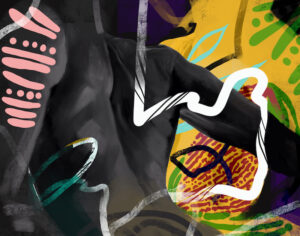
One key element didn’t require a model — Martin Luther King Jr.’s fingerprint.
Hamidullah also designed the sets which comprise 10 large flying set pieces painted in colors that complement the costumes.
Said Schreier: “There is so much depth and color and vibrancy to what she does, and I could clearly see the connective tissue between her work and the music.”
The last section in the ballet, Schreier said, ends in a “dark and intense space . . . with the wail of a sole individual.” She wanted to explore “what it means to be part of a community, the complexities that come along with that and how you can feel unequivocally alone in spite of the constant busyness.” That darkness in the music is reflected not only in the movement but also in the dark mesh overlay that is added to the costumes for that segment.
Schreier and Hamidullah both identify as Black and biracial and, while they want to portray a universal message, their love of America’s — and Atlanta’s — Black culture is very present in the mood, the movement, the costumes and the set design. And, of course, it’s right there in the music, Schreier said.
“ [Marsalis] infuses each movement with a different take on current urban life but also includes references to Black history, Black culture and the struggle of Blacks in America.”
“There have been so many conversations, particularly in the last four to five years, that have called us to speak to our identity and how it relates to the work we are creating,” Schreier said. “There is this desire to put forward what represents us as individuals but also to honor the culture and history we are part of.”
And jazz, she says, is as Black as it gets.
::
Gillian Anne Renault is ArtsATL’s Senior Editor for Music and Dance and has been an ArtsATL contributor since 2012. She has covered dance for the Los Angeles Daily News, Herald Examiner and Ballet News and on radio stations such as KCRW, the NPR affiliate in Santa Monica, California. Many years ago, she was awarded an NEA Fellowship to attend American Dance Festival’s Dance Criticism program.
STAY UP TO DATE ON ALL THINGS ArtsATL
Subscribe to our free weekly e-newsletter.

PLEASE SUPPORT ARTSATL
Your Gift Sustains the Coverage You Count On!
Related Posts