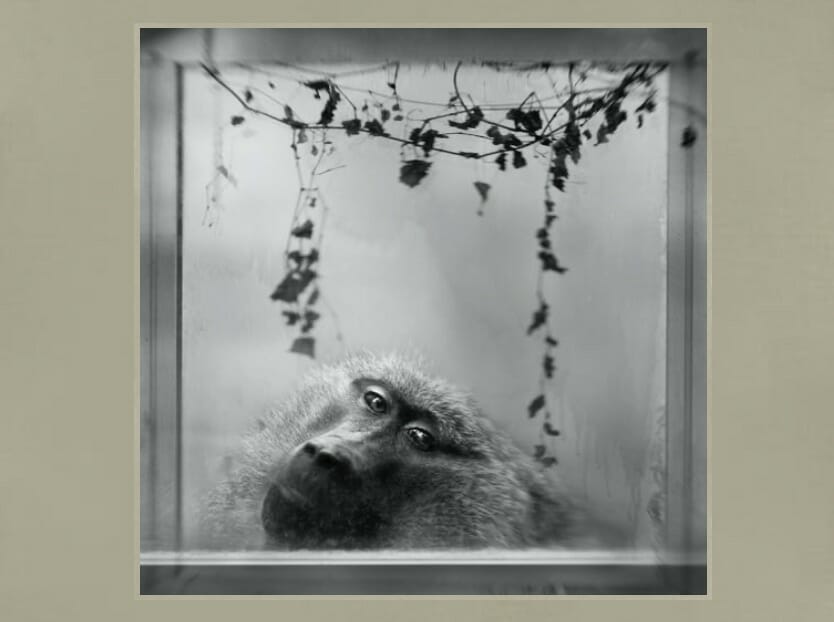
Anne Berry photographs evocative portraits of primates in “Behind Glass”
In Daniel Quinn’s book Ishmael, in which a talkative gorilla schools a young man on the bond between nature and all the creatures who inhabit it, the question is raised: “With gorilla gone, will there be hope for man?”
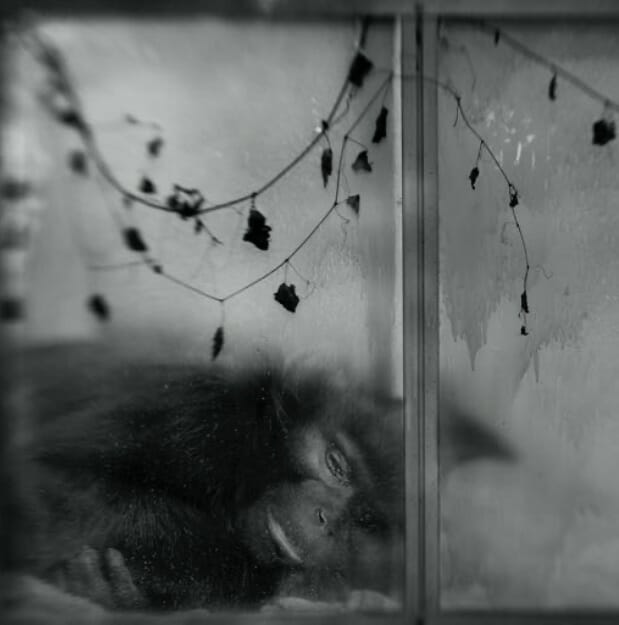
That thought is focused in a new book of photography by Anne Berry, Behind Glass, which features stark and evocative portraits of a variety of primates in European zoos (along with three photographs taken at Zoo Atlanta). The book includes a note from Jane Goodall, and essays by ArtsATL writer Jerry Cullum and Dr. Jo Setchell, anthropologist and president of the Primate Society of Great Britain. Photos from the book have been featured in European publications, mostly notably The Guardian in England.

Berry grew up in Atlanta and now lives in Newnan. She studied photography in college, but put it aside when she married and had children. Her husband is an executive at Southwire in Carrollton and when her kids were older, she picked the camera back up and began to accompany her husband on his business trips to Europe, where every little town seemed to have a zoo.
Like many, Berry has mixed feelings about zoos. On one hand, primates are generally social and transitory animals in their natural jungle habitats. On the other, their natural habits are being taken away by mankind and, for many, zoos are the last barrier against extinction.
Berry obviously formed deep connections with her subjects. As Cullum writes, “There are the facial expressions conveying wistfulness and contemplative loneliness that Anne Berry has captured in these remarkable photographs.”
Berry recently sat down with ArtsATL via Zoom to discuss her work, and her journey as a photographer. Her book is available via Berry’s website.
ArtsATL: What sparked your interest in photography?
Anne Berry: I majored in art and English in college. I took photography and really enjoyed it; I learned the craft and learned how to use a darkroom. My grandfather gave me an old Nikon camera. I got married and had kids. When they got older, around 2005, that’s when I started getting back into photography.
ArtsATL: What led you to photograph primates?
Berry: I love animals. I’ve always ridden horses and I loved to go to the zoo; my mom used to always take me to the zoo. When I went on business trips with my husband, I looked for things to take pictures of. I’m not a street photographer and I don’t like to take pictures of people I don’t know.
We were in Paris and I went to this little zoo, Jardin des Plantes. I took pictures of an orangutan in a small enclosure.
She was acting out for me and engaging. So I decided I was going to visit zoos wherever we went. And it turned gradually that the thing that attracted me and other people were the primates because they are so much like us.
ArtsATL: It often looks like they are posing for you. What was your process in getting such intimate photographs?
Berry: I liked to go during the week. Europe has so many zoos, especially Germany and the Netherlands. Every little town has a zoo. They’re not crowded. I’d go and sit there and it’d be only me in the monkey house.
If they’re living in a zoo, they’re a little more acclimated to people. They’re also interested in the people who are there. I go to zoos in Germany and the people there don’t speak English, so I’m not talking to anyone and I’m just sitting there. I think most people don’t sit there quietly and wait for the animal to sense that communication. It’s being quiet and being patient.
One day, I was in a room with a sketch artist and we started talking. She said, “I want you to meet my favorite chimpanzee.” The room had a full-length window. She walked me over there and a chimpanzee was on the other side of the enclosure. He came running up and she said, “This lady’s from America and she wants to take your photograph.” He ran off and came back with a screw. And sat down holding up the screw.
She knew he shouldn’t have a metal object, so she ran off to tell the zookeeper. He sat there and I took his picture for several minutes and when I put my camera down, he ran off and hid his screw. It was like, “If I’m going to have my portrait made, then I’m going to be holding my precious object.”
ArtsATL: What are your thoughts on zoos?
Berry: I have a mixed feeling. I do understand that gorillas need a lot more room than they have in a zoo. But I’ve also been to South Africa and for the most part, there’s no wild left. The animals often don’t have what they have in a zoo — privacy. Most of their natural habitats now are preserves, and they have people looking at them all the time.
The people I’ve met who work at zoos are really passionate about animals and passionate about what they do. If you don’t have that experience of going to a zoo, you’re not going to have the empathy and children won’t either. If you only want them to live in the wild, most of the animals I photographed are on the endangered list and they won’t be there. And we won’t either. It’d be sad for that to happen.
The animals in zoos, it’s almost like they are ambassadors. If people see them and get passionate about those animals, maybe they will help preserve some habitat for them.
ArtsATL: How did the book come about?
Berry: I always wanted to do this book. It was a matter of doing the book the way I wanted to do it. I was approached by some university presses, but they wanted a lot of text. I just wanted a couple of essays and then the (photo) plates. Most publishers now want the artist to pay for the book, and then they’ll distribute it.
I’m getting a lot of orders from Europe. It’s funny because I go to the little post office in Newnan to mail them off to Europe, and I don’t know what the folks at that post office must think I’m doing. [laughs]
ArtsATL: Do you have a favorite photo from the book?
Berry: The one on the cover is one of the oldest ones. If I have an iconic photo, it’s that one. I took that picture in Moscow. That’s a baboon. He was just laying there and he had his head up against the sill of the window. I shoot with old lenses and I shoot with the aperture wide open so I can shoot through the glass. If there’s a distortion, it’s because I liked it there. You couldn’t do that with a modern lens because it wouldn’t know what it was trying to focus on. He looked so dreamy.
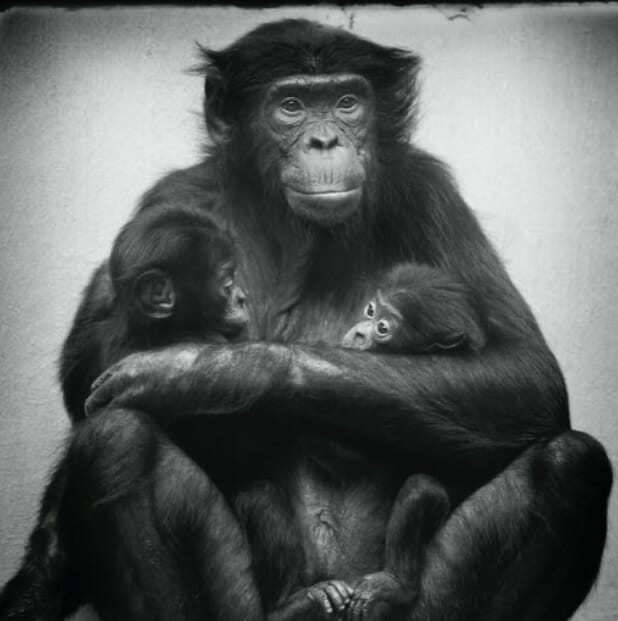
I also really like the one where the bonobo is holding her twins. I took that shot at Der Grune Zoo in Wuppertal, Germany. It’s rare for bonobos to have twins and those may be the only twins in captivity. I love how she looks so serene and sitting there holding them.
ArtsATL: What’s next for you?
Berry: I go down to Cumberland Island and Ossabaw Island all the time. I’m putting together an exhibit with the One Hundred Miles Foundation, which is a watchdog for all things that threaten the coast, for 2023 that will debut at a museum in Greensboro, North Carolina. These pictures aren’t documentary, but the text will be from One Hundred Miles and it will help them raise money and bring awareness.
::
Scott Freeman is executive editor of ArtsATL. He is a multiple award-winning journalist, and the author of four books, including the bestselling Midnight Riders: The Story of the Allman Brothers Band and Otis! The Otis Redding Story. He once held hands with a female gorilla named Kinyani.
STAY UP TO DATE ON ALL THINGS ArtsATL
Subscribe to our free weekly e-newsletter.

PLEASE SUPPORT ARTSATL
Your Gift Sustains the Coverage You Count On!
Related Posts