An artist’s experiments with light: ‘Panorama’ at the Woodruff
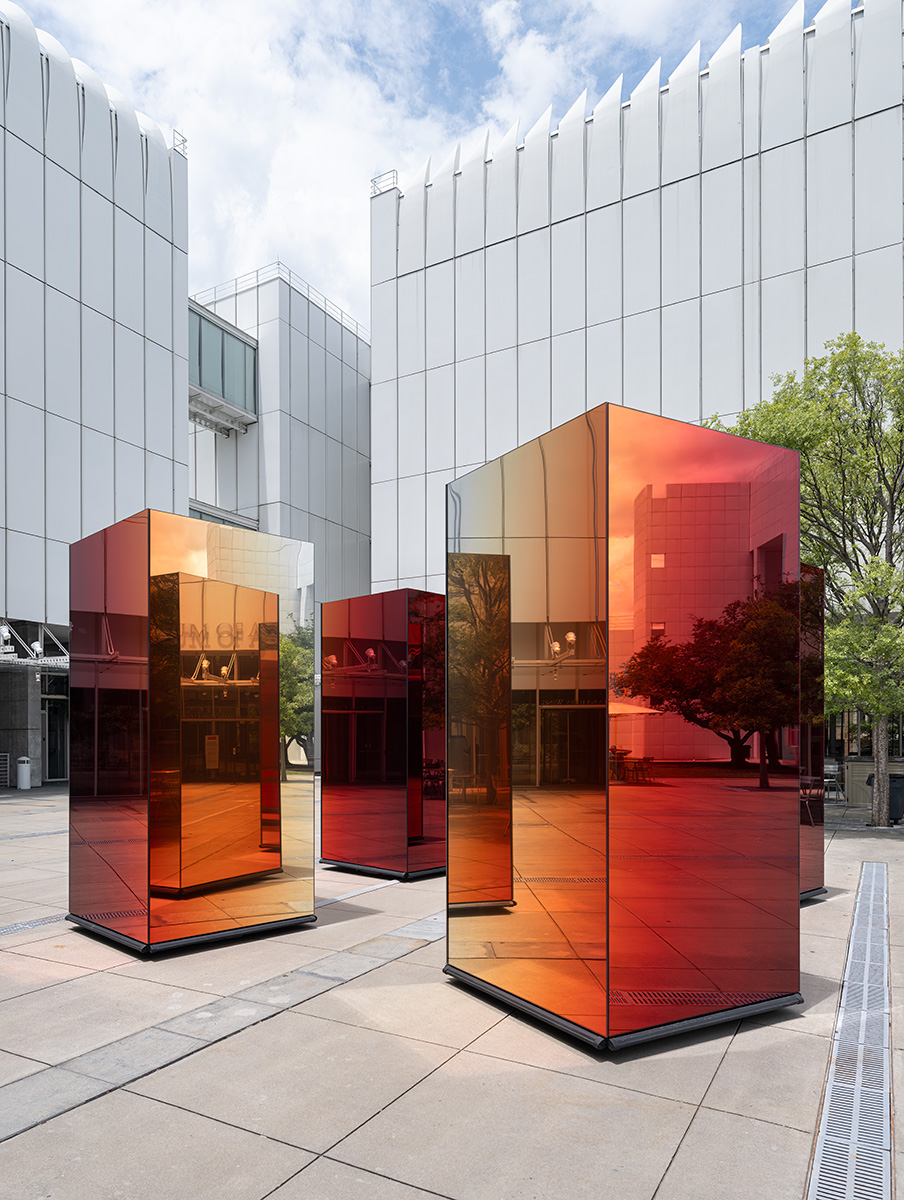 This summer, the High Museum of Art has mounted a new installation on the Woodruff Arts Center’s Carroll Slater Sifly Piazza: Panorama by Rotterdam-based Studio Sabine Marcelis. This is the ninth in the series of temporary interactive works from the museum’s Department of Decorative Arts and Design that began in 2014.
Previous piazza installations include HAPPY JOYLANTA by Tanya Aguiñiga (2023); Outside the Lines by Bryony Roberts Studio (2021); Murmuration by New York-based architectural firm SO – IL (2020); Sonic Playground (2018) by Japanese designer Yuri Suzuki; Merry Go Zoo (2017) and Tiovivo (2016) by Spanish designer Jaime Hayon; and Mi Casa, Your Casa and Los Trompos (“The Spinning Tops”) (2014-2015) by Mexican designers Héctor Esrawe and Ignacio Cadena.
The Sifly Piazza is a perfect canvas for Dutch designer Marcelis’ installation of columns of red and orange mirrored glass set against the white concrete of the piazza floor and surrounded by the white metal flashing on the facade of the High Museum. Marcelis has made similar installations of deeply hued red-to-orange mirrored surfaces on rectangular columns in other locations around the globe, from Rome to Giza, Riyadh and Dubai.
Marcelis also has made objects for such brands as Bulgari, IKEA and Dior, including a rug pieced together from a slew of fuzzy textile doughnuts for CS rugs (which produces custom rugs) and a swirling perfume bottle in pink for the fragrance Miss Dior. Her primary interests as a designer are in color, form and reflection, all of which characterize this new work for Atlanta.
Monica Obniski, the High’s curator of decorative arts and design, who commissioned the work, says of Panorama by email, “I hope that the public appreciates Sabine Marcelis’ attention to material surfaces and that she is a master colorist; together, these elements conspire to create a new experience for our visitors on the piazza.”
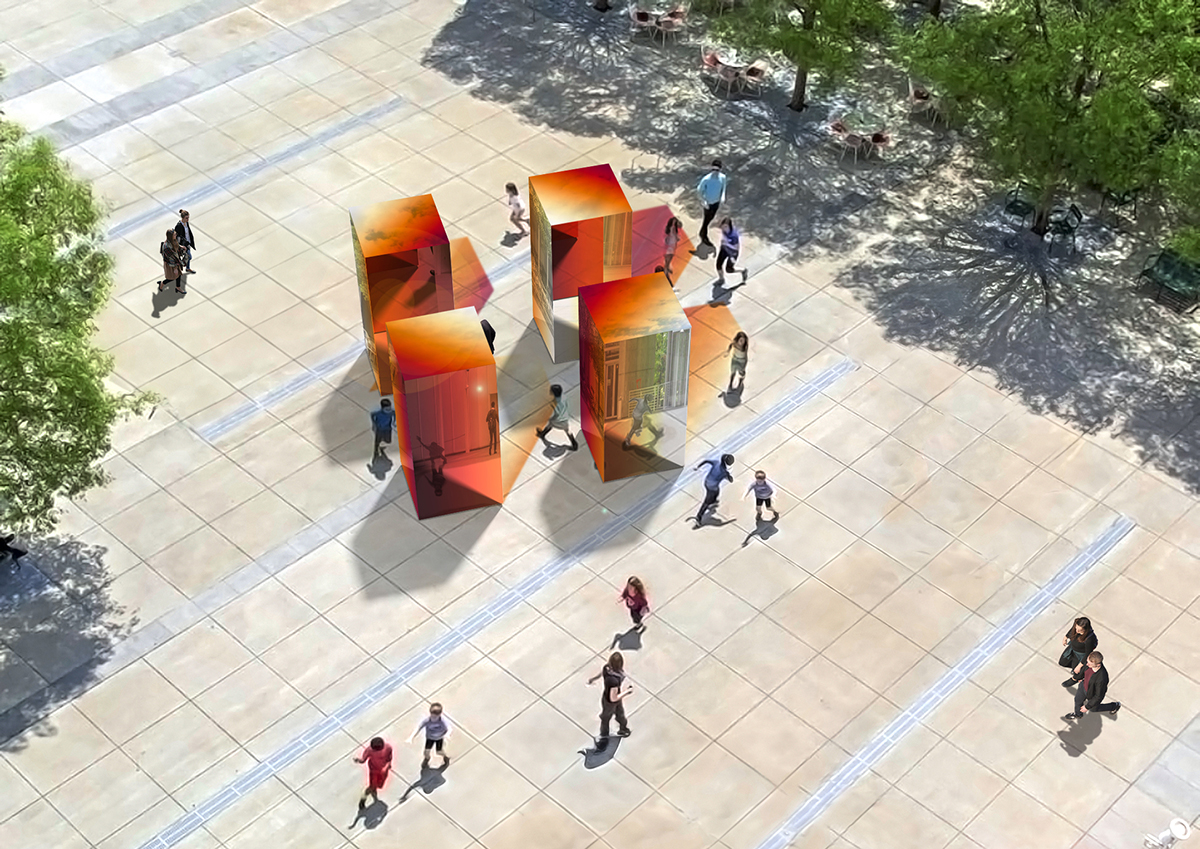
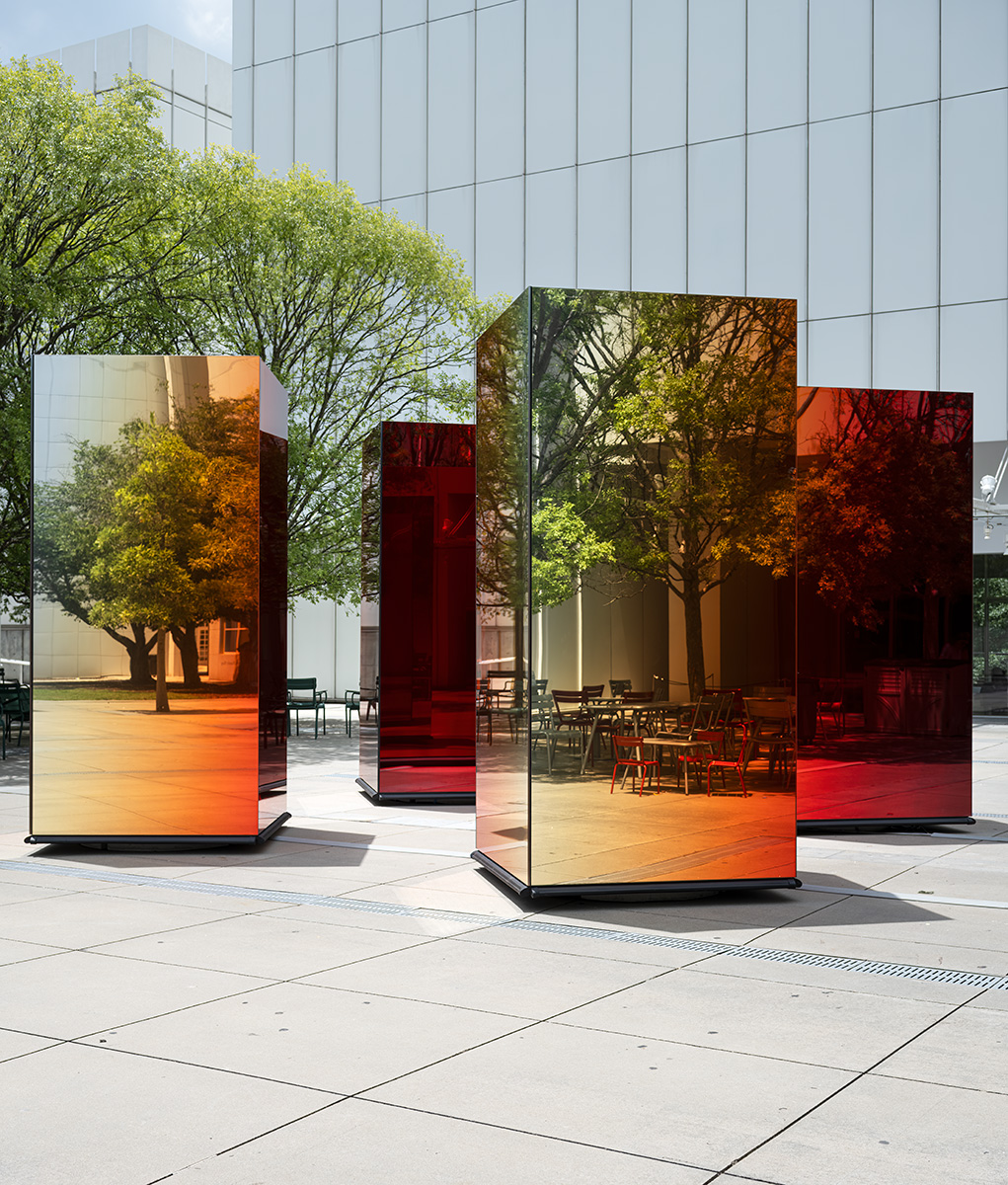 With Panorama, Marcelis traverses the boundary between art and design in a sculptural work. In the past, Marcelis made a series of mirrors in softly circular forms and in colors that ranged from blue to green to orange; she created each hue with a mix of tints that range from light to dark and warm to cool. The four richly hued and mirrored vertical columns that make up Panorama are in a palette that moves from a deep garnet red to a gradient palette of orange. They are placed in a square formation and slowly rotate clockwise in unison. This slowly paced rotation creates everchanging viewpoints as the columns’ movement changes who and what the viewer sees reflected on the sides of the columns.
Panorama fits well into a conversation with the High’s collection of modern and contemporary art. Several works currently on view are made of glass or steel and reflect the viewer. Anish Kapoor’s Untitled (2010) is a stainless-steel concave disc whose fractured surface is a delight for the selfie addict — it might be the most photographed artwork in the High’s collection.
Monir Shahroudy Farmanfarmaian’s Untitled (Muqarnas; 2012), with two wing-like forms in faceted mirror parts that suggest the vaulting of Islamic architecture, is another work currently on view that employs mirrored surfaces.
Rashid Johnson’s Rumble (2011) has a surface of mirrored tile in an asymmetrical grid that has been paint-bombed with black paint by the artist.
Fred Wilson’s black glass chandelier, which he had fabricated on the island of Murano, Speak of Me as I Am: Chandelier Mori (2003) is hung in the stairwell straddling the High’s departments of Modern and Contemporary Art and Decorative Arts and Design.
It is not just because these works are made of glass or mirror that they relate to Panorama but also for the ways they cross over between art and design and question the compartmentalization between the two.
Marcelis created these monoliths with multiple fabricators that are all close to her studio in the Netherlands. Via an email exchange, the artist has said about her work for Atlanta, “I can’t wait for museum visitors to discover the piazza through Panorama from a new perspective. Offering a moment of wonder and interaction with the piazza, its surrounding architecture, themselves and the sun. I invite visitors to come back at different moments during the six-month installation period to experience Panorama and its colorful reflections at different times of the day and year, when the sun is approaching the volumes from different angles offering an ever-changing experience.”
The Sifly Piazza is flooded with viewers both young and old; it is a pleasure to watch people interact with Panorama. Children and adults equally find joy in the richly hued columns that slowly rotate and mirror the exterior space and themselves. It can be viewed almost as a sundial reflecting changes of light and season and a work whose contemplation inspires both play and reflection.
::
Deanna Sirlin is an artist and writer. She is known internationally for large-scale installations that have covered the sides of buildings from Atlanta to Venice, Italy. Her book, She’s Got What It Takes: American Women Artists in Dialogue (2013), is a critical yet intimate look at the lives and work of nine noted American women artists who have been personally important to Sirlin, based on conversations with each one.
STAY UP TO DATE ON ALL THINGS ArtsATL
Subscribe to our free weekly e-newsletter.

PLEASE SUPPORT ARTSATL
Your Gift Sustains the Coverage You Count On!
Related Posts