Streaming in August: the search for reality, the truth about ‘Mommy,’ more
NETFLIX: A Family Affair
For a lesson in how virtually the same plotline can float along nicely in one streaming movie and sink like a stone in the next, consider May-December romances The Idea of You (on Prime Video, covered in May’s column) and Netflix’s newer A Family Affair.
In the former, art gallery owner Anne Hathaway ends up with barely-older-than-her-daughter Nicholas Galitzine, a boy-band singer. Their love is threatened by social media haters, who brand Hathaway’s character a cougar. In Affair, Nicole Kidman is a successful author who lives in a Nancy Meyers-style house and falls for her adult daughter’s boss, a famous Hollywood action star played by Zac Efron and his surgically altered jaw.
In Affair, the main pushback to romance comes from Kidman’s icked-out daughter. Both films are set in the entertainment industry; both are full of insider showbiz references. And though both films are supposed to unfold in Los Angeles, they were largely shot in Atlanta. (Affair has one of those faux “Xmas” scenes, featuring a charming yet rustic house sprayed with toxic-looking fake snow. I may be wrong, but it looks like a nice patch of Georgia woods got this unseasonal blitz.)
So why does Affair sink where Idea floats? Maybe it’s the slightly unhuman, cosmetically enhanced faces of its two leads, and the script’s airless, snarky Hollywood argot. And maybe it’s because, while Galitzine’s character in Idea was a bit of a player and a little naïve, Efron’s guy is an infamous womanizer and pretty stupid — he’s the star of a series of films playing an action hero called Icarus, but Kidman’s character has to explain that the name comes from Greek mythology. Even Kathy Bates, as the down-to-earth mother of Kidman’s dead husband (she brought similar emotional ballast to Max’s The Great Lillian Hall) can’t save A Family Affair from terminal fakeness.
::
MAX: Fantasmas
Speaking of fake, there’s not a touch of visible reality in Julio Torres’ Fantasmas. Weirdly, that’s good news. Normally I have a very low threshold for whimsy, but, since Fantasmas is nothing but whimsy, the only way to watch it is in a state of surrender. Torres, creator of HBO’s weirdo-supernatural series Los Espookys, was earlier a writer on SNL, responsible for fey, gay notions — like a TV ad for wishing wells, manufactured for sensitive young boys to dream beside. He’s an original, tender flake.
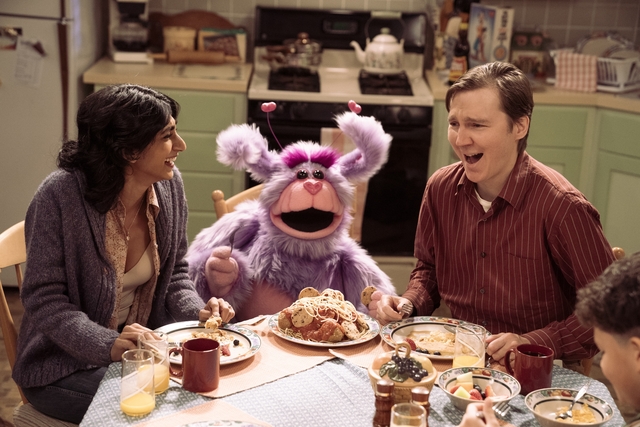
His new show is set in a New York City that might have been imagined in a no-budget, public-access cable studio. Torres plays Julio, a variation of his usual persona: unsmiling, fragile-tough, delicately aggrieved by the nonsense of daily living. He’s a creative multihyphenate, trying to get work of any kind from Vanesja (the “j” is silent), played by Martine Gutierrez. A wannabe actor, she has posed so long as Julio’s agent that she has de facto become just that. When he’s not pursuing a job, Julio is searching for a tiny golden, oyster-shaped earring he lost. It was the same size as a birthmark on his cheek, which he now fears is a cancerous mole, but to get medical attention he has to present a Proof of Existence card. (As a native of El Salvador, Torres knows his way around the sort of bureaucratic nightmare this fictional card represents.)
Meanwhile, the airwaves around Julio are full of court coverage of an elf named Dodo suing Santa for unpaid labor and TV ads from a fanatic designer who wants to make personalized outfits for your toilets. These oddballs are played respectively by Torres’ SNL colleagues Bowen Yang and Aidy Bryant. (If all of this sounds bizarre, you don’t know the half of how immersively nuts Fantasmas is. It’s a descendant of the surrealism of screenwriter Charlie Kaufman and director Michel Gondry, with a healthy spicing of Pedro Almodóvar. Julio’s cheerful, car-service driver, played by Tomas Matos, is a first cousin of the bleach-blond disco cabbie who drove Carmen Maura around Madrid in Women on the Verge of a Nervous Breakdown).
Julio’s pursuits of either a Proof of Existence card or a biopsy for his mole are really just the framework Torres uses to hang his surreal sketches on. Fantasmas has the shaggy-dog structure of something like Luis Buñuel’s The Discreet Charm of the Bourgeoisie, in which a group of posh French friends attempt to sit down to dinner, but their plans are constantly interrupted by intrusive side stories. At first, I had a tough time getting into Fantasmas. It’s so mired in a GenZ mind-set that it took a minute to realize Torres is both celebrating and annihilating his generational cohort’s ways of navigating the 21st-century world. The show is both affectionate and scathing. It includes lively cameo appearances by actors with great street cred, including Paul Dano, Steve Buscemi and Natasha Lyonne. Fair warning, though: Fantasmas can make you feel like somebody slipped you a hallucinogen.
::
APPLE TV+: Sunny
Always reliable for programming that probes the space between speculative science fiction and our ever-changing daily reality, the 10-episode Sunny puts us in a near-future Japan where service bots are on the edge of becoming as common as household pets.
In the shock-struck days following news that her husband Masa (Hidetoshi Nishijima of Drive My Car) and young son are on the MIA list of passengers on a crashed airline, American émigré Suzie (Rashida Jones) stumbles through her new reality. She’s not too thrilled when the Kyoto corporation that Masa worked for issues her “Sunny” (voiced by Joanna Soytomura), a cheerful AI companion insistent on bonding, while all Suzie wants is to empty whatever bottles of booze she can find.
Teetering on the edge of overwhelming loss, the show creates an immediate disconnect between Suzie’s devastation and Sunny’s chirpy presence. Anyone who goes in thinking the show might be a serious or sensitive exploration of grief will be disabused of that hope after a few episodes.
The fact that it’s derived from a novel called The Dark Manual, a very different sort of title, clues you in that there are darker plot twists ahead following the awkward Suzie/Sunny buddy comedy. Cue the appearance of comical/murderous Yakuza gangsters intent on seizing a thread part of Sunny’s coding.
It turns out that Masa, though he claimed to work in developing state-of-the-art refrigerators, was involved with dangerous robotic programming. I won’t spoil more, but the show ultimately feels a little secondhand and a little halfhearted. It doesn’t help that Jones, whether she’s expressing grief or anger or drunkenness, draws on a limited emotional range. She’s a walking scoff. Sunny, continuing weekly through September 4, is both sort of watchable, mainly due to its Japanese setting, and sort of a missed opportunity.
Still, I’ve got my hopes up for another new Apple TV+ series that continues through Aug. 23: Lady in the Lake, a period murder mystery starring Natalie Portman and Moses Ingram. I’ll plan to cover that in the next column. Also, a 10-episode adaptation of Terry Gilliam’s weird 1981 film Time Bandits sounds like such a bad idea, it may be worth a watch.
::
DISNEY+: The Acolyte
If you thought that we’ve had all the Star Wars spin-offs we need, The Acolyte won’t change your mind. Set long before even the prequels, the eight-episode series purports to be the origin story of those who turned away from the Force-driven path of the Jedi and cultivated their dark-side mojos under the name of the Sith. That sounds exciting, but the show’s most convincing argument is that anyone would be turned away by the generic mumbo-jumbo spouted in the training rooms of young Jedi knights.
Squid Game’s Lee Jung-Jae plays Sol, on the hunt for a rogue assassin who’s killing his fellow Jedi masters. She’s Mae (Amandla Stenberg), the turned-evil twin sister of Osha (also Stenberg), who once dreamed of being a Jedi herself. The plot trajectory of the show has potential, as we see through flashbacks how the sisters developed along different paths. And Acolyte deserves credit for killing off characters you initially think are immune from peril. But while it takes risks like that, the show stumbles over its stilted dialogue and bogs of exposition. It’s somber nonsense that lacks the offhand poetry or wit that made so many fall in love with George Lucas’ space opera so many years ago.
Because the creator, Leslye Headland, is not only a woman but identifies as lesbian, Star Wars trolls — um, sorry, fans — preemptively screamed that Acolyte would turn their beloved, long-ago and far-away galaxy all woke. Well, considering the many colors and races Lucas crammed into that Tatooine bar in A New Hope, that was a laughable nonstarter of an idea. You can claim the new series is DEI all you want to. But the biggest problem with The Acolyte is that — except for several good light saber battles and star Manny Jacinto’s stealth seduction of both the twin girls and the viewers with his ripped physique — the show is slow, dull, talky and clunky.
::
MAX: Faye
My writer-director friend Chad worked with Faye Dunaway off and on while he was in Los Angeles. He learned the hard way that you don’t say these two little words around the Oscar-winning actor: Mommie Dearest.
The documentary Faye dares to mention that camp classic directly to Dunaway. To her credit, she doesn’t bolt from the interview. That’s because she’s in safe company, literally sitting beside her son Liam, in this loving, if superficial, tribute to the woman who blazed through one of Hollywood’s greatest periods. Remember, she starred in Bonnie and Clyde, The Thomas Crown Affair, Little Big Man, Three Days of the Condor, Chinatown and the frighteningly prophetic Network before she created her own sort of Waterloo by portraying Joan Crawford with singular ferocity. The problem with Mommie Dearest isn’t Dunaway; it’s Frank Perry’s clunky, amateurish filmmaking. At the time, that distinction was a hard one to make — possibly more for Dunaway herself than for filmgoers.
Anyway, Faye reminds movie lovers of the great talent that was partly sidelined by this one film. It also explains some of Dunaway’s famous temperament as being the result of bipolar disorder, the sort of thing that was neither diagnosed, much less discussed, at the height of her career. The usual cultural sexism only added fuel to her rep as a diva. The movie could have been much deeper and smarter, but it’s enough to make you hope for some sort of comeback or at the very least a renewed appreciation of her work.
::
HULU: The Bear
With 23 nominations for its second season, The Bear broke Emmy records recently for a comedy — even if many viewers disagree that the frenetic, high-pressure show should be running in that category. Meanwhile, the third season dropped last month and got piled on by critics who called it self-indulgent and plotless. I’ve only watched the first three episodes. To me, they feel like poetic meditations on a theme, rather than a normally shaped comedy-drama. I’m fine with that. Creator Christopher Storer and his ensemble cast have earned enough of my goodwill that I’m happy to let them cook whatever they want to this season. … so I’ll be doing a steady, slow-drip watch for the rest of the summer. Whatever you’ve got on your streaming list — enjoy.
::
Steve Murray is an award-winning journalist and playwright who has covered the arts as a reporter and critic for many years. Catch up to Steve’s previous Streaming columns here.
STAY UP TO DATE ON ALL THINGS ArtsATL
Subscribe to our free weekly e-newsletter.

PLEASE SUPPORT ARTSATL
Your Gift Sustains the Coverage You Count On!
Related Posts