Q&A: SAG-AFTRA president, negotiator Eric Goins reveals what’s at stake
Georgia is a major force in the film production industry, alongside Los Angeles and New York, and any big-picture look at the SAG-AFTRA strike warrants a closer examination of nuances from a Georgia angle. While nationwide solidarity is key — of supreme importance, actually — geography adds its own twists and turns to the strike.
No one has a better vantage point on this than Eric Goins, local SAG-AFTRA president and member of the organization’s TV, Theatrical and Streaming Negotiations Committee.
As president, Goins is in charge of leading our state’s SAG-AFTRA members — a group of just under 4,000 in line with the organization’s 170,000 members nationwide.
Goins, who himself is a storyteller, actor, husband and father, recently sat down with ArtsATL to discuss his role on the negotiating committee, what led to the strike and what exactly is at stake for Georgia.
ArtsATL: Can you share a big picture view of the SAG-AFTRA strike as it stands today?
Goins: Generally speaking, our industry has changed with the growth of streaming services. And our employers are trying to run a 21st-century business using a 20th-century contract that no longer works. They refuse to accept that, and, while CEOs and our employers continue to grow their own personal wealth, it’s done on the backs of our members. That’s the issue right there.
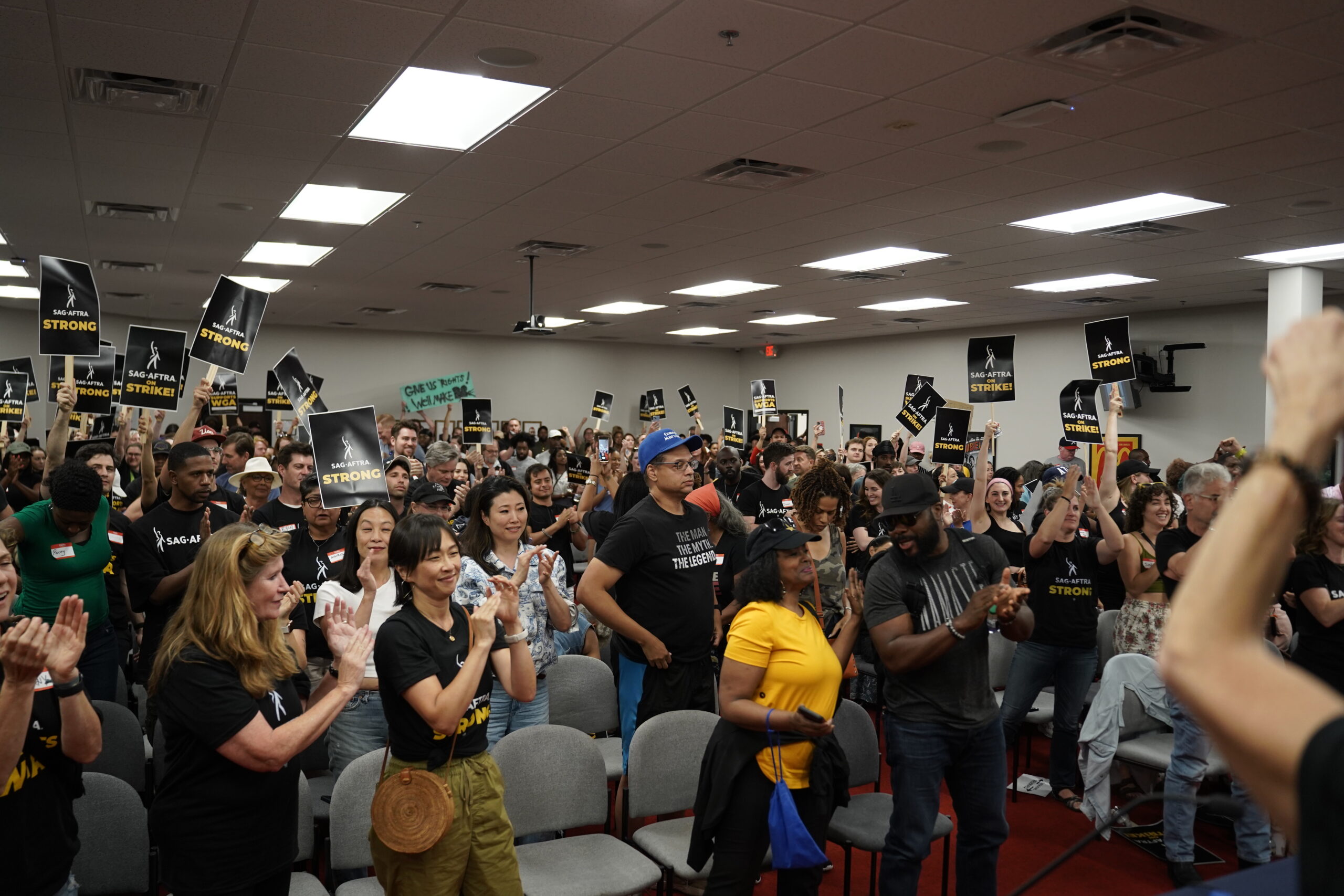
[Since the strike officially began on July 13, 2023] . . . across the board, both in the country and in Atlanta, we’ve seen unprecedented solidarity among membership [on the issues] on which we strike that affect a large swath of our working class members every day. The level of unity and solidarity has been the biggest I’ve seen.
I went to Los Angeles for six weeks and sat across the table from the Alliance of Motion Picture and Television Producers to negotiate our contract. I was part of the team that worked vigorously to find some common ground and negotiate a fair deal with our employers . . . on compensation, AI and pension and health contribution caps . . . and on all points, they refused meaningful engagement.
We told the [studios] in the beginning not to underestimate our resolve. And we’re seeing the repercussions of that underestimation. We have a righteous case.
ArtsATL: Describe what’s at stake in the strike, specifically in Georgia.
Goins: There’s one issue that specifically affects our members here in Georgia, outside of New York and Los Angeles. In our proposal, we have [a section] about Georgia discrimination and casting, where actors outside of New York and Los Angeles are offered lesser terms for roles. The [studios] rejected that discussion.
Often, our [Georgia] members are doing the same work for lesser terms because of our geography, so our employers are consistently using our local markets outside of Los Angeles and New York as a low-cost provider. So we would like to determine how we can stop this practice.
We believe the terms of our contract should extend across the country, and, when they don’t, it’s problematic. The [studios] refused to have a discussion on that. I can’t think of a strong enough word to describe it right now, but it’s incredibly disappointing.
There has been great support here in Atlanta, where people are used to fighting for the rights of others. I’m proud to be part of that tradition. The expression of our voice in Atlanta is unique and special. We have a tradition of diverse voices and passionate expression in the fight for human rights, and Atlanta will continue to be that.
All [across the country], I’ve seen national solidarity around these issues and unity. Everyone, regardless of different cultures and locations, is united around the issues of fair treatment, respect, AI [concerns] — and this transcends geography. [At the end of the day,] we’re working to build a successful industry.
ArtsATL: What are the issues surrounding AI?
Goins: The studios want to scan performers once and use their image in perpetuity. That’s unacceptable to SAG-AFTRA. This issue affects everyone — anybody with a face.
Our members should be consented for the use [of their likenesses]. SAG-AFTRA isn’t trying to stop technology but to put up guardrails to protect our members — [to ensure] consent and proper compensation for the use of that image. And finally, control over how that image is used.
The stars have aligned, and SAG-AFTRA is at the front of this fight because our image is how we make a living. We’re the first to fight this at the public level, but it will eventually affect all of us.

ArtsATL: It seems many of these issues are important to people outside the entertainment industry as well. What’s your take on that?
Goins: The issues we’re fighting for are issues the general public can certainly relate to: fair and reasonable wages, protection of our image and common respect for workers.
These issues transcend the entertainment industry. We’re on the front edge of a labor movement. The [studios] expected a strike, and they have received a labor revolution.
Over the past three to five years [especially], there has been an expanding gap between the haves and have-nots. The highest earners have continued to build more and more, but those on the front lines of the labor workforce have not been paid fairly or treated with dignity.
I think what has caused such a high level of support [for the strike] is that the public has traditionally seen the industry through the eyes of the top one percent — the highest earners in our industry. But the issues we’re fighting for are focused on the performers still struggling to pay their rent and get access to health care. These are mainstream issues that I believe have always been there, [and everyone can relate]. Ninety-nine percent of the industry is working class actors who want to make a modest living for themselves and their families.
I believe in the intrinsic value of all our [SAG-AFTRA] members. They are storytellers, and the world needs them. Just as we need doctors, teachers and plumbers, we need storytellers to pass along our stories to the next generation, to turn a mirror on ourselves.
ArtsATL: How can the public support SAG-AFTRA’s efforts?
Goins: The general public can share our stories and our efforts on social media. [Also,] if it’s within their ability, they can donate to organizations such as the SAG-AFTRA Foundation and the Entertainment Community Fund, which are organizations to help provide emergency resources in times like these. And they can [give] to local organizations that are helping support [the needs of] talent.
The media has asked how we’re going to survive this strike. People fail to realize that storytellers have been surviving their whole lives in this industry. We are hustlers. Our members are also supporting each other through organizations like talentsupportingtalent.com, where people can support actors on strike in their side businesses.
We encourage the public to join us at big rallies [as well]. Many are open to the public. Go to sagaftrastrike.org for updated information on the strike and to find a list of related local activities.
::
Carol Badaracco Padgett is an Atlanta freelance writer who specializes in film and television coverage. A graduate of the University of Missouri School of Journalism, her work has appeared in publications nationwide.
STAY UP TO DATE ON ALL THINGS ArtsATL
Subscribe to our free weekly e-newsletter.

PLEASE SUPPORT ARTSATL
Your Gift Sustains the Coverage You Count On!
Related Posts