‘Women Rock!’ in Philip Auslander’s vibrant, engrossing and erudite new book
It is an unfortunate reality that the story of rock music is often told without due recognition to its female contributors. The chronology is familiar: The era of Elvis, Chuck Berry and Little Richard gives way to the Beatles, Jimi Hendrix and the Doors in the 1960s, only to be replaced in the ’70s by Pink Floyd, Led Zeppelin and Black Sabbath. On and on it goes from one chart topping epoch to another with female rockers, no matter their success, seeming to exist as a notable novelty in the shadow of their male counterparts.
With the release of Women Rock!: Portraits in Popular Music, White Star Publishers and Georgia Tech performance studies professor Philip Auslander — already known for his writing on popular music — seek to correct the narrative. The book is a vibrant and engrossing photo compendium from the art rock stylings of Bjork and Kate Bush to the rip-roaring heavy metal of Doro and everything in between. It’s a visual smorgasbord, but Auslander’s deep, erudite prose are what sets the project apart from similar fare.
(Kat Taylor’s book She’s a Badass: Women in Rock Shaping Feminism, recently reviewed for ArtsATL by Shannon Marie Tovey, takes a very different approach, asking women in rock ‘n’ roll if they consider themselves feminists. Some of the answers were surprising.)

“I teach a course on American popular music,” explains Auslander. “I’ve always been looking around for textbooks to use in that course, and, a number of years ago, I happened upon a history of rock music textbook which had a picture of Joan Jett on the cover and absolutely zero mention of Joan Jett in the book. That really to me was kind of shocking.”
When White Star Publishers approached Auslander with the Women Rock! project, he saw it as an opportunity to correct that oversight and further expand on the subject. The contribution of women in rock music is crucial, indelible and deserving of greater recognition than just a perfunctory mention of Janis Joplin and Grace Slick in an otherwise phallocentric story.
Sister Rosetta Tharpe, the electric guitar wielding gospel maven, served a crucial but overlooked role in the development of rock ‘n’ roll. The Riot grrrl punk movement laid the foundation for the emergence of grunge and alternative rock long before Nirvana rocketed to stardom. That expanding of the narrative is what Women Rock! seeks to address.
Auslander is quick to point out that things have improved in recent years. “You have things like School of Rock where girls participate and guitars are being made specifically for women’s bodies.” To the latter point, the book cites the examples of Daisy Rock, a guitar brand made with girls in mind, and art rocker St. Vincent’s signature guitars designed specifically to fit a female torso.
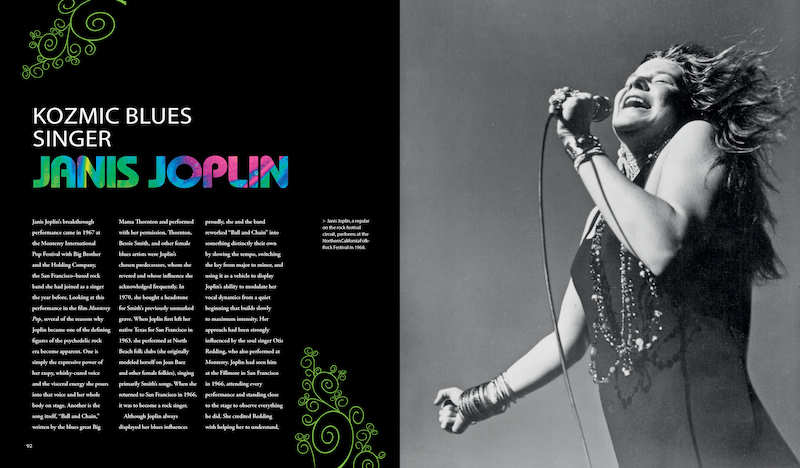
“A lot has changed in the right direction,” he continues, “but I still came upon the statistic that in the United States only 20% of professional musicians are women. That’s pretty daunting.”
Equally daunting was the challenge of breathing new life into the already well-known women rockers covered in the book. Joan Jett, Cher and the like are already household names. What new life could be breathed into such well-known careers?
“That’s really the heart of the matter,” says Auslander. “I went into this with the tacit assumption that I had a limited word length, and I was just writing mini-biographies. But I realized there are already a gazillion mini-biographies out there. So that made me think about how I might be able to do something different.”
That realization led Auslander to focus less on the biographical element of his subjects and more on their artistic and technical contributions. “In the case of Bonnie Raitt, I talked mostly about her slide guitar playing. I’m not even trying to tell you everything about Bonnie Raitt; let’s just look at this as something that can stand for achievements as a musician.”
That lean and focused approach served to liberate many of the artists from the traditional confines of their familiar narratives. “When I was writing about Courtney Love,” explains Auslander by way of example, “I decided to write about herself, her band and what she’s done — not as Mrs. Kurt Cobain,which is almost universally the way she’s talked about. It’s mentioned in a caption for a photograph but that’s it.”
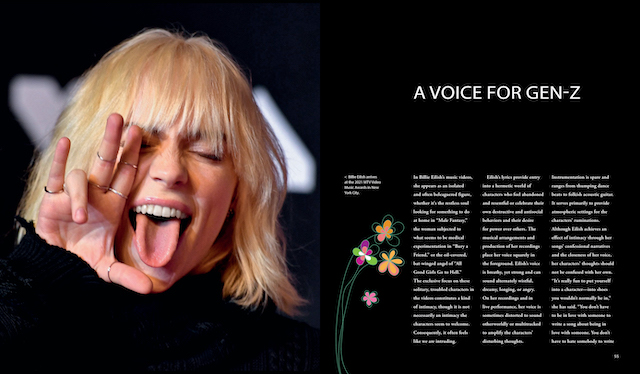
The result is a narrative on Love that develops organically by focusing on her greatest asset: a visceral, no-holds-barred persona equally grounded in detached introspection and feral impudence.
That stripping of traditional baggage pays off time and again throughout the book. Lady Gaga, so often lampooned for her seemingly erratic shifts in visual and musical style, is rebranded as a conscious and calculating master of re-invention. Similarly, Blondie’s Debbie Harry is revealed to be satirizing the sex symbol status to which she was elevated. That theme of finding the depth beneath what the world at large had written off as shallow serves to legitimize the performers covered in the book. It is at once exalting and humanizing.
For all the book’s comprehensive history, spatial constraints inevitably mean some important figures get left out. When I showed the book to several of my own young female music students, they reacted with enthusiasm but also asked about the exclusion of certain personal favorites.
To that Auslander replies with a chuckle: “All I can say is I hope we get to do a volume two!”
::
Jordan Owen began writing about music professionally at the age of 16 in Oxford, Mississippi. A 2006 graduate of the Berklee College of Music, he is a professional guitarist, bandleader and composer. He is currently the lead guitarist for the jazz group Other Strangers, the power metal band Axis of Empires and the melodic death/thrash metal band Century Spawn.
STAY UP TO DATE ON ALL THINGS ArtsATL
Subscribe to our free weekly e-newsletter.

PLEASE SUPPORT ARTSATL
Your Gift Sustains the Coverage You Count On!
Related Posts