Beyond the body: Jess Self’s emotive power at the Marietta Cobb Museum of Art
Jess Self, a Decatur-based sculptor and educator whose practice draws on Jungian archetypes and spiritual traditions, explores autobiography through figurative form. In Celestial Perspectives, now on view at the Marietta Cobb Museum of Art, Self has constructed an immersive, installation-scale textile environment. The body remains omnipresent across the exhibition, appearing in resin, plaster, felted wool, fiber and rope. What makes Celestial Perspectives distinctive, however, is that fidelity to the body is never the point.
In exhibitions centered on the human form, the rendering of the body is often the primary measure of success; the viewer marvels at how convincingly flesh has been translated into clay, bronze or resin. Self sidesteps this expectation entirely. She demonstrates enough technical command to prove that her departures from realism are choices, not limitations. In doing so, the work is freed to operate in the emotive and spiritual space she is actually trying to engage, rather than being reduced to its technical competency.
Notably, the work communicates itself fully to the viewer without the assistance of companion materials. Even without reading any wall text, the spiritual and metaphysical content of the show is perfectly clear. The themes of connectivity, motherhood, bodily experience and transcendence are legible in the work itself. The companion materials, when consulted, confirm and lend nuance to what the work has already conveyed.
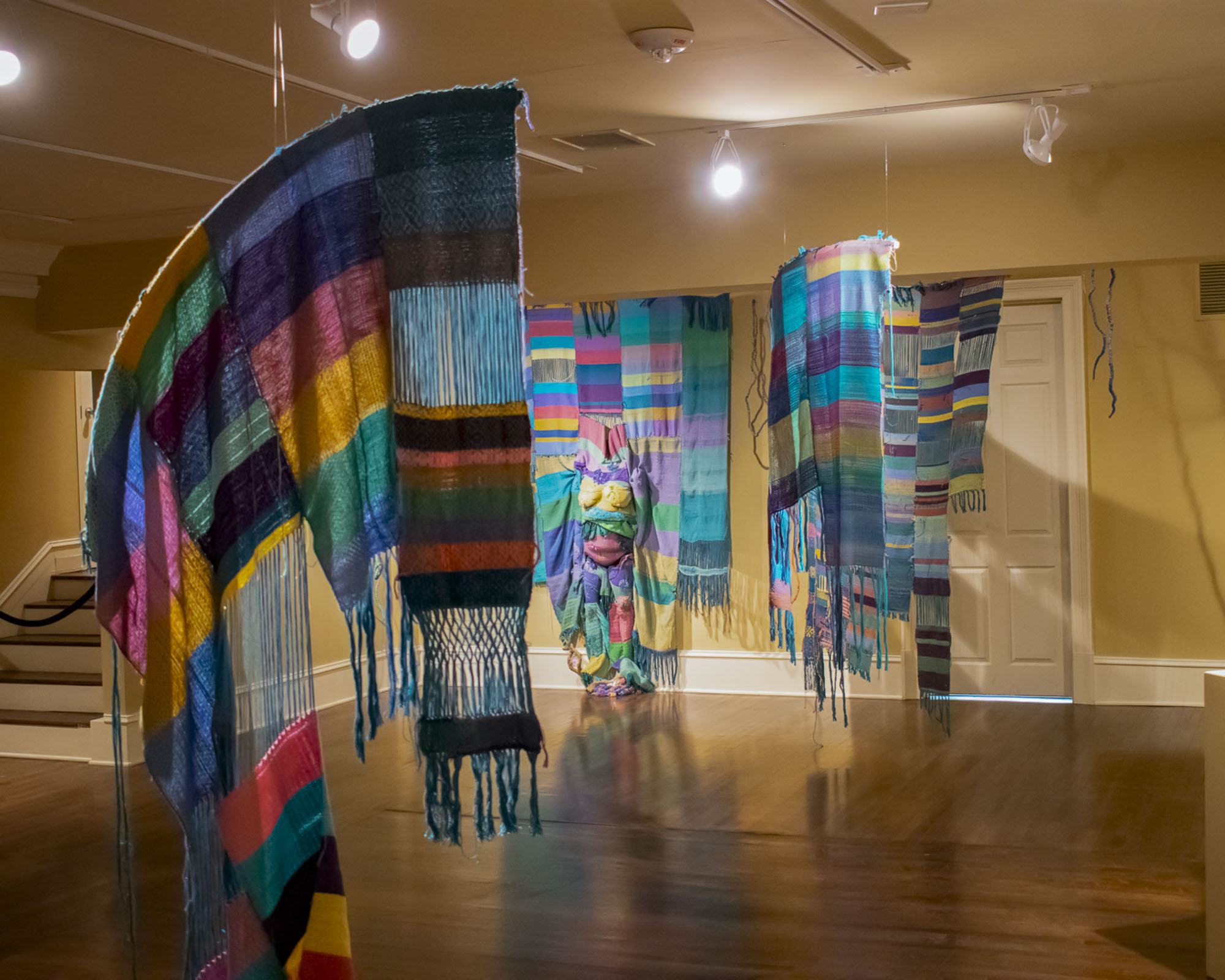
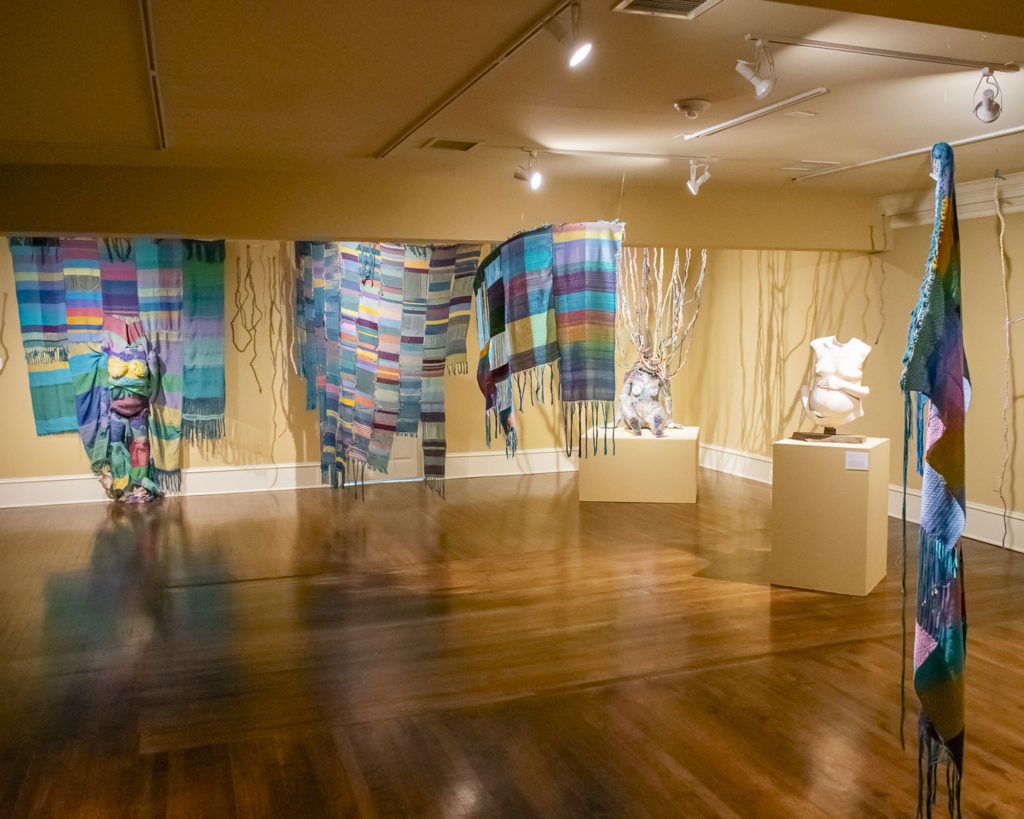
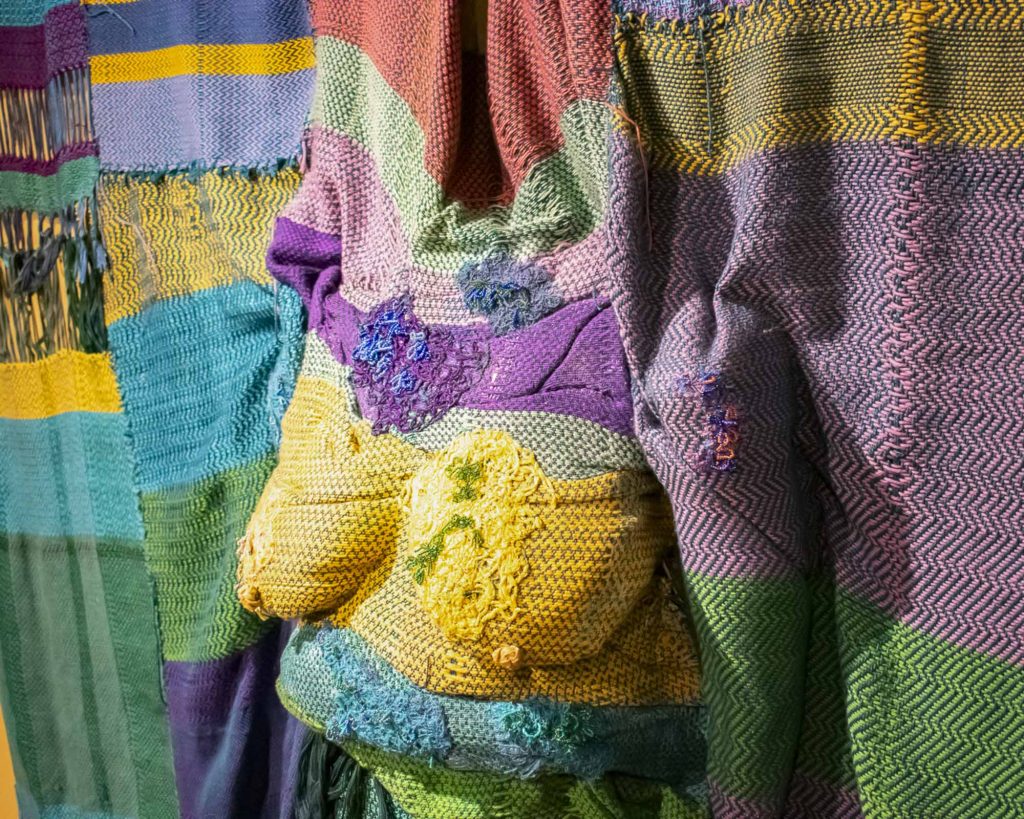
This is especially true of the left gallery, where an installation of woven sculptural shapes hangs from the ceiling, a figure protrudes from a wall-mounted piece and ceramic elements drape in front of threaded outlines, lit from above. The room is anchored by a large-scale work titled The Veil, which functions as a mood-setter for the entire space without becoming the whole story. Distributed in pieces across the gallery, The Veil is as much an orientational concept for the installation as it is a discrete “work” of art.
By focusing closely on overall atmosphere rather than individual items, Self affords viewers the ability to engage the works both in isolation and as a collection. It is possible to pick any single piece and examine its particulars without exiting the immersive metaphysical mood.
This is achieved, in part, by allowing the shadows of the objects to make their own mark. The world building here is not executed by filling the room to the brim with fabric; it emerges through the interplay of light and form, such that every surface of the gallery is covered in the artist’s work — with much of it not occupying physical space. The effect is ethereal and enveloping without suffocating or limiting the viewer’s motion.
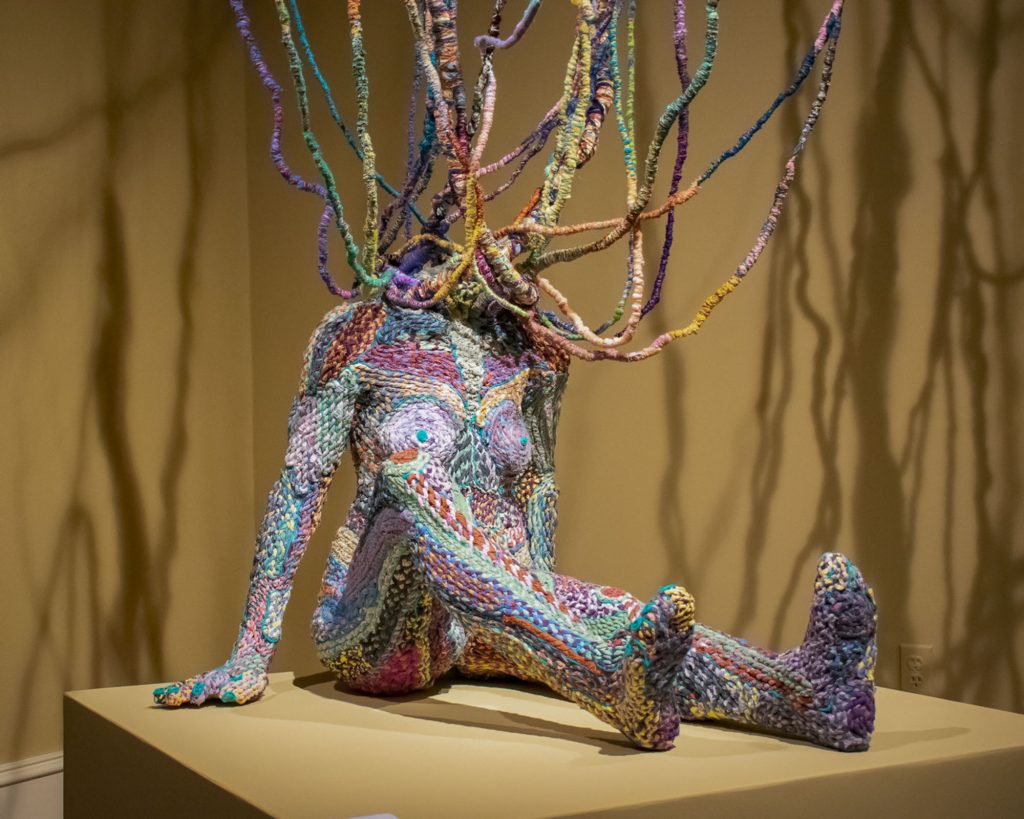
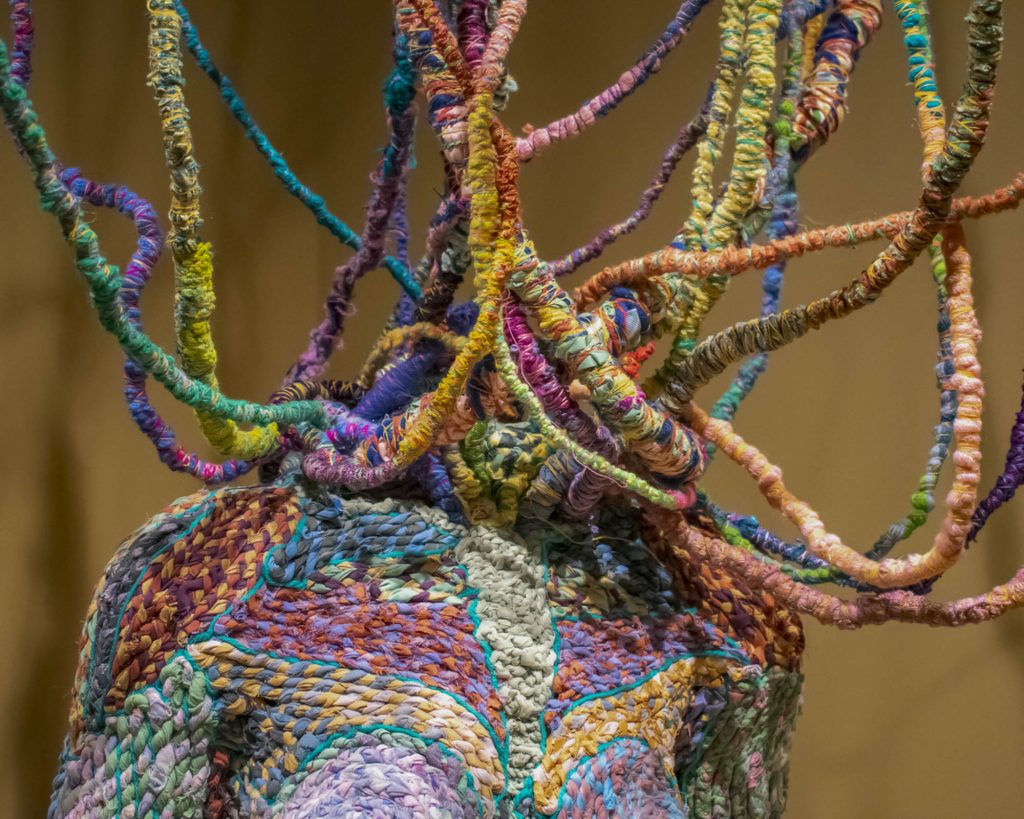
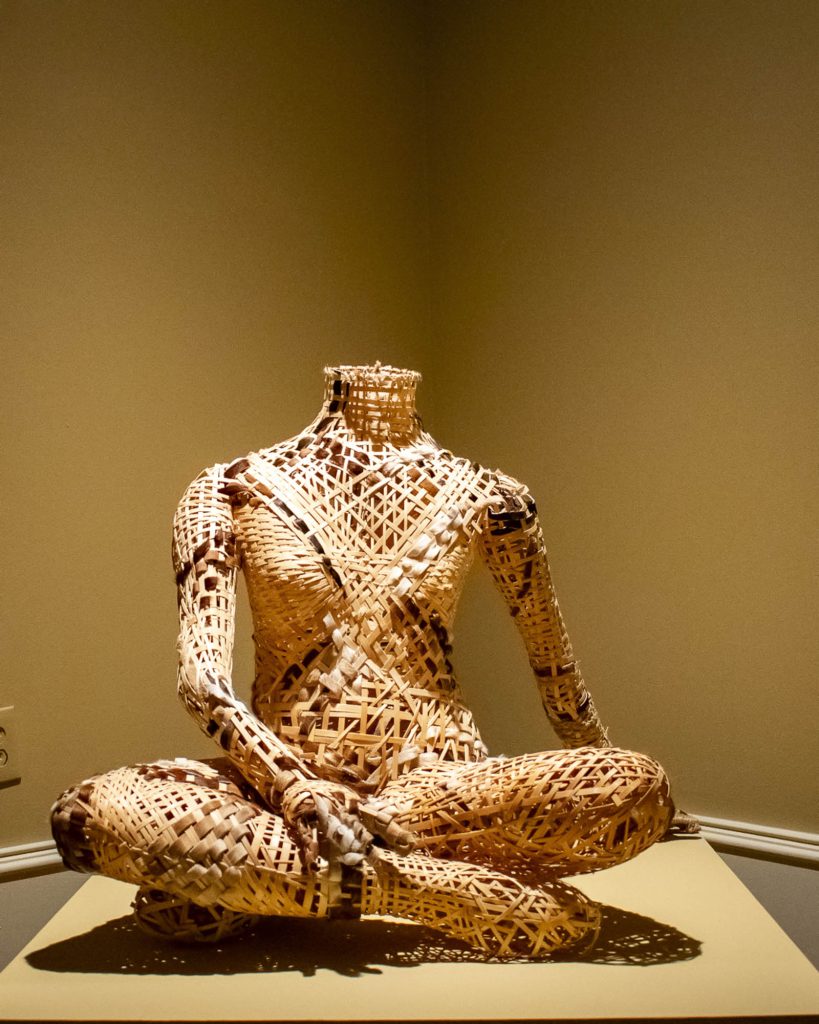
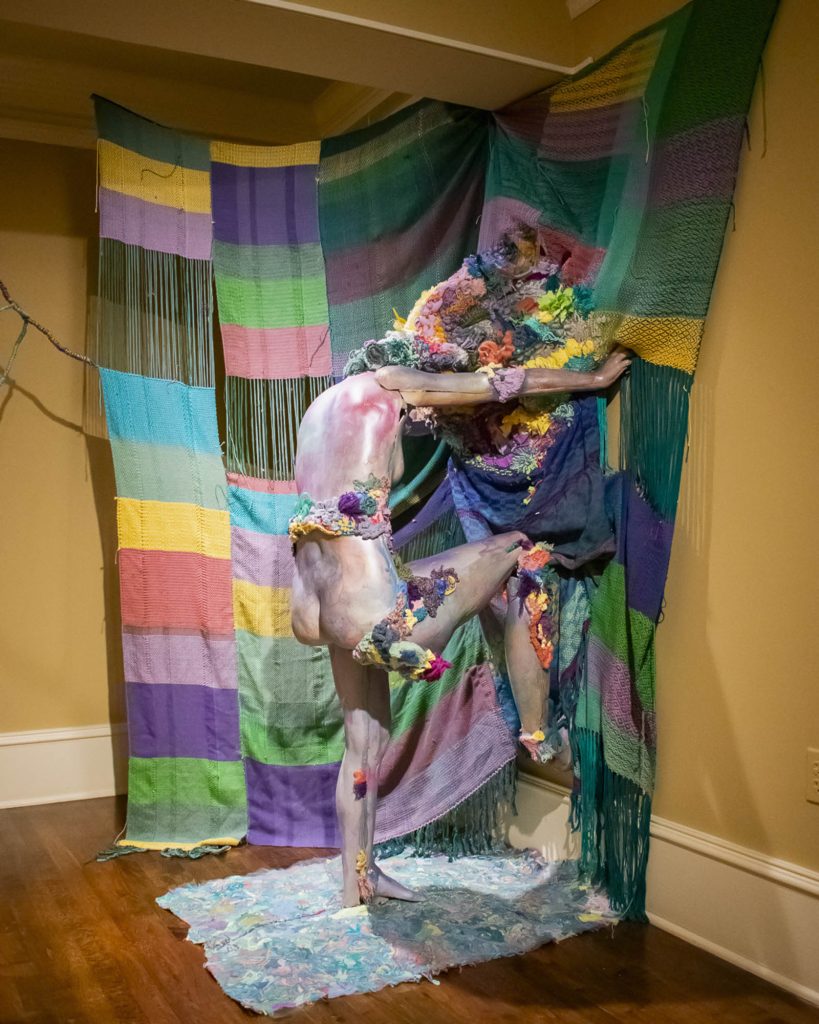
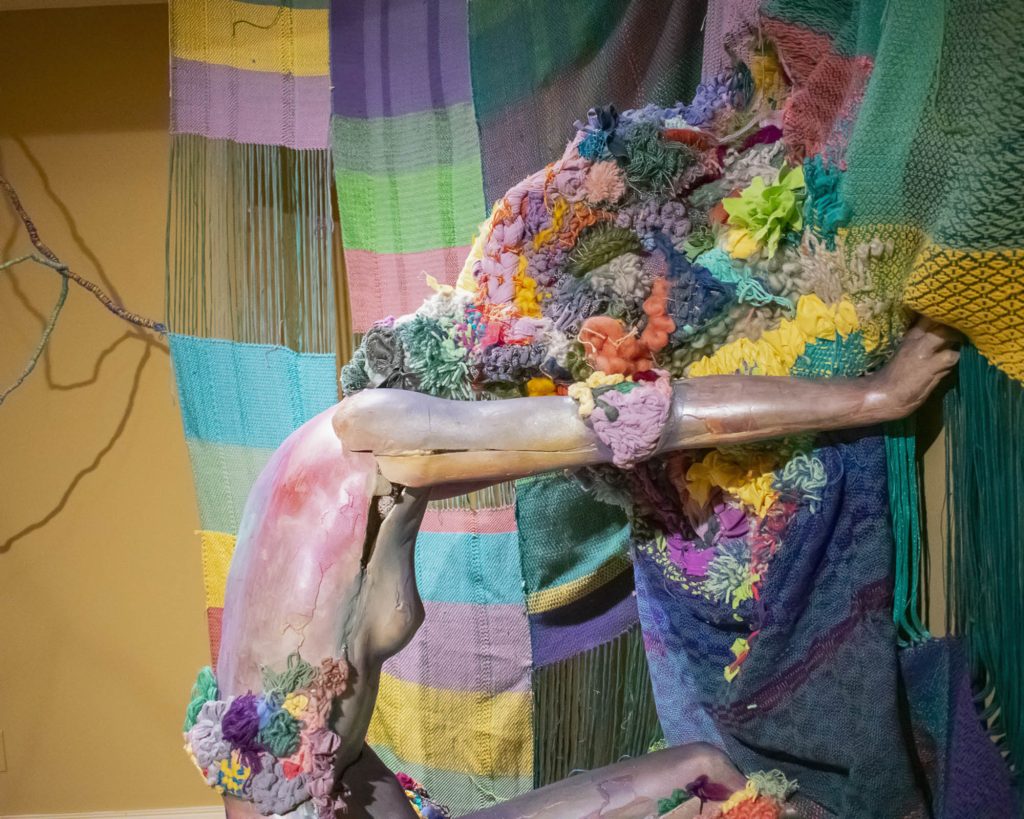
The most immediately arresting work in the left gallery is The Sutratman (The Thread Spirit), a seated figure rendered in mixed fiber and rope that extends upward into the ceiling as though connected to a dimension beyond the gallery. It provides clear connective tissue for uniting the visual elements on the floor and ceiling. The powerful work appears on the exhibition’s promotional materials for good reason.
But, arguably, the most compelling work of all is She Who Ties Magic Knots, a resin and plaster cast of the artist’s pregnant torso. The cast itself is exquisite: Individual pores and hair follicles offer a detailed and dimensional surface that evidences real technical precision.

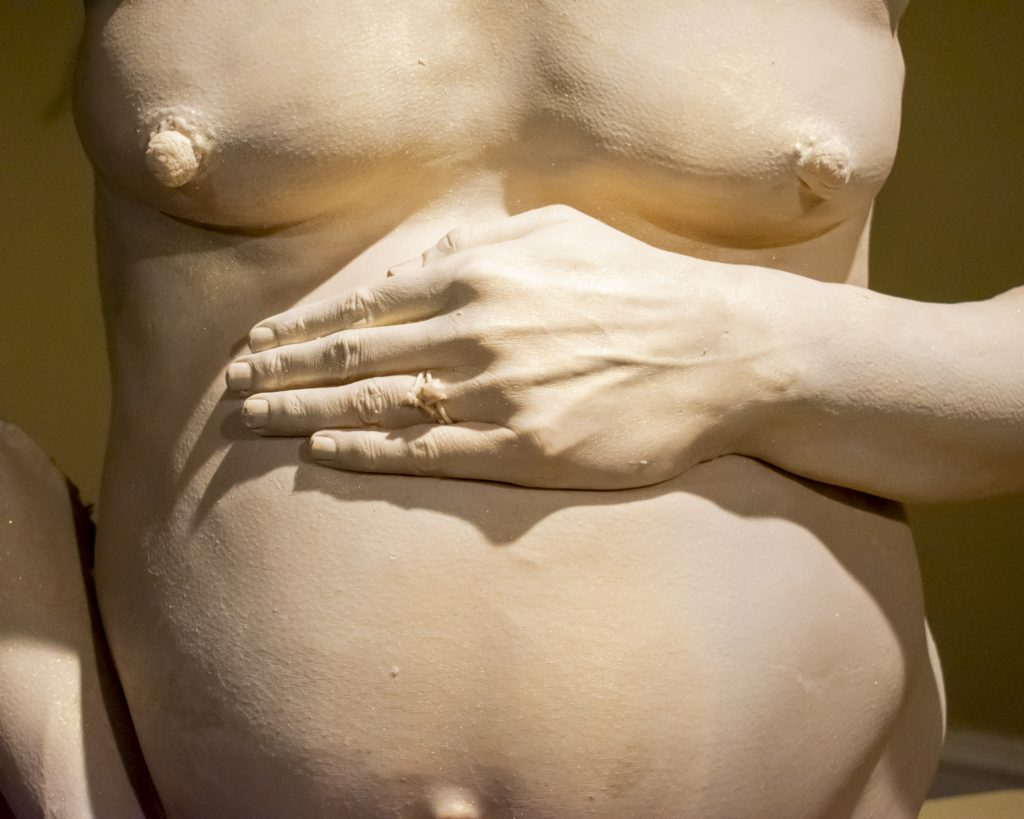

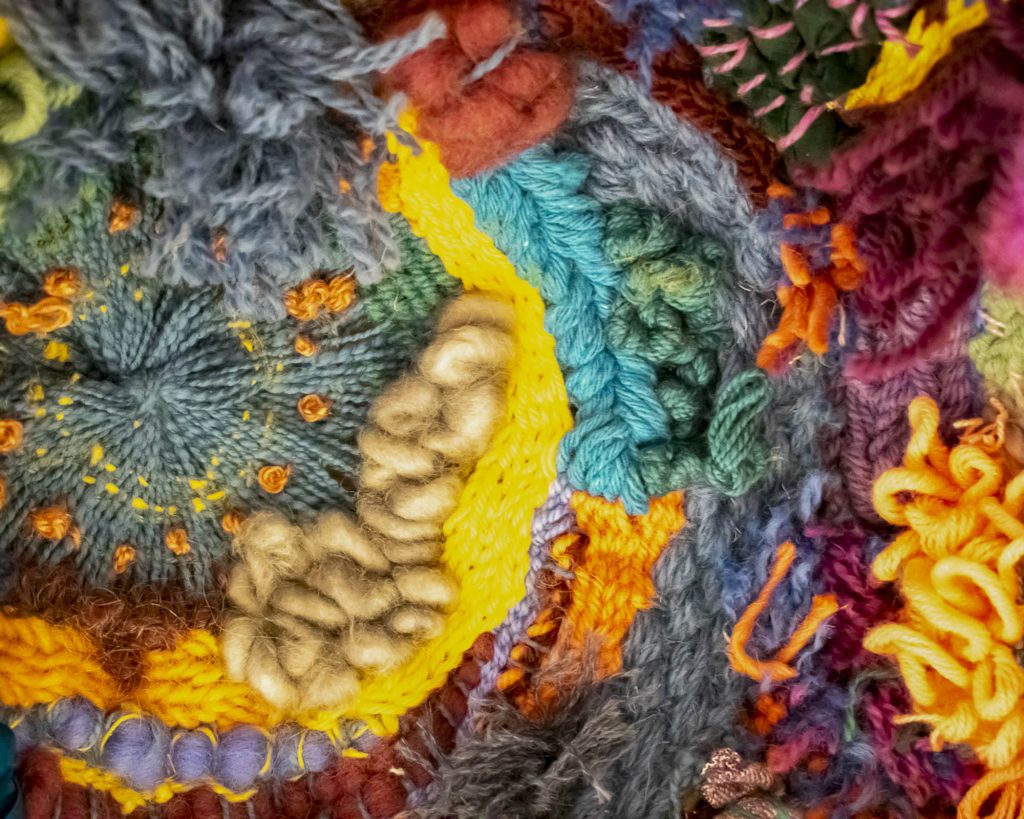
Likewise, the work’s concave interior adds to the piece’s sophistication. Mixed textiles fill the back of the sculpture with seemingly endless layers of texture, color and depth. That one might wish the piece were displayed in reverse, or at least lit from behind, is both an opportunity for critique and a testament to the work’s success. Body casting is well-worn territory, yet Self’s treatment here is genuinely fresh. Sometimes a small, compelling improvement on a familiar motif is more exciting than spectacle.
The right gallery contains individual works of considerable analytical depth. In Untitled Mother, paracord visible at the knee reveals genuine precarity and tension holding the form together. Anito, when viewed at the level of the figure’s bent body, reveals directed light passing through found mesh, creating an airiness invisible from the outside and a hidden delicacy that rewards close looking.
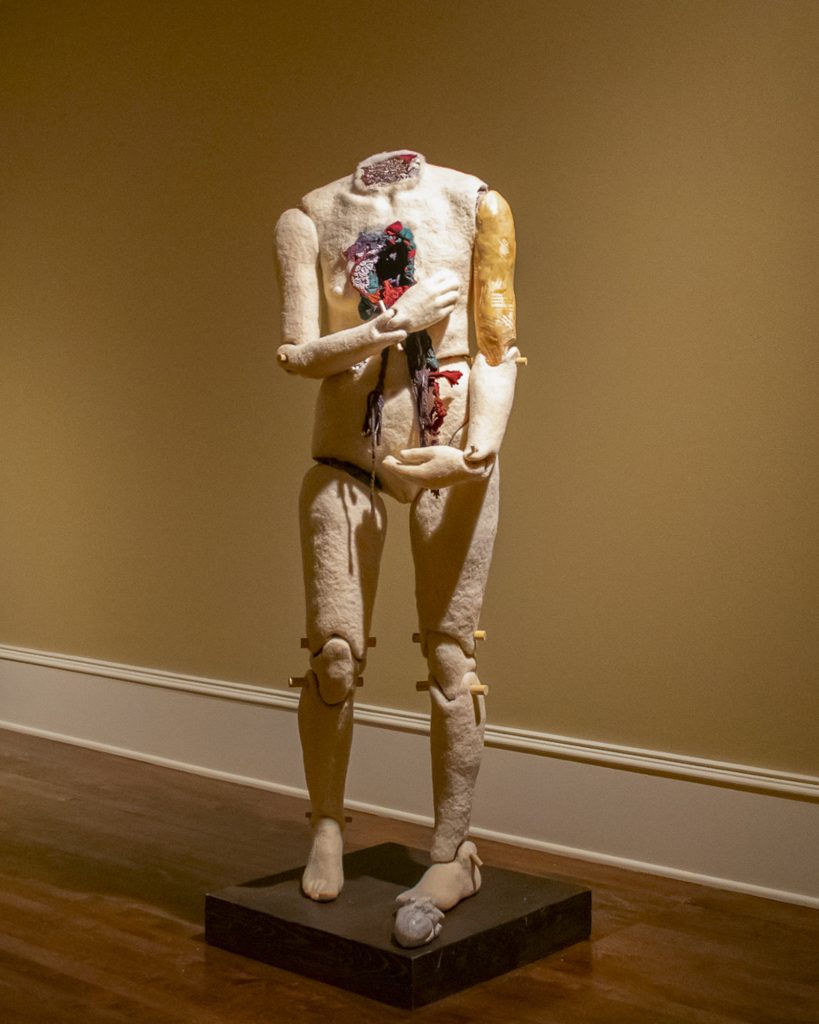
Container weaves fur into bamboo with a textural contrast that preserves the earthiness and warmth of the bamboo. Across the room, Twoness, a human-scale body rendered in felted wool, evidences an extraordinarily laborious process and produces a tactile density that practically demands to be touched (But please do not touch the art.). Piece by piece, the technical skill in this space is unimpeachable.


And yet the disjointness between the two galleries creates an unintended dynamic. The viewer is invited, almost structurally, to weigh which space is more successful. This is unfortunate, because you could make the case for either.
The left gallery is immersive, visceral and emotionally immediate, clearly a single artist executing an installation. The right gallery, for all its individual excellence, reads closer to a group show about bodies. It lacks a focal point, the arrangement leaves a conspicuous gap on the back wall and there is not enough color contrast to generate visual dynamism as a unit.
For these reasons, I found the left gallery to be the more exceptional space, but another viewer could legitimately argue the opposite based on the sheer depth of the individual pieces on the right. The issue is not that one room is weak, but rather that the dichotomy presents itself as an invitation to choose a favorite when both are genuinely good.
A smaller but less forgivable criticism is found in the series of tufted rug pieces placed on the floor before the mezzanine galleries, unlabeled and in a different palette from the rest of the work. The artist’s impulse to include these pieces is understandable; MCMA’s architecture makes it non-obvious where the upstairs galleries are, and the pieces may be intended to guide viewers into the space — but they read as a moment of self-consciousness that the show does not need.

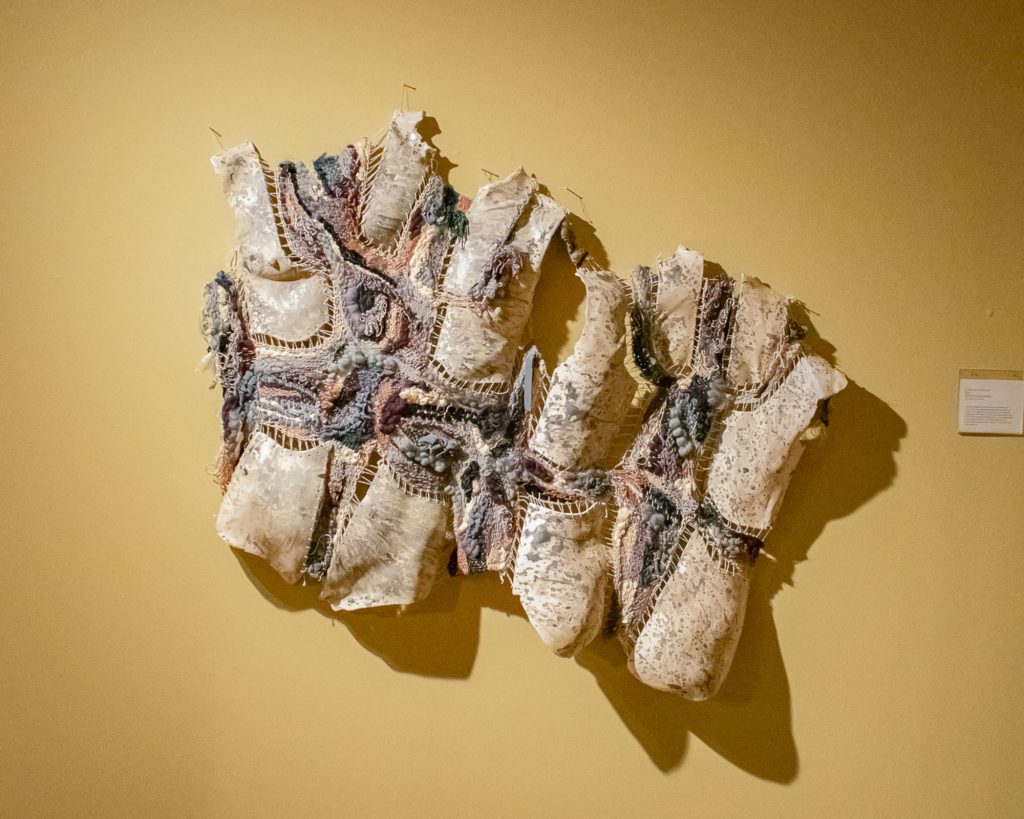
Celestial Perspectives ultimately offers two distinct modes of encounter. The left gallery transports the viewer to a metaphysical realm and operates as a unified whole. The right gallery rewards the analytical eye, offering individual pieces of exceptional depth that can be closely read on their own terms. That both modes are present and both are genuinely successful speaks to the range of Self’s practice, even if the exhibition would benefit from a more cohesive bridge between them.
MCMA curator Madeline Beck deserves immense credit for bringing a forward-looking and conceptually-rich exhibition to an institution that does not necessarily demand such contemporary work. The safety of a more conservative exhibition could have been justified, and here Beck’s courage is rewarded. Celestial Perspectives is an exceptional exhibition, and it stands to attract viewers from all corners of the Atlanta Metro area to Marietta.
Celestial Perspectives by Jess Self is on view at the Marietta Cobb Museum of Art through June 21.
::

Dr. Kevin M. Storer is a multidisciplinary computing researcher living, working and collecting art in Atlanta. His approach to art criticism and collecting prioritizes the discursive power of artistic practice over purely aesthetic qualities. This perspective is informed by his internationally-awarded scholarship on the complex relationships between people and the objects we create — especially as they shape our identities and social realities. Kevin earned his Ph.D. in informatics from the University of California, Irvine.
STAY UP TO DATE ON ALL THINGS ArtsATL
Subscribe to our free weekly e-newsletter.

PLEASE SUPPORT ARTSATL
Your Gift Sustains the Coverage You Count On!
Related Posts