

‘Who gets to dance?: choreographer Ashlee Jo Ramsey-Borunov responds
Racism, colonialism and moral superiority shape the physical athletic ideal in Western dance, Ramsey-Borunov says. Her work Disform challenges the concept of an ideal body for dance; it will be presented as part of Beacon Dance’s program at The B-Complex April 4 through April 6.
::
Contemporary American dance artist Liz Lerman famously and persistently poses the question, “Who gets to dance?” Atlanta choreographer Ashlee Jo Ramsey-Borunov explores potential answers in her piece, Disform, for Beacon Dance’s Moving Bodies/Moving Hearts/Moving Minds III, April 4 through April 6 at The B-Complex.
Ramsey-Borunov said recently that, by putting certain bodies on stage and not others, dance participates in the Western, Euro-centric association of a particular form of the physical “athletic ideal,” which itself is shaped by racism and colonialism, with a kind of moral superiority. Disform, she added, seeks to counter the contemporary wellness industry’s emphasis on the role of personal choice as a factor in physical and mental well-being by highlighting salient socio-economic factors such as race, geography and household income.
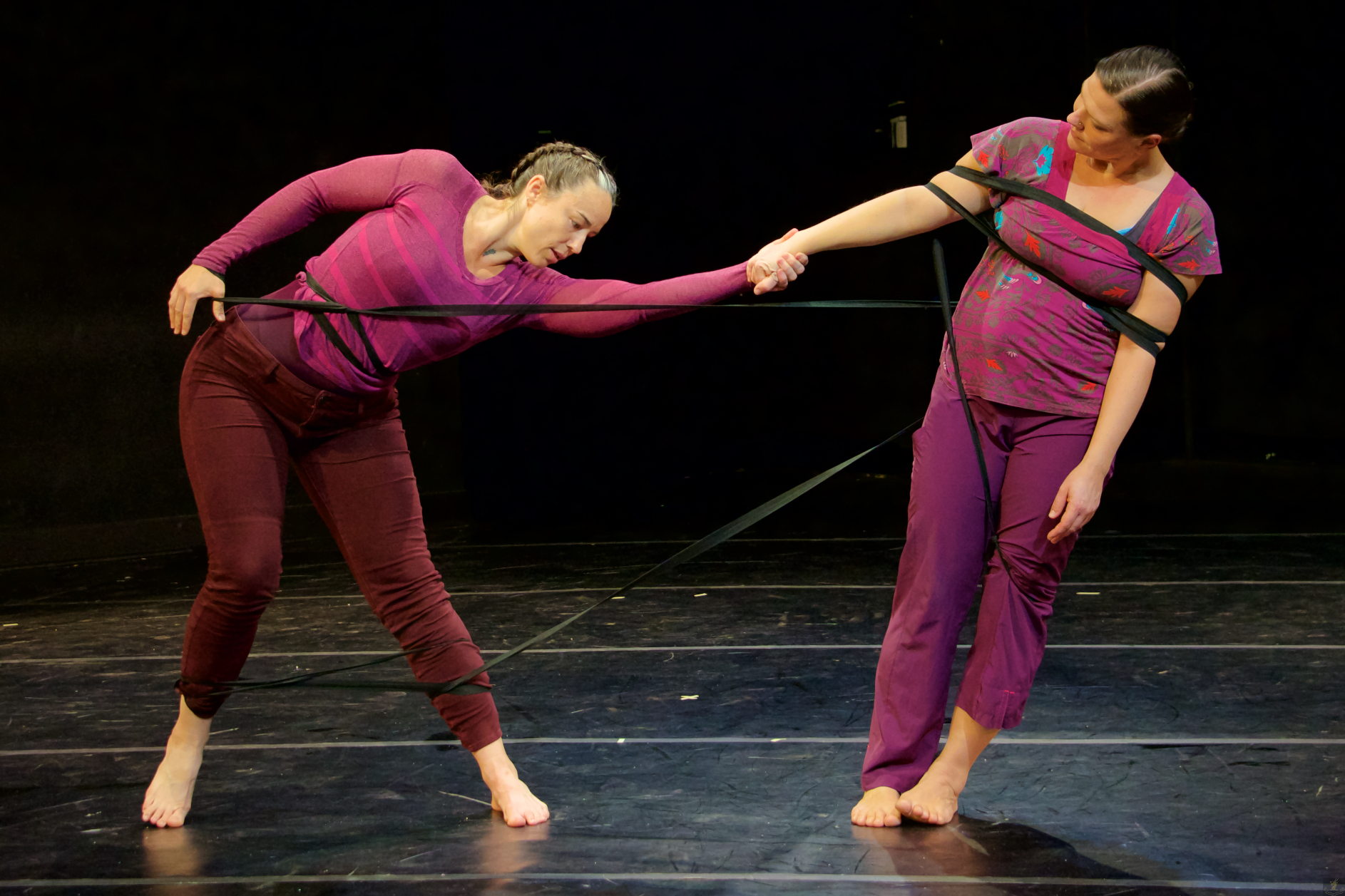
Disform also challenges some of our implicit cultural assumptions about what “healthy” bodies look like and how they move, in part by attempting to embody what “failure” to conform to certain aesthetics or meet a measure of performance looks like.
Ramsey-Borunov cited the work of writers Aubrey Gordon, Sabrina Strings and Christy Harrison, and, like them, she is engaged in critiquing the elevation of White, young, thin, (often) male, cis-gender, temporarily-abled bodies as both physically and morally superior.
Ultimately, however, she said Disform is about imagining another possible world in which aging, injury and exhaustion, for example, are seen not as failures but as opportunities to ask for and receive support from the community.
“To put this idea into movement for Disform,” said Ramsey-Borunov, “the dancers and I created a scale of different effort levels, one through 10.”
Level one might be very gestural, a hand wave or pedestrian walk. Level 10 is all-out athletic exertion. During the piece, a disembodied voice calls out the effort levels, and the dancers adjust their movement accordingly. “And then level 10 repeats over and over, and the dancers are all-out killing themselves, at which point, when the voice calls out ‘fail,’ failure looks a lot like relief.”
In addition to Disform, the program for this third iteration of Moving Bodies/Moving Hearts/Moving Minds includes four other pieces, one each by Atlanta-based emerging choreographers AK Bayer, Leah Behm and Madison Lee and another, Corpus Elementus, by Beacon Dance Administrative and Artistic Director D. Patton White.
White described Corpus Elementus as a “pseudo-nostalgic mashup” of the music that inspired When Monsieur met Madame, an early work from 1989-90, along with material from his ongoing Elemental Project, in which he draws inspiration from the four elements of water, earth, fire and air.
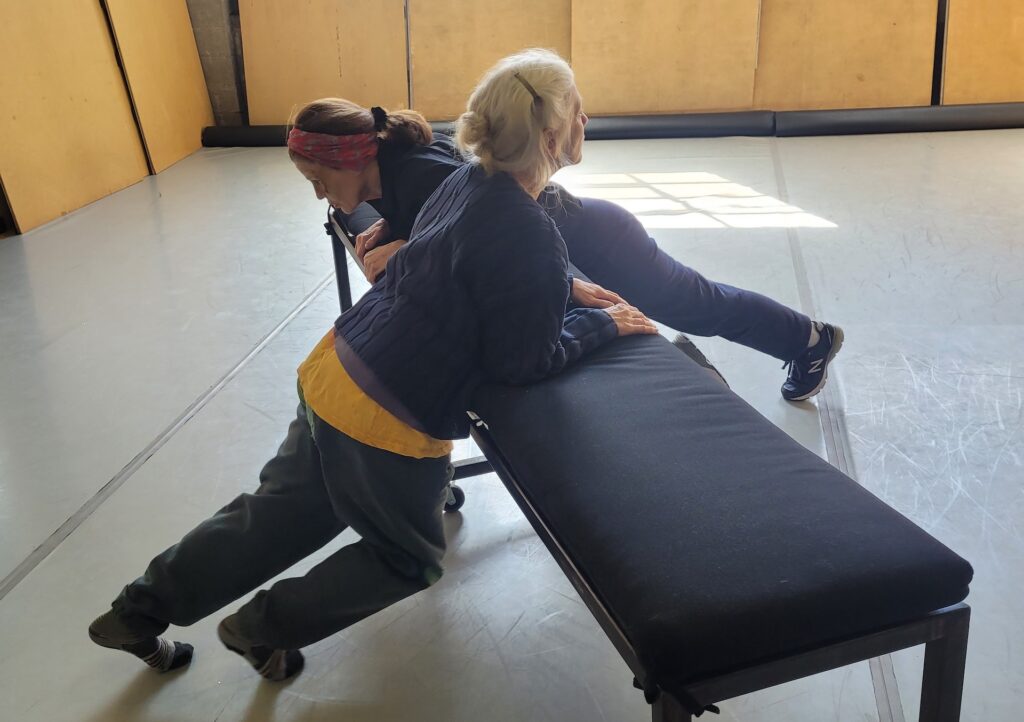
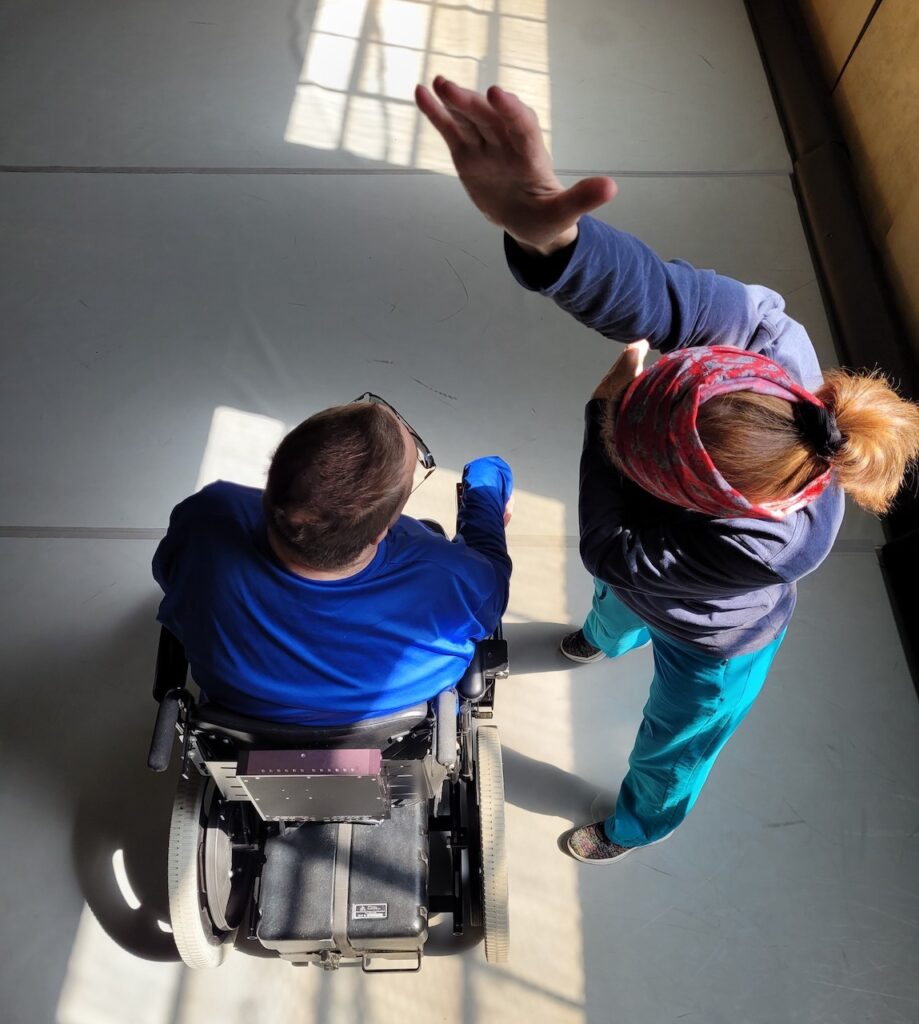
Set to music from Enya’s 1988 album, Watermark, Corpus Elementus will feature two dancers who are wheelchair users and two dancers who are over 70. Social and environmental justice are at the heart of Beacon Dance’s mission, and, for White, the form of Corpus Elementus “becomes the social justice work,” offering White’s own response to Lerman’s questions.
White said the annual performance series, Moving Bodies/Moving Hearts/Moving Minds, also updates an idea from the past to respond to the current moment.
“Beacon Dance began by presenting repertory concerts of multiple shorter dances and only later shifted to programs featuring one evening-length piece of 50 to 60 minutes,” White explained. “The pandemic was in some ways a reset opportunity for returning to and re-imagining the repertory concert as a ‘disruption’ of that practice.”
Beacon Dance still comprises a troupe of company regulars who take class and perform together. It has, however, also embraced a theater model in which the company produces the work of independent choreographers who select the dancers with whom they want to work. He said, “Moving Bodies/Moving Hearts/Moving Minds is like a mini play festival, but it’s dance.”
In this way, White said, Beacon Dance addresses the lack of local support for Atlanta-based emerging and mid-career choreographers.
“Many artists at that stage of their career in Atlanta are independent — they’re not associated with a company — and are working on bare bones,” he said. “They are often not getting paid themselves for what they are doing, and the dancers they engage to create work are doing it as a labor of love, rather than out of any expectation of being fairly compensated.”
Moving Bodies/Moving Hearts/Moving Minds receives funding from Fulton County and the city of Atlanta Mayor’s Office of Cultural Affairs, as well as from the Georgia Council for the Arts (which itself is funded largely by the National Endowment for the Arts).
Based on conversations with participating artists, White said the commission Beacon Dance offers — along with rehearsal space and the performance venue and underwriting — is significantly more than what many of them would typically receive from other funding sources.
“For many of these artists, this is one of the first opportunities they may have had to pay themselves and their dancers a fair wage for the art they are creating” White said. While the artists are paid, the performances are free to the public.
For Ramsey-Borunov, the resources from Beacon Dance come at a crucial time. Disform emerged last summer as she was transitioning away from performing, primarily with Full Radius Dance since moving to Atlanta in 2019, to choreographing and directing. She staged an earlier version of the work in October’s Fall for Fall festival.
“My own struggles with being an aging dancer, dealing with injuries and embracing radical fat acceptance are mirrored in the research questions and creative process of Disform,” she said. By supporting the development of Disform, Moving Bodies/Moving Hearts/Moving Minds has allowed her to envision the next stage of her career and network with fellow artists and collaborators.
Where & When
Beacon Dance’s Moving Bodies/Moving Hearts/Moving Minds III will be presented at The B-Complex April 4-6. Admission is free. 1272 Murphy Avenue SW, Atlanta, GA 30310.
::

Robin Wharton studied dance at the School of American Ballet and the Pacific Northwest Ballet School. As an undergraduate at Tulane University in New Orleans, she was a member of the Newcomb Dance Company. In addition to a bachelor of arts in English from Tulane, Robin holds a law degree and a Ph.D. in English, both from the University of Georgia.
STAY UP TO DATE ON ALL THINGS ArtsATL
Subscribe to our free weekly e-newsletter.

