

‘Tomorrow mourning’ explores modern grief and impermanence at Hambidge Hive
Hambidge Hive — an experimental pop-up gallery extension of the Hambidge Center for Creative Arts & Sciences located at Uptown Atlanta — serves as a vital incubator for emerging and mid-career talent. Today, the 30,000-square-foot industrial venue offers the setting for tomorrow mourning, the fifth exhibition to emerge from Anna Akpele’s curatorial project elsewhere. Akpele is an accomplished curator and has served as project coordinator since 2023 for local arts nonprofit Dashboard, through which immersive, site-specific arts initiatives are brought to life across metro Atlanta and beyond.
As an exhibition, tomorrow mourning represents a direct response to a contemporary climate of impermanence and modern grief, offering fractured perspectives on a collective emotional landscape. As society sprints toward an uncertain future in an increasingly volatile world, artists included in this exhibition seek to determine how we can honor the roots of our identities while existing in a constant state of evolution. The resulting collection interrogates the nuances of grief, tenderness, transformation and acceptance.
Akpele’s curation is refreshingly minimalist. The majority of the artists opt for raw materials — wood, cement, limestone and canvas — deployed within a stark emptiness that deliberately encourages interaction and physical movement. By leaving ample negative space, the gallery gives viewers an intimate choreography with each piece, inviting them to shift angles, ponder material weight and sit with underlying meaning.
One such moment of quiet arrest belongs to Makeda Lewis-Kinuthia’s Camera Obscura, (2026). Tucked beneath an unobtrusive canvas tent toward the back of the gallery, the piece creates an unexpected sanctuary dedicated to ephemerality and our powerlessness against the unpredictable fluidity of our environment. Sitting in this dark, hushed enclosure, one’s eye is forced to develop the projected image on its own time — an optical process that simply cannot be hastened. Viewers must surrender to the slowness; in exchange they are rewarded with the fragile beauty of an image that only patience and time can reveal. The image that emerges is, by its very nature, fleeting, as the time of day alters its color and intensity until eventually, as night falls, it is no more. The work is a quietly powerful and spatial extension of the film and documentary arm of Lewis-Kinuthia’s practice.
Scott Keightley also offers an evocative interpretation of the exhibition’s thematic core with Tomorrow Morning (2026). Atop three oblong limestone blocks rests a bust cast entirely out of ice, slowly melting and weeping down the porous stone. Suspended within the frozen form is a European bee-eater, caught mid-air as if still perched on a branch.
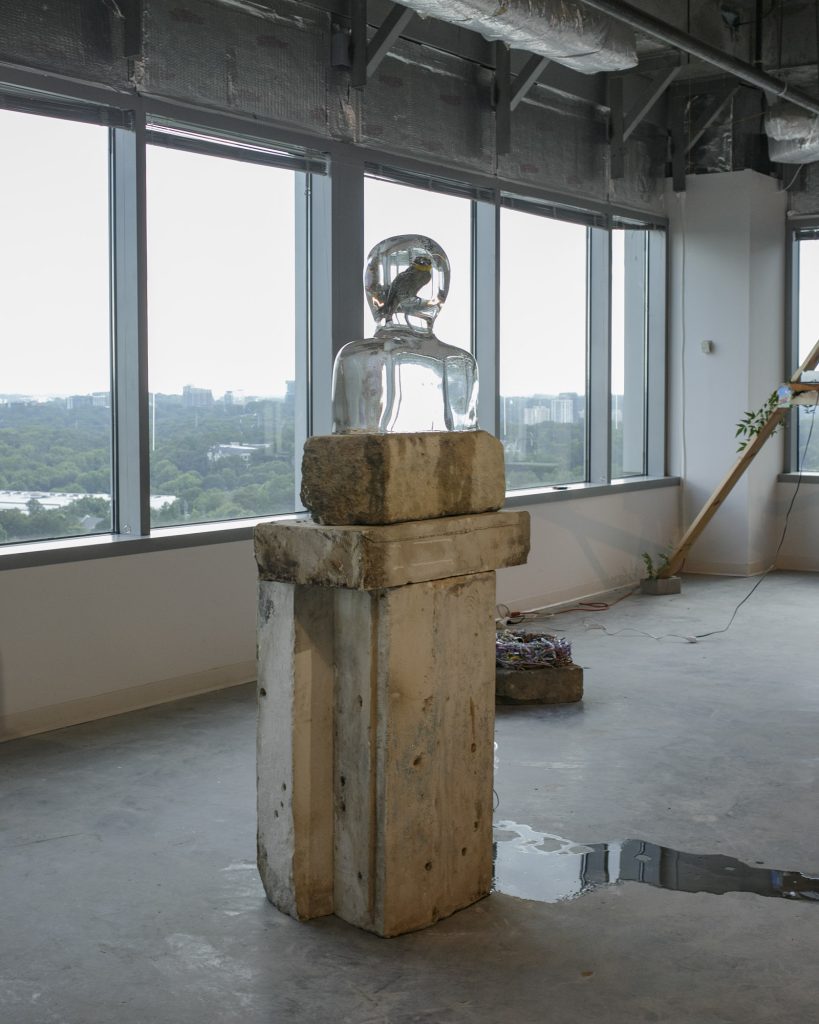
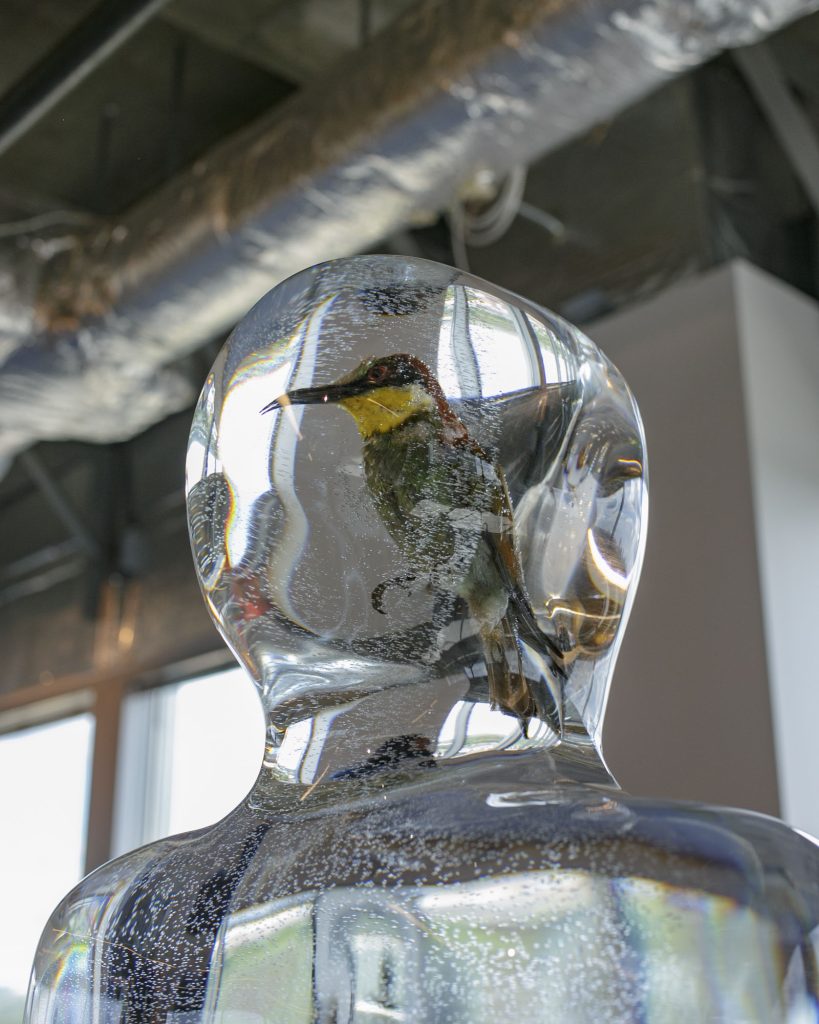

The temporality of the melting ice contrasted against the locked stillness of the bird creates a tension that perfectly embodies the anxiety of inevitable transformation. The melting ice mimics a shedding of the self; a necessary, albeit destructive, liquidation required to progress to the next phase of freedom. The bird lies in wait within the ice. Across various cultures, the European bee-eater signifies beauty, liberation and resilience. Witnessing this slow and deliberate dissolution of form reminds us that the enduring the erosion of who we were is often the only way to uncover who we are becoming.
Crafting an exhibition around such vast emotional architecture presents a distinct challenge: tackling the ambiguous nature of grief without losing structural cohesion. That struggle to extract a unified narrative rears its head in several pieces throughout the space.
Ezekiel Robinson’s Swing (2026) offers flashes of nostalgic brilliance but falls just short of communicating a clear thesis. Indicative of Robinson’s signature mixed-media builds, a heavy wooden swing structure sits anchored on cement blocks while a plastic spider’s web glistens under a spotlight at its center. The web introduces a literal, kinetic movement to the piece, physically tethered to a spinning Audio-Technica LP60x turntable. Rather than music, however, the needle emits a harsh, repetitive metal-on-metal scraping. Original illustrations are tucked into various corners of the installation and faux foliage blankets the high and low joints of the frame.
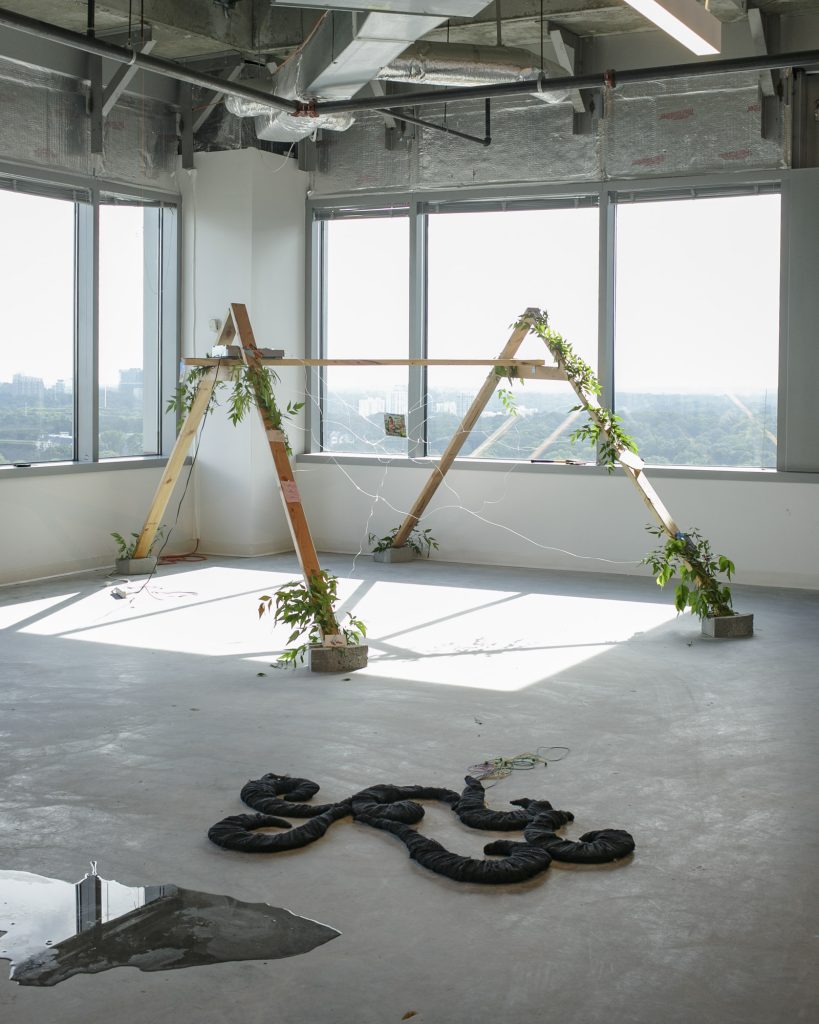
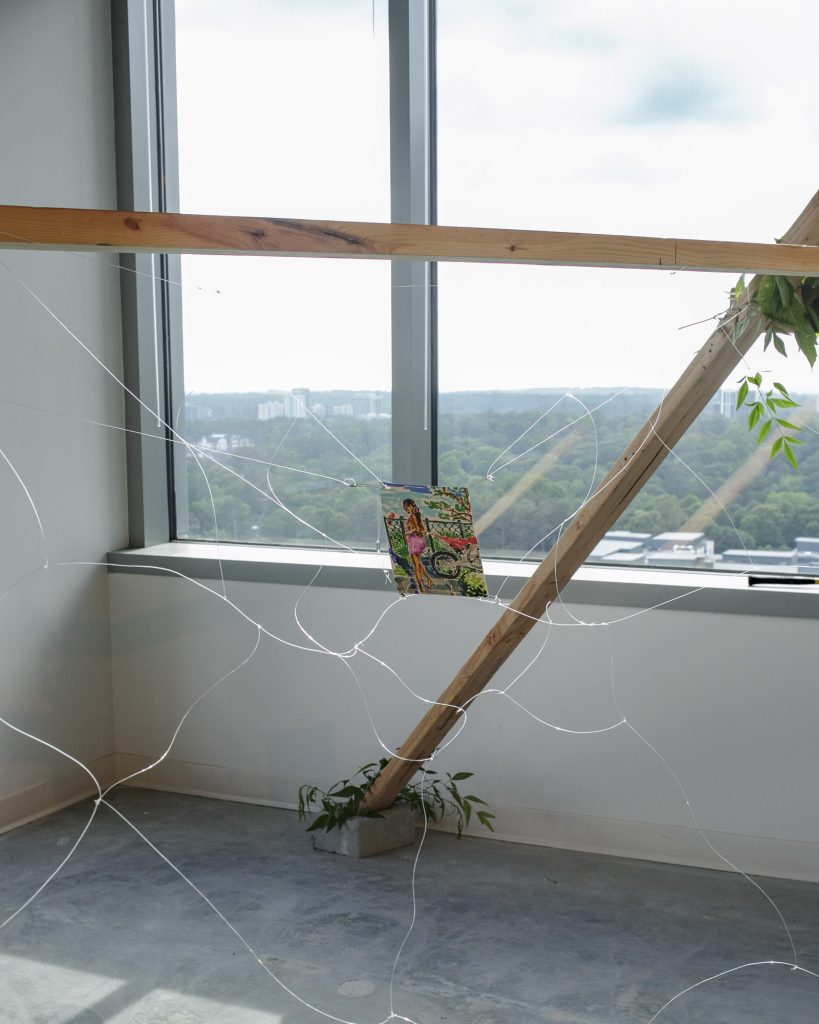
On paper, these elements — the playground swing, the vintage record player, the fragile geometry of a spider’s web rocking back and forth under the threat of its own destruction — are the ideal ingredients for a poignant meditation on memory and loss. In execution, however, the piece inspires more questions than answers. The components here struggle to converse with one another, ultimately missing the opportunity to serve a larger, singular vision.
Whirl Music (2026) by New York-based Nigerian American experimental producer Stemlines, leans even further into obscurity. Here, cheesecloth, spandex, copper, foil, PVC and tinned copper wire merge into a low-profile mass resembling a black gust of wind resting at the viewer’s feet. Where Robinson’s piece says too much, Stemlines’ contribution says too little. The installation lacks the visual vocabulary necessary to anchor it to the exhibition’s broader conversations regarding transition, grief or impermanence.
Akpele’s elsewhere has built a well-deserved reputation for presenting thought-provoking, organic and liberating spaces for artists eager to create without institutional limitations. While tomorrow mourning undoubtedly fits under that progressive creative umbrella, its frequent pockets of narrative uncertainty make the overarching concept difficult to fully grasp. The exhibition ultimately hangs in the balance: It offers just as many sobering, brilliant moments of reflection that force us to grapple with our own mortality as it does pieces that leave us scratching our heads and pulling at loose strings.
Tomorrow mourning will remain on view at Hambidge Hive through June 28.
STAY UP TO DATE ON ALL THINGS ArtsATL
Subscribe to our free weekly e-newsletter.

