
At Mason Fine Art, artists from disparate generations confront an ongoing struggle for Civil Rights in America
Legendary photographer and cinematographer John Simmons is the central focus of the exhibition It Started in the 60s, now on view at Mason Fine Art. Featuring iconic photography and collages made by the artist since the early Civil Rights era, Simmons’ work is joined by pieces from Robert ‘Bobby’ Sengstacke and Vivian Maier. Born in 1950, Simmons grew up in segregated Chicago and was introduced to photography by a friend’s older brother — Sengstacke — whose father had founded one of the oldest Black-owned publications in the United States in 1905. Simmons’ photographs were first published in The Chicago Defender when he was still a teenager.
Simmons eventually dropped out of high school but earned his diploma through a correspondence course and in the late 1960s accepted a scholarship to study at Fisk University. There, he studied under film director Carlton Moss. “I was just taking pictures for myself, right? And I had heroes that I aspired to be like . . . [including] Bobby [Sengstacke] . . . Gordon Parks, Roy D. Carava, James Van Der Zee . . . photographers that actually told stories with their cameras with a single frame . . .” said Simmons in a 2024 interview with the American Society of Cinematographers titled Turning Challenges into Art.
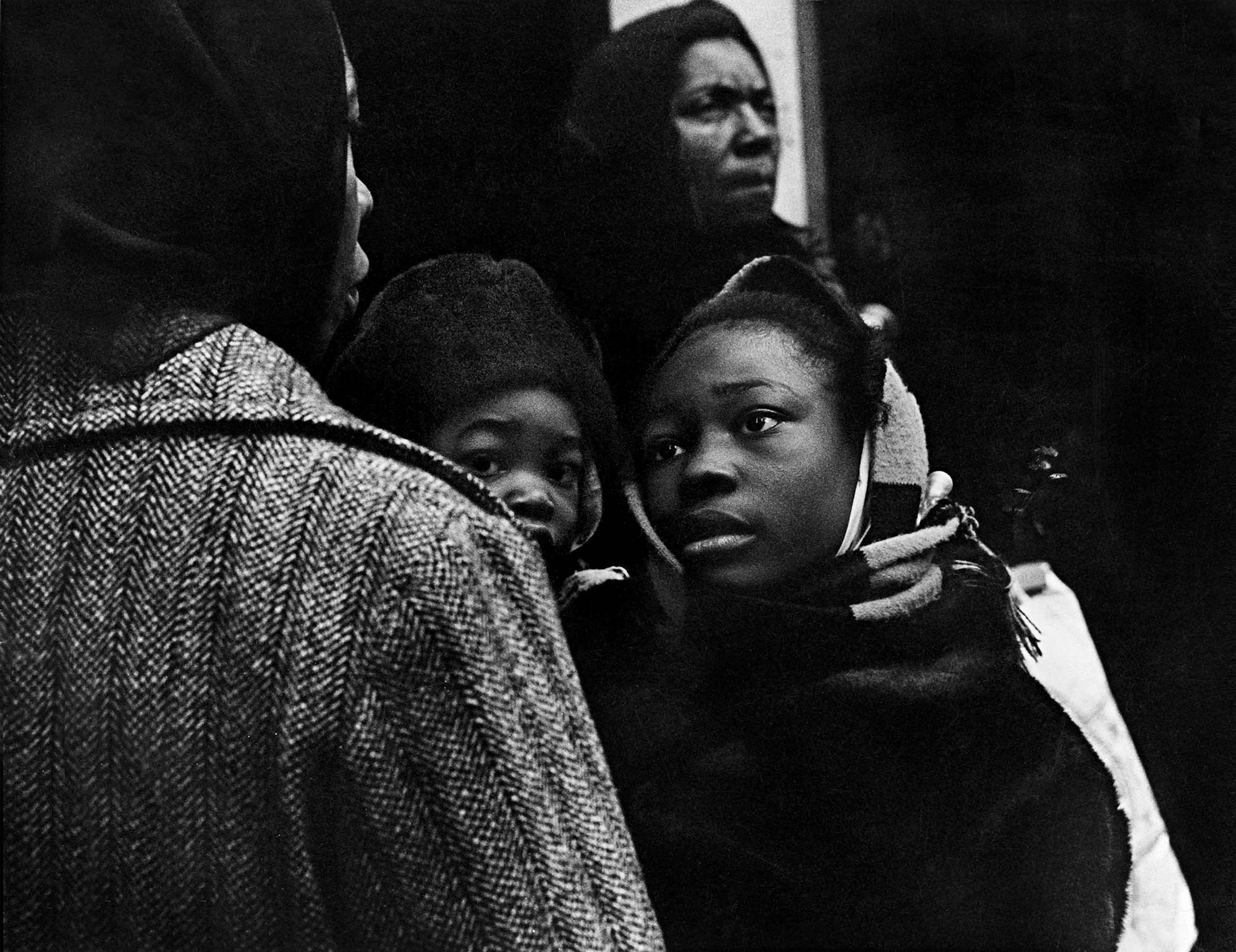
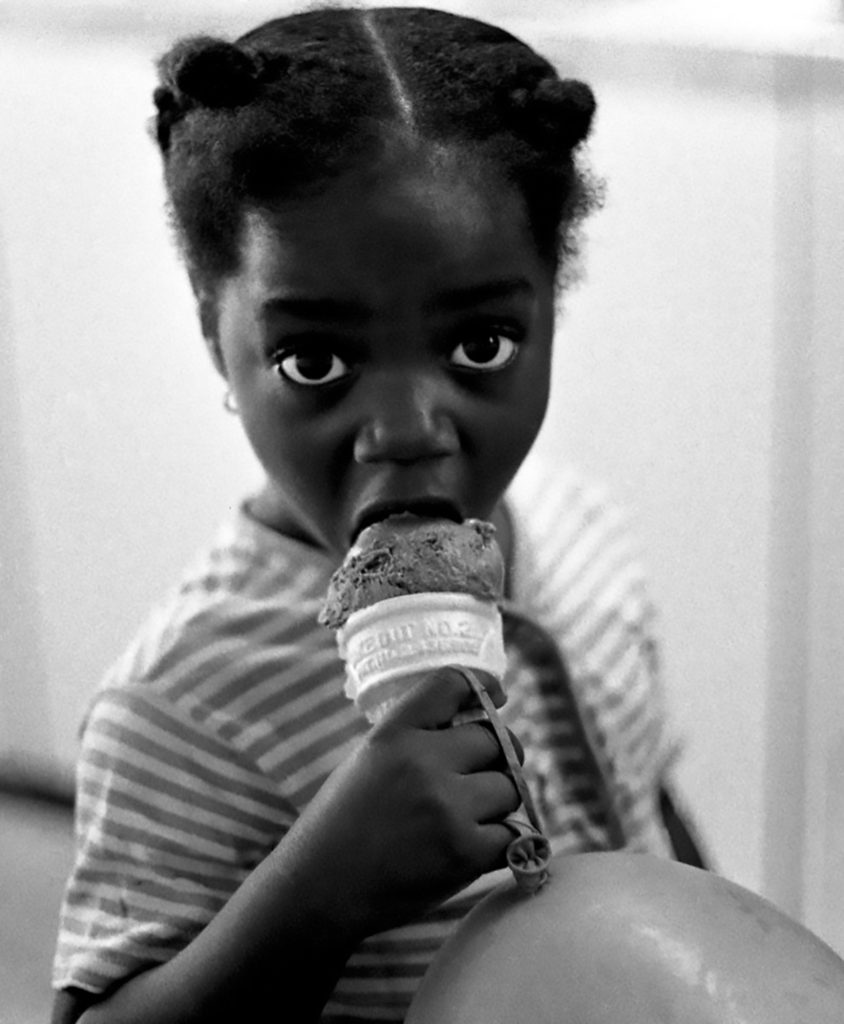
Simmons captured the images for Love on a Bus and Girl Eating Ice Cream in Chicago in 1967 before he relocated to Nashville. Both offer close-ups of Black life in segregated Chicago — the first shows a young man protectively holding a young woman at the very back of a bus, the other shows a very young girl with her hair tightly braided, staring directly at the viewer while enjoying an ice cream cone. Neither picture explicitly protests inequality or advocates for Civil Rights, but both present ordinary citizens living their lives just like any other American, despite limitations imposed by race. Nanny (1969) similarly presents a nicely dressed African American woman closely following two little white boys as they ride their tricycles across a tree-lined, suburban street. The simple yet descriptive title and the straightforward, undramatic presentation of the scene belies a story of racial privilege during the Civil Rights era.
In the American Society of Cinematographers interview, Simmons recalled something that he learned from Sengstacke about the ability of a simple photograph to communicate more than what is seen: “[the picture] may not touch everybody, but anybody that knows the history of what happened in the image feels something special . . . [if] that picture doesn’t have its own soul, if it doesn’t have what he referred to as a ‘ghost’ in it, then it’s not worth printing.”
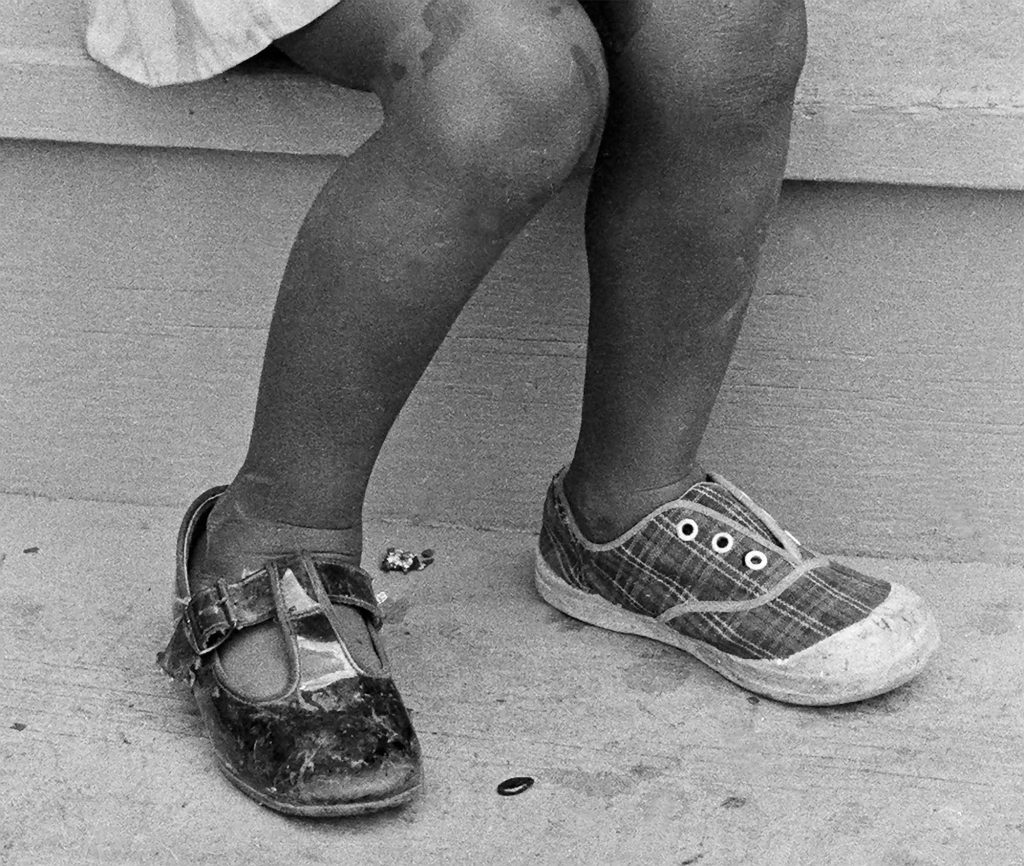
The power of the “ghost” in Simmons’ photographs can be demonstrated by a recollection from a past exhibition that included Two Shoes (1969). The unassuming photograph with its simple, descriptive title, shows a closeup of the knees and feet of a seated African American wearing mismatched shoes. A tall, white businesswoman bought the photograph, and with tears in her eyes, told Simmons that the image made her feel appreciative of and grateful for her lifelong privilege.
While his preference for black-and-white photography derives from its directness and immediacy without distractions, he later began making colorful collages in 2020. In an artist talk at Mason Fine Arts on May 30, Simmons explained that “Photography is about a moment. Collage lets me bring different moments together . . . I can put history, memory and what’s happening now in the same space.”
In Between Blue and Grey (n.d.), black-and-white images of a seated Union and Confederate soldier with a Black child on the ground in front of them and a Black man standing between them occupy the center foreground. The Great Seal of the United States pulled from the reverse side of a dollar bill, with the Eye of Providence floating above an unfinished pyramid, form a halo behind the standing man’s head.
The seal was designed to represent strength, divine guidance and the birth of a new era; here, its placement behind a Black man seems ironic, especially considering the recent rulings of the U.S. Supreme Court that nullified the Voting Rights Act and permitted state legislatures to gerrymander congressional districts to disfavor people of color.
Bread from Before (n.d.) features a photographic image of a young Black woman holding a bowl in the center foreground, with stars in the dark sky above a setting sun beyond a distant shoreline. The sun shining down on her, the colorful vista and the stars above could signify a promising future, but closer inspection reveals a bound and gagged woman’s head at her feet. It is positioned behind a fence that appears to be made from cut-out drawings that resemble historical records of bound Africans sold into slavery.
Again, the combination of imagery collected from different sources allows Simmons to bring historical moments together with the present, as he explained “sometimes putting those pieces next to each other says more than anything else.”
Elsewhere in the gallery, Shareon “Bhare” Blenman’s large canvases with swathes of bold color, graffiti-like figures, enigmatic symbols and overlaid writing confront visitors at the entrance of the exhibit. The self-taught Barbadian American’s chosen moniker “Bhare” is the Hindi/Urdu word for “full” or “filled” and a homophone of the English word “bare,” meaning “exposed” and suggesting vulnerability. This duality reflects the Gen Z artist’s ongoing questioning of his place in the world. In the artist statement on his website, he explains “… exploring ideas of identity and belonging as a Black first-generation American, I’m constantly cross-examining the complexities of identity, belonging and what it means to exist between cultures.”
Unfinished Projects (n.d.) shows a dark-skinned figure in blue jeans splayed across a textured gold background, resembling the character Neo dodging bullets in The Matrix (1999). The figure’s arms are flung wide, clutching a document labelled “N.D.A.” in his left hand while white birds perch on his head and outstretched right arm. He floats in an ambiguous space defined by an apparent corner at the far left and abruptly ended by a band of black with hand-lettered white text running across the bottom and expressing frustration with the business side of making art:
. . . IN A CYCLE OF PROJECTS THAT DON’T SEE THE LIGHT OF DAY. PLEASE SIGN THIS NDA . . . I’M READING WORDS I ONLY SLIGHTLY UNDERSTAND, ME THE PHONY BUSINESSMAN. HEY SORRY TO BE THE BEARER OF BAD NEWS, BUT WE ARE GOING TO DELAY INDEFINITELY. OH, OKAY, BACK IN THE VAULT IT GOES . . .
Stars and Spikes (n.d.) also features textured gold paint, this time in a grid-like pattern of loose circles brushed over an off-center gold rectangle, a large black trident in its center flanked by blue panels with white doodles resembling diagrams and words on a chalk board.
Like the name “Bhare,” the trident signifies multiple things in different contexts. In Greco Roman mythology, the god of the sea wields a trident to create water sources but also to cause earthquakes. As the primary weapon of the Hindu deity Shiva, the trident symbolizes the balance of destruction, preservation and rebirth.
To the left of the trident, a brown-skinned man with red horizontal stripes cradling a black-skinned figure in his arm walks gingerly to the right across a khaki-colored floor that changes from red stripes in front of the figure to a darker, vine-like pattern behind. The man holds a white form loosely resembling a tree and gazes at his limp companion whose body is covered with stars. Line drawings over traces of erased marks with scrawled words and phrases populate the blue background on either side.
For example, to the left of the figures, blue drops cross over a white bottle labeled “MAU” and an arrow points to the words “Golden Brown Elixir.” A blue wine glass, the mathematical pi symbol and a blue drawing with four cardinal points like a compass dial float just above the brown man’s pink hair. A plethora of figures and symbols alight on the blue background. Free writing adds additional layers of meaning: “A LADDER IF CLIMB FAST ENOUGH . . . THE GOAT CULTURE . . . STARS STARS I’M A STAR . . . I DREW THE FLAG FROM MEMORY I ALL I HAVE IS THE MEMORY . . .” On the Artwork Archive website, the artist explained that his paintings are visual manifestations of his own inner dialogues; “. . . complex, layered and often full of contradictions, much like the human experience itself.”
In the adjacent room, A Beautiful Legacy features prints by Lev T. Mills (1938-2021), an art professor at Spelman College for 30 years before his retirement in 2009. Although generationally far-removed from Bhare, his prints similarly engage issues of identity and belonging as an African American artist in the United States. After earning a B.A. in art education from FAMU in 1962, an MA in 1970 and later an MFA in 1972 from the University of Wisconsin, he was awarded a fellowship to attend the Slade School of Fine Art in London. He returned to settle in Atlanta in 1973.
According to a gallery text panel, Mills described himself as “constructionist,” explaining, “I create by building up ideas, tearing them down and rebuilding again until the subject matter, design and color have been integrated into a unified visual statement.” His constructionist approach to printmaking combines refined craftsmanship with socio-political content reflecting the late ’60s and early ’70s. While pursuing graduate studies at the University of Wisconsin, Mills created I… (1970) which juxtaposes textures and fragments of imagery to address the systematic police crackdowns on the Black Panther movement specifically and the struggles for Black liberation and Civil Rights generally.
The central image of I… is a large, serifed capital letter “I.” The top serif features the left lens of a pair of eyeglasses in front of the iris of a large eyeball with blue lids emerging from darkness. Gathered Black Panther leaders, including Amiri Baraka (aka LeRoi Jones), are reflected in the single lens. Below the eyeball, the darkness shifts to a sepia-toned stone wall that continues through the stem, where anonymous young men hang from a ladder, packed shoulder-to-shoulder. Their uniforms and generic faces strip them of individuality, just as penal systems reduce human beings to anonymous numbers.
This section can be understood as an allegory of mass incarcerations that targeted Civil Rights activists during the period. The visual image of hanging bodies also recalls the history of racially-motivated lynching and Jim Crow violence against Black bodies in the American South. At the same time, the image of the figures holding on becomes a metaphor for survival, despite the crushing weight of systemic, historical racism.
I’m Funky, But Clean (1972) reflects the cool, self-assured counter-culture lifestyle of Civil Rights activists during the 1970s. Centered in the foreground, two images of activist Stokely Carmichael in different shades of blue confidently stand in front of enlarged Black Power fists. The background is a solid dark blue-black, with a gray rectangular grid in the center. To the left of the grid is a pink eyeball that stares directly at the viewer and connects across the grid to a transparent, X-ray image of a human. The eyeball represents the all-seeing eye, which had a double meaning for Black Americans in the 1970s: It could represent heightened awareness, consciousness and clarity, which were important themes of the Black Power Movement, or signify the external surveillance and heightened scrutiny with which mainstream American culture watched and judged young Black men.
The xX-ray image of a skeletal figure strips away the funky, stylized, cool outer self to reveal the clean skeletal structure of every person’s core humanity. The cat in the upper left is the “cool cat” — representing African American slang in the ’70s for effortless style and urban sophistication — but also a symbol of resilience and independence. Finally, the burning factory at the top signifies the harsh reality of the urban landscape, where many Black Americans lived in industrial, working-class cities. Carmichael is the Black man trapped inside a rigid urban environment, where he is constantly watched but remains confident, dignified and clean.
The choice of these three artists, from different generations, for a group exhibition at Mason Fine Arts also makes a powerful statement about our continuous push for Civil Rights. This exhibition confronts the viewer with the struggles our nation has endured — and continues to endure — in the effort to realize a nation where all humans are created equal and guaranteed life, liberty and the pursuit of happiness.
It Started in the 60s will remain on view through July 25.
STAY UP TO DATE ON ALL THINGS ArtsATL
Subscribe to our free weekly e-newsletter.

