The Atlanta Opera gives Mozart’s “Don Giovanni” a distinctly film-noir edge
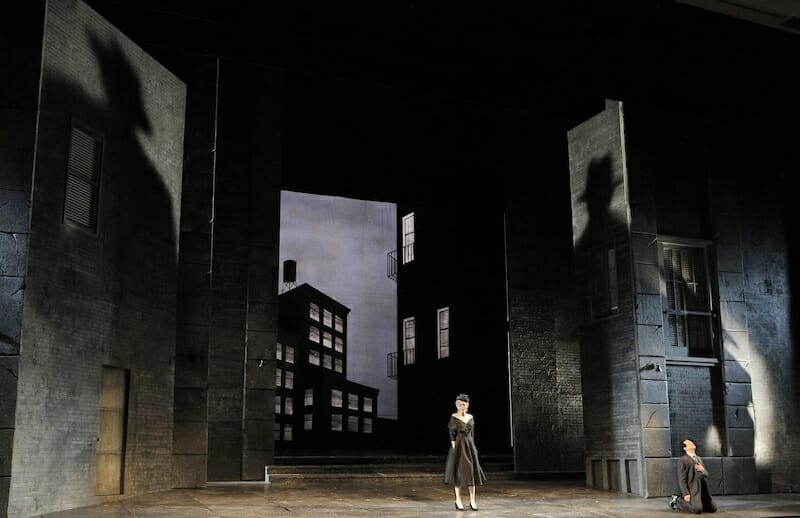
Director Kristine McIntyre makes her mainstage debut with The Atlanta Opera for Mozart’s Don Giovanni, which opens Saturday at the Cobb Energy Performing Arts Centre and runs through January 29. This version of the opera was conceived in the style of American film noir of the 1950s.
McIntyre has established herself in recent years as one of the most creative forces in the opera industry. A veteran of America’s largest houses, including San Francisco Opera and an eight-year stint on the directing staff of the Met, McIntyre has won wild acclaim in her freelance career with her uncanny ability to draw meticulously nuanced, multilayered characterizations from operatic performers.
She is also one of the relatively few directors around today who really knows how to handle large ensembles; each chorus member in a McIntyre mounting emerges as an individual being with his or her own unambiguous soul.

Born in Philadelphia and raised in San Diego, McIntyre first encountered opera at the age of 16, when she attended a dress rehearsal of Rossini’s The Barber of Seville. She immediately knew that opera was where she was headed (and that the production she was watching wasn’t very good). A director was born. She subsequently studied at Georgetown University and overseas at Oxford. McIntyre has enjoyed particular success in contemporary and 20th-century repertory, including highly celebrated productions of Benjamin Britten’s Billy Budd, Alban Berg’s Wozzeck, and Jake Heggie’s Moby-Dick.
ArtsATL recently talked to McIntyre about her take on Don Giovanni, her career and her thoughts about presenting classic opera to modern audiences.
ArtsATL: Tell us about your film-noir version of Don Giovanni. How did you arrive at this concept?
Kristine McIntyre: Giovanni is a problematic piece, and as a young woman working as an assistant director on productions of it, I was aware of feeling uncomfortable in the rehearsal hall. The women in the piece often don’t seem to have any agency, and there is always a sort of apologia about Giovanni himself. People justify his behavior in strange ways and never really deal with what he does. But if you make him completely dark — well, this is a long evening in the theater, and the audience needs to be with him.
I started to think of the notion of antiheroes, and the idea of noir popped into my head. Noir is filled with antiheroes. There is also something about the music in Giovanni, particularly his second-act serenade: It reminded me a little bit of the zither music in The Third Man.
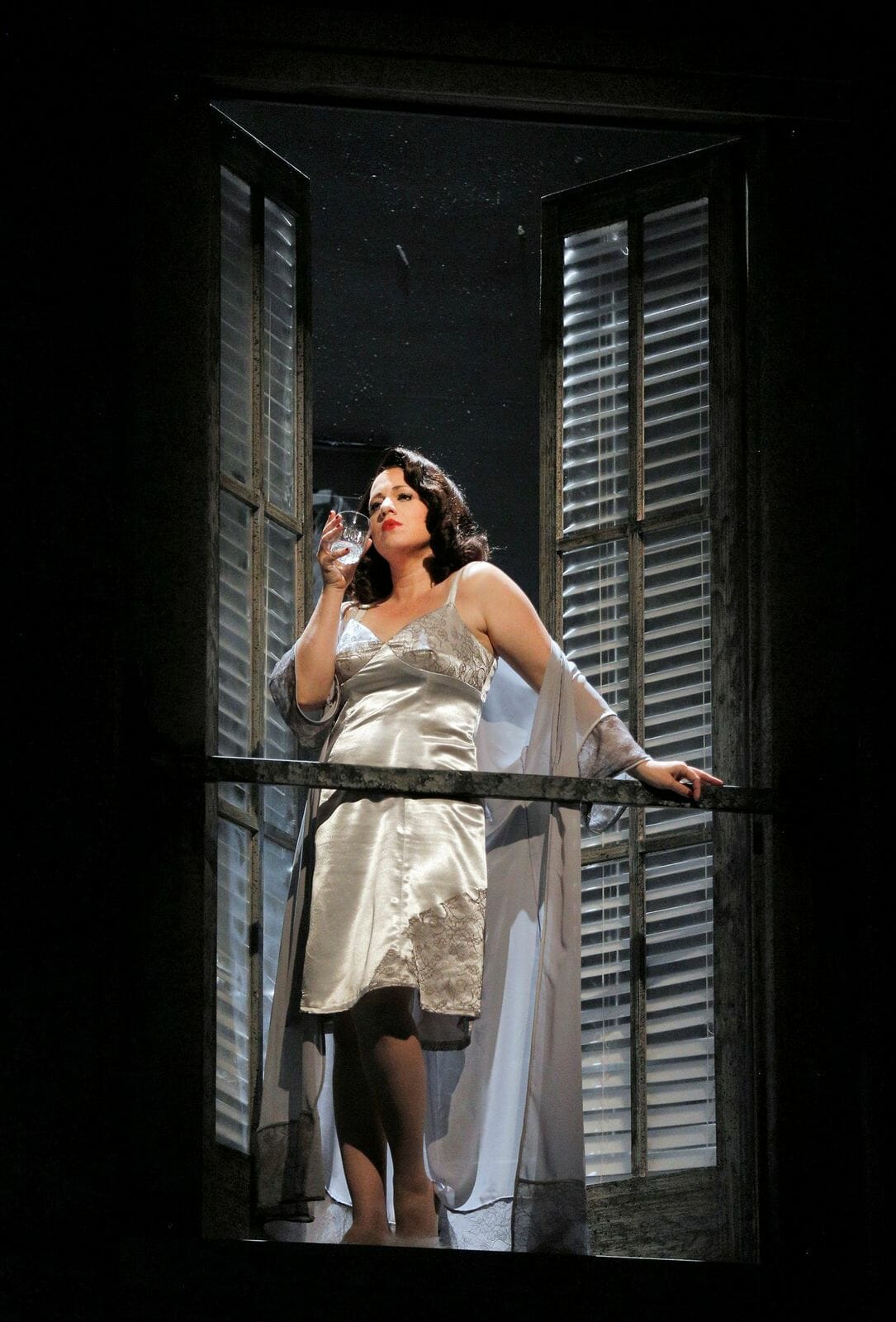
I made a sort of aural connection, and the more I explored noir, I realized that there was a wonderful correspondence there. I could set Don Giovanni in the American noir of the 1950s. I could give agency to Donna Elvira as a femme fatale who could give as good as she gets, and acts as a powerful foil to Giovanni.
Noir also often features a young couple in peril, in which the woman in that couple crosses the wake of the antihero but makes it out the other side — very much like Zerlina and Massetto. And there is often someone whose life is tragically affected by what the antihero has done. That of course is Donna Anna, what with the horrifying effect Giovanni has on her relationship with Ottavio.
ArtsATL: Taking that approach seems to open a lot of creative doors.
McIntyre: This idea allowed me to separate out the women, give them agency and still have a way to present Giovanni in an intriguing manner and give us permission to follow his story, knowing — because it’s noir — that he’s going to get it in the end. We know the last “shot” is going to be him bleeding out onstage.
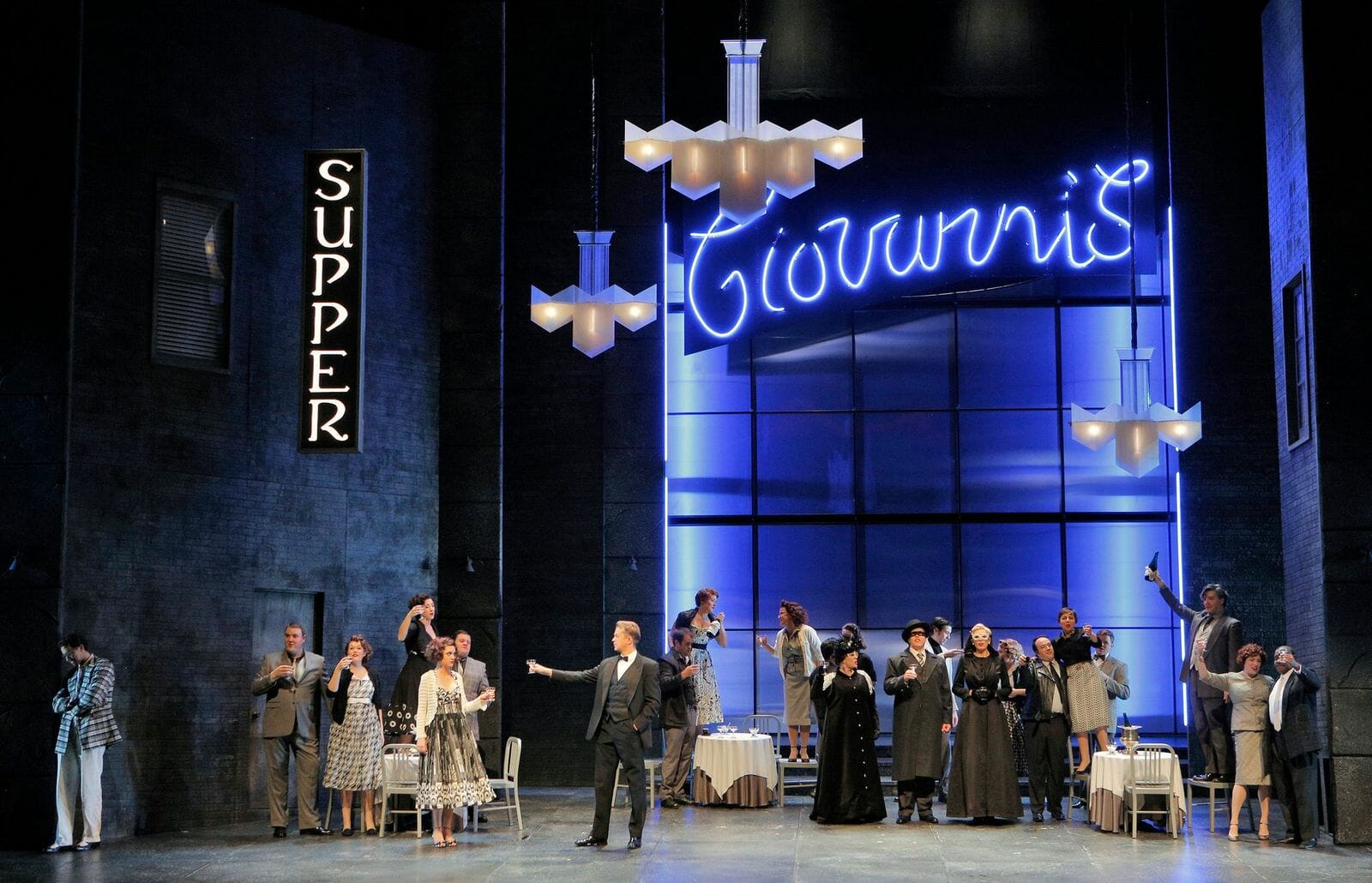
For Mozart and Da Ponte’s audience, this piece would have worked a certain way; there were certain character tropes they played into. Noir allows contemporary Americans to understand the characters instantly. When you understand that Giovanni is the antihero and Elvira is the femme fatale, we know exactly what is going to happen between them. We understand that they are attracted to and repulsed by one another. We understand that she is dangerous, and he needs to get the better of her, because chances are she’ll have a gun in her hand at some point. Americans love noir, and here they see the violence played out in an understandable way.
When you wrap the opera up in velvet capes and swords, it risks becoming romanticized and feels like The Three Musketeers. In noir, you see that snub-nosed revolver and you understand how dangerous these characters are.
ArtsATL: We must ask you that much debated question about the events in Donna Anna’s chamber before the curtain rises. Was she sexually assaulted, or was she perhaps a willing participant until things got out of hand?
McIntyre: The idea of Anna as a willing participant is an invention of male directors in the 1960s. Before then, that idea never existed, and given the heroic quality of her music, I don’t think it occurred to Mozart or Da Ponte, either. Had Mozart wanted her to be lying to Ottavio, or having regrets, he would have given her music a different quality.
We know what it would have sounded like, because that is exactly what he did with Fiordiligi’s aria “Per pietà” in the second act of Così fan tutte. But there is nothing in Anna’s music that indicates that this would be the case with her. Again, I think that is part of this need to justify Giovanni’s behavior. It’s 2023. Let’s believe the women and deal with consequences.
That’s the struggle with Giovanni, to see his behavior for what it is yet admit to ourselves that we are still attracted to him and his power. It’s a challenge for the singer portraying Giovanni and, I must say, for the director. This is how the idea of noir has helped tremendously.
ArtsATL: You have won tremendous acclaim in contemporary and 20-century repertory. Are there particular challenges involved in going back to a purely classical piece like Giovanni?
McIntyre: There absolutely are. I think this noir Giovanni is my answer to that and has given me a way to remain true to a piece from the classical period yet make it instantly recognizable, musically and psychologically, to an audience in 2023. For example, it is hard to do Mozart “ugly.” Given the character of the music, it needs a certain style. I have done grunge productions, but I don’t think that would work here. But noir has a style; it looks great. Even when the antihero is rumpled in his day-old tux, he still looks fabulous.
ArtsATL: Bass-baritone Timothy Nolen, who successfully straddled opera and Broadway, once commented that the reason some think that opera singers can’t act is because nobody asks them to. Thoughts?
McIntyre: I totally agree. In the old days, people didn’t ask as much. But tastes have changed, and there is no better trained singer than the modern American opera singer. What they go through now in terms of acting training and the fusion of that with their musicianship is incredible, and they are incredible to work with. Sometimes Europeans who come over have a challenge adapting to this modern style. Singers know I approach things from a theatrical standpoint. That said, opera creates a heightened environment; you have music determining emotional character. We use a lot of the same ideas, but it’s a bit different from directing a straight play.
ArtsATL: Yes, and something that sets you apart is that you clearly understand and trust the operatic genre.
McIntyre: I love music and I got into this to stage stories told through music. I am a musician. I play the piano, and in directing I work from the score, just as the singers do. I passionately respect the work the composers have done.
ArtsATL: Why do you do what you do?
McIntyre: I think there is nothing more human than a voice telling a story. I am a storyteller, and I have found over the years that opera allows me to tell stories the way I want to. I had my own theater company in San Francisco, and I loved that work. But there was always something that felt a little naked for me. I missed the music terribly. I love the fusion, and when we can bring people together to listen and to enjoy — well, that’s what is going to save the world. This is my small contribution to that.
I love this work. I want people to come. If someone has never seen an opera before, this Don Giovanni is a great one to start with. They will recognize the characters and the setting, and it will take them right along. I want nothing more than to entertain. Opera is for everybody. We need to make this an art form where everyone is welcome.
::
Mark Thomas Ketterson is a Chicago-based arts critic and writer. He is the Chicago correspondent for Opera News, and has also written for Playbill, the Chicago Tribune and other publications.
STAY UP TO DATE ON ALL THINGS ArtsATL
Subscribe to our free weekly e-newsletter.

PLEASE SUPPORT ARTSATL
Your Gift Sustains the Coverage You Count On!
Related Posts