Sergio Suárez’s ‘Anamnesis’ asks what objects remember
On a recent Monday, when Emory’s Carlos Museum is typically closed to visitors, the galleries are anything but quiet. The corridors and maze-like rooms are filled with the sound of banging tools, the electric hum of a motorized scissor lift, the voices of workers and the shifting of objects into position.
The plaza-level galleries are precisely organized by period and culture, but a set of unfamiliar new works are slowly taking their place among objects made centuries, sometimes millennia, earlier.
Atlanta artist Sergio Suárez moves through the museum as the installation takes shape, looking at the works and the spaces around them.
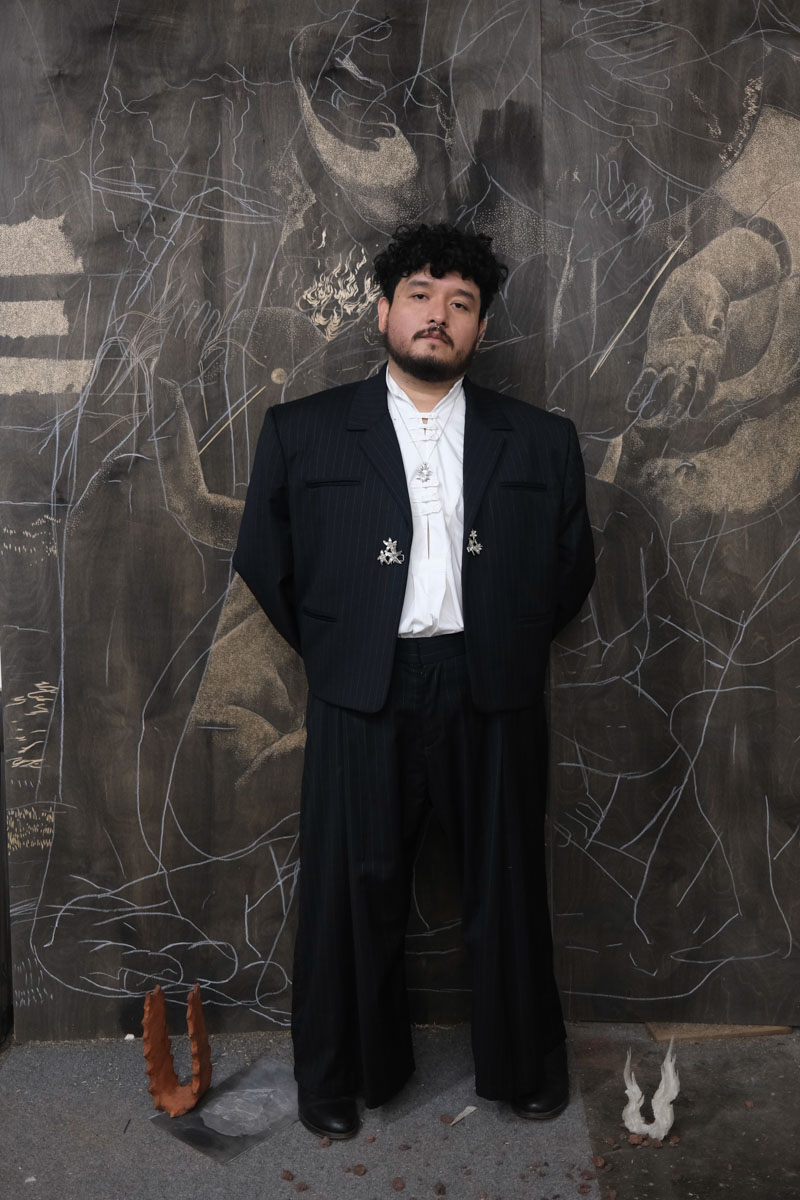
For the show, which opens September 19, the artist’s prints, drawings and ceramics will be installed throughout the Carlos Museum’s galleries, where they’ll sit alongside the museum’s collections of ancient Greek and Roman art and indigenous art of the Americas. Rather than asking viewers to move neatly from the past into the present, the exhibition asks what happens when both occupy the same physical space.
“The present equalizes everything,” Suárez said. “All these objects are here now. And they share space in the present.”
The Greek word anamnesis can be translated as “reminiscence.” In Plato’s writings, he describes a kind of remembering, knowledge recovered rather than newly acquired. Suárez first encountered the word years ago while reading Edwin A. Abbott’s Flatland, an 1884 novella exploring multidimensional spatial perception, and it offered him a framework for how memory and time might collapse into physical surfaces.
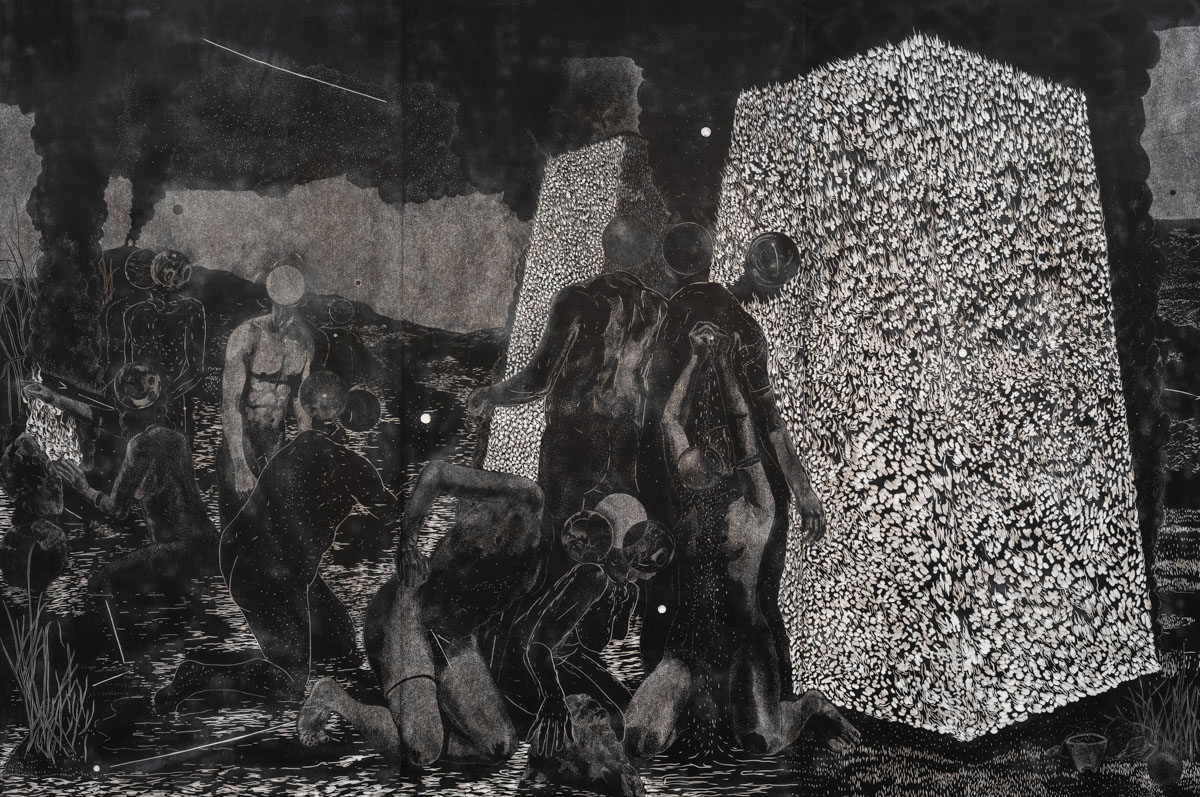
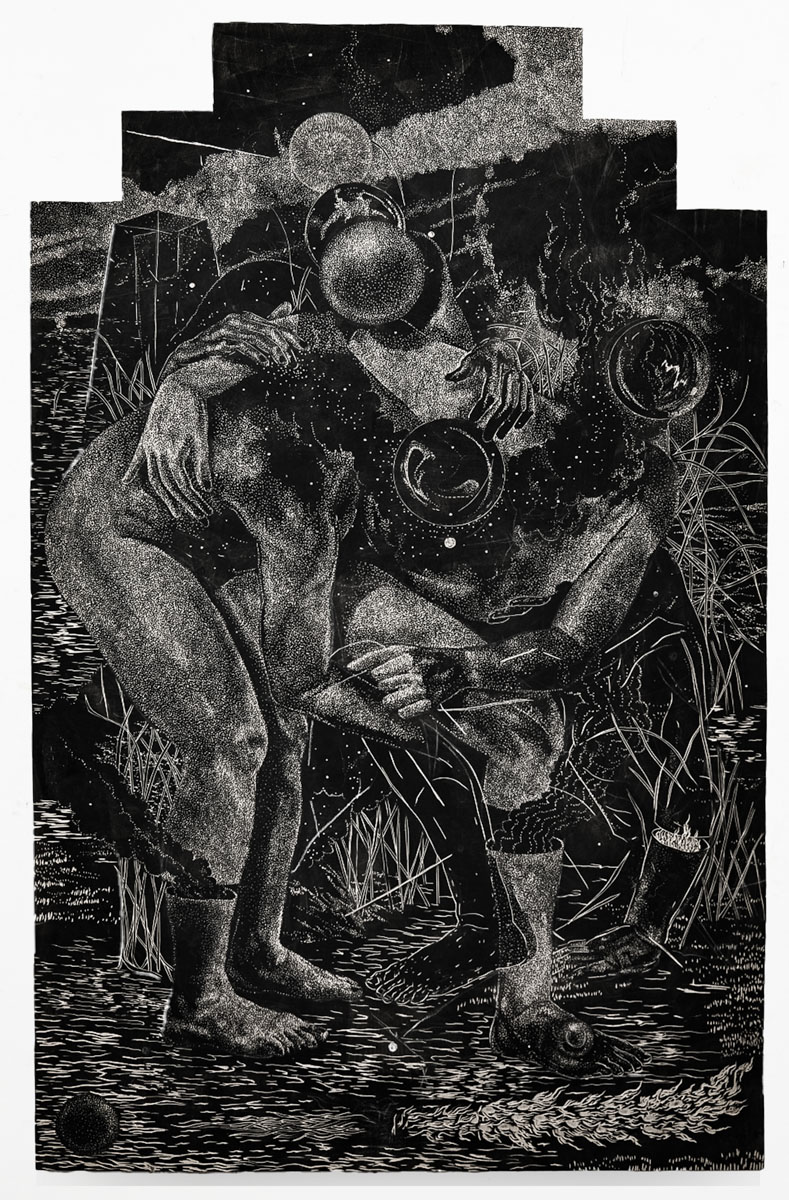
Suárez begins many of his large woodblock prints in his South Atlanta studio with sheets of birch plywood. He covers the surface with black ink, then draws and carves into it, removing material piece by piece.
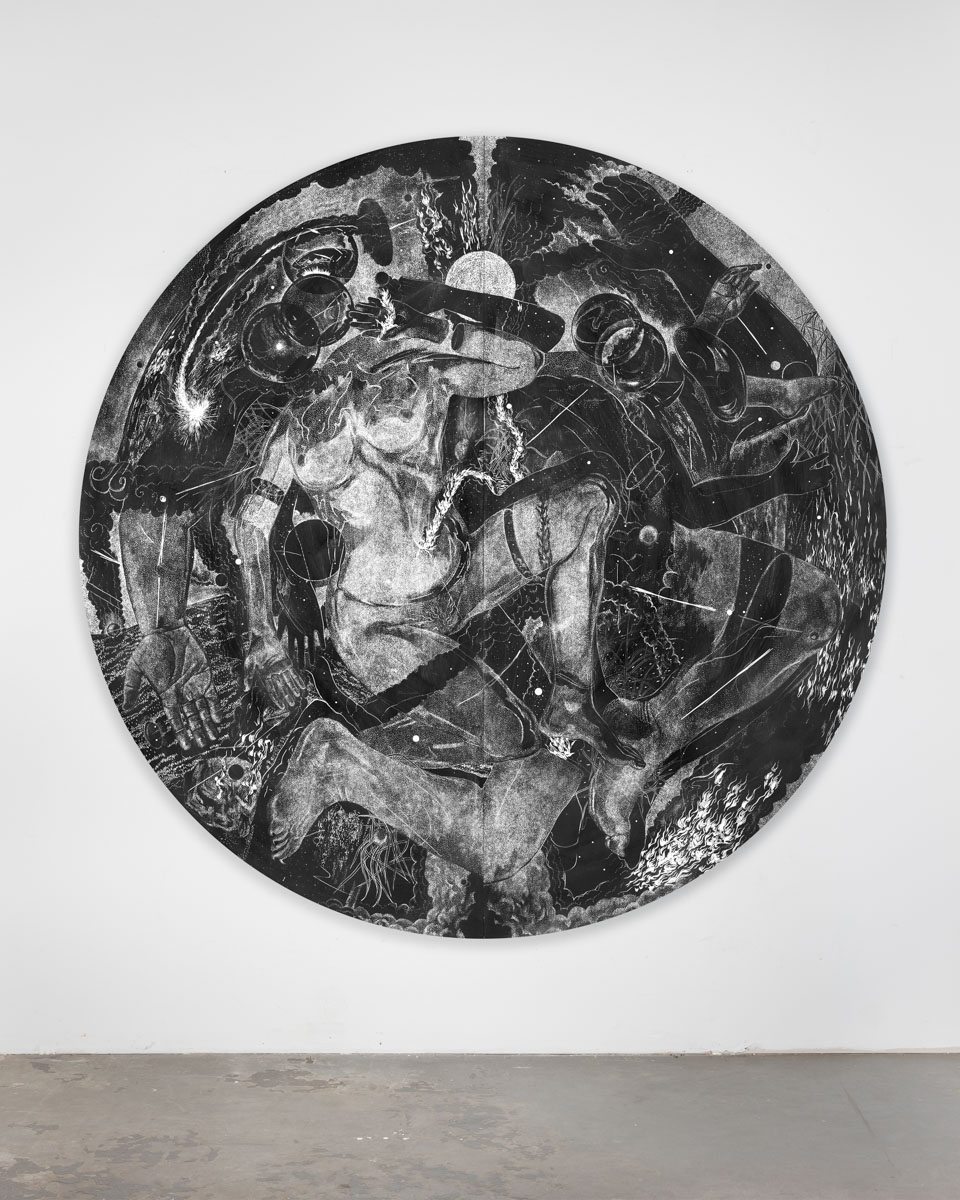
For Suárez, the block is more than a means of producing the print. It holds the physical record of the work: the labor, the marks, the decisions and the time spent making it.
“The site of memory, the site of labor and where time condenses — that is the block,” he says. “This action or this mark is this singular unit of information.” As the constellation-like marks accumulate, they become something more complex: bodies, landscapes, celestial forms or something harder to name. “For all I know, these bodies are made out of smoke.”
His ceramics similarly preserve evidence of their making. He draws into clay with needle tools, creating textures and lines before the pieces go into the kiln. After firing, he introduces another element of chance. He places wood over the tiles and puts his full weight on it, cracking the clay surfaces into haphazard pieces that interrupt and obscure the drawings with new fault lines.
The clay, he says, “preserves memory.”
Suárez was born in Mexico City in 1995. He remembers encountering pre-Columbian objects there not necessarily as “ancient” things but simply as objects that were still present. The city itself, he says, is a kind of palimpsest, where older buildings, materials and histories remain visible in the contemporary city.
Moving from Mexico City to Georgia at 17 brought a dramatic change in scale and environment, starting with the realization that his new street in Stockbridge didn’t even have sidewalks.
He did not initially intend to become an artist. At Georgia State University, he explored subjects including statistics, physics and chemistry before taking an art class as an elective. His professor, Atlanta artist Craig Drennen, became an important mentor. Suárez had always drawn. As a child, he made drawings of superheroes and video-game characters and even sold some for a few pesos, but art class gave that impulse a different framework. An adviser eventually recognized his interest in science and suggested printmaking.

In his Atlanta studio, a warehouse space near Lakewood, he works with large blocks of wood and clay. Some carvings take weeks or months to complete.
For the Carlos exhibition, that slow process has expanded into an unusually ambitious installation. Some large woodcuts have been printed onto fabric and suspended from the ceiling. Others occupy the niches and curved recesses of architect Michael Graves’ building.
Suárez also used his phone to make 3D scans of selected museum objects. He had replicas made from those scans, took them to his studio and traced their shadows under intense light, turning the silhouettes into drawings.
“I definitely wanted to make the architecture a participant and a co-author,” he said.

In one narrow space, he designed two tapering wooden structures that physically funnel visitors deeper into the gallery.
Rather than confining the exhibition to a single gallery, Ruth Allen, curator of Greek and Roman art, and Andi McKenzie, curator of works on paper, worked with Suárez to distribute it throughout the museum. Allen first encountered Suárez’s work at Whitespace Gallery in Atlanta.
“We wanted to bring Sergio’s work into conversation with our collections for a long time,” Allen said. “His work resonates with so many aspects of the collection in really provocative and exciting ways. It’s asking us to think outside the boundaries of classification, of chronology, of putting existence into these kinds of buckets.”

Suárez’s interest in objects is also tied to a more personal question: What remains after the person who made them is gone?
“My ego is going to disappear,” he said. “The people that remember me are going to disappear.”
At the Carlos, his works step into dialogue with objects that have already outlasted their makers, occupying the same space in an ongoing present.
::
Andrew Alexander is an Atlanta-based writer, editor and arts journalist. A longtime contributor and former senior editor at ArtsATL, his work appears regularly in local, regional and national publications, covering theater, visual art, music, film, dance, literature and the artists and institutions shaping Atlanta’s cultural landscape.
STAY UP TO DATE ON ALL THINGS ArtsATL
Subscribe to our free weekly e-newsletter.

PLEASE SUPPORT ARTSATL
Your Gift Sustains the Coverage You Count On!
Related Posts