Leia’s Long Look: Seemingly mundane objects hold story and power in ‘Spirit Object’
Leia’s Long Look is a new monthly column providing focused looks at individual artworks, prompting slow looking and deeper reflections. This month, Leia examines the work of Kimberly Fulton Orozco and Amanda Phingbodhipakkiya, on view at Swan Coach House Gallery.
Recently, there has been a rising return of offline music formats like iPods, CDs, vinyl albums and cassettes. A primary cause is the ability to enjoy them without subscriptions, advertisements, algorithms or data tracking. But there is also a nostalgic dimension — the association of these formats with fond memories. This trend is evidence of how seemingly inconsequential objects have the power to carry deep personal and cultural significance. This power is explored in a two-person exhibition, Spirit Object, now on view at Swan Coach House Gallery through September 17.
Featuring Kimberly Fulton Orozco and Amanda Phingbodhipakkiya and curated by Jiha Moon, the connotative power of objects takes two conceptual forms: a vessel and a net.
Along the left wall of the main room hangs Orozco’s insecure mix. singing your inner child to sleep in a treehouse (2026). Part of a series of similar artworks, this insecure mix is comprised of an audio cassette painted to resemble a face, adorned with mother-of-pearl buttons on its front and unruly strands of various materials dangling from its bottom edge.

While born in California, Orozco’s artistic practice is rooted in her Mexican, Kaigani Haida and Scottish ancestry. In this artwork, Orozco references Chilkat weaving practiced by Tsimshian, Tlingit and Haida indigenous nations. These practices include weaving “ghost faces”–stylized faces that symbolize the enduring presence of deceased ancestors — and incorporating long fringe, which accentuates movement when worn on a garment. Both are translated in insecure mix, making it a vessel of intergenerational knowledge.
What is interesting though, is that the ghost faces and fringe are not applied to a traditional textile but rather to an audio cassette. While once the standard for portable music, the format has long since been replaced. Born in 1985, Orozco grew up in the era of cassette tapes and likely used them throughout her adolescence to enjoy and share music. Applying Chilkat weaving motifs to an audio cassette intermingles personal and cultural significance; this isn’t a demonstration of ancestral knowledge but a cross-section of the artist herself.
The word portrait comes to mind, not only because of the artwork’s painted face. Cassettes are a form of memory storage, transcribing sounds onto tape for playback later. Though this artwork is highly personalized, it is not a biography but a messenger, carrying its contents to relay to others. In short, a vessel.

Adjacent to insecure mix is a conglomeration that hangs indeterminately from the wall. Labor, heavy and unkind (2026), by Phingbodhipakkiya, is displayed with a lengthy material list: sewn burlap apron, hand-built glazed stoneware, beads, industrial shelf, lace, tin spice container, hand-knotted cord, embroidery floss, mother-of-pearl, fish scales, salt and copper. The work has almost no visible structure. The metal shelf provides a sort of scaffolding, but it is so intertwined with the other materials that most of its form is obscured.
As stated by the exhibition text, Phingbodhipakkiya creates artworks that incorporate “handmade ceramic elements alongside found objects that she has both inherited from her family business and collected over time.”
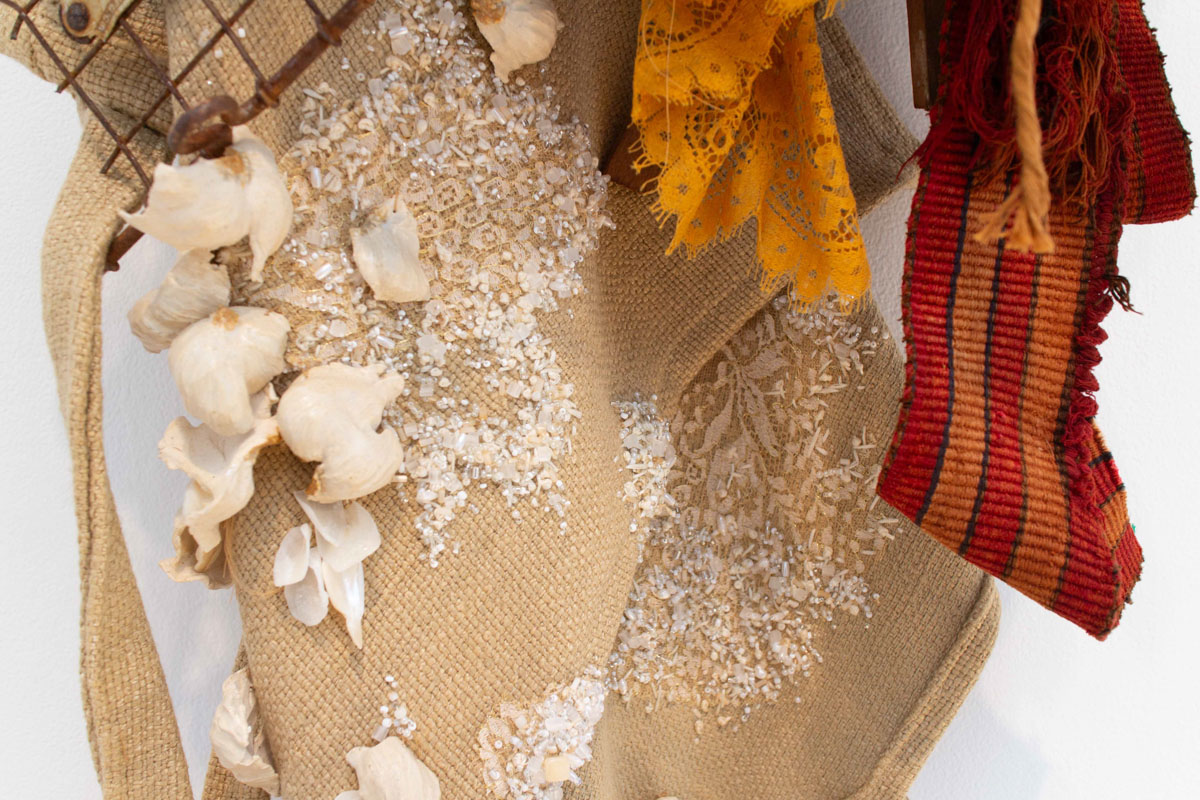
The random nature of found objects carries through to the artwork as its form trends toward chaos and disorder. In Labor, heavy and unkind, objects are suffused with significance upon their collection. With origins from her family’s business and her personal life, each acts as an individual scrap in a collage, unique on their own and revelatory in a composition. Seen this way, Labor, heavy and unkind acts as a net, opening to a flow and trapping whatever cannot escape its mesh.
It is easy to see both artworks as self-portraits. Though they contain no direct depictions of the artists, each contain materials and techniques that could have only arisen from them. The artists hold onto parts of their history, using objects as proxies for archives. This is a smart move since, as this year has demonstrated, the mundane can hold remarkable meaning.
::

Leia Genis is a trans artist and writer currently based in Atlanta. Her writing has been published in Hyperallergic, Frieze, Burnaway, Art Papers and Number: Inc. magazine. Genis is a graduate of the Savannah College of Art and Design and is also an avid cyclist with a competition history at the national level.
STAY UP TO DATE ON ALL THINGS ArtsATL
Subscribe to our free weekly e-newsletter.

PLEASE SUPPORT ARTSATL
Your Gift Sustains the Coverage You Count On!
Related Posts