

Review: the tender delicacy of Eve Brown’s ‘light leaves this prism’
We overflow. Two small stones lay on a bench, each bearing one word: we overflow. Handwritten, each letter is feathered with wispy ornaments. The letter “e” of “we” fans out into a white web, flecked with colorful dots.
These words are a mantra, an incantation I found myself repeating endlessly while residing within Eve Brown’s solo exhibition light leaves this prism at shedspace. We are fluid entities, brimming with energy and mass. We overflow. In this space, Brown has crafted a net to catch our glorious detritus.
Located in the garden adjacent to whitespace gallery, shedspace is — as the name would suggest — a former garden shed transformed into exhibition space. The squat building opens to a staircase leading down several steps. A bench lines the perimeter of the subterranean wall and clerestory windows fill the space with natural light. There is hardly any flat white wall space. Such a gallery necessitates nontraditional exhibition design — something Eve Brown is most familiar with.
Brown is known for circumventing most traditional gallery spaces, instead choosing to work in or around nature. Culling both materials and inspiration from the natural world, the artist uses her practice as a means of (re)connection between humans and nature. Which is to say, shedspace is the perfect gallery for Brown.
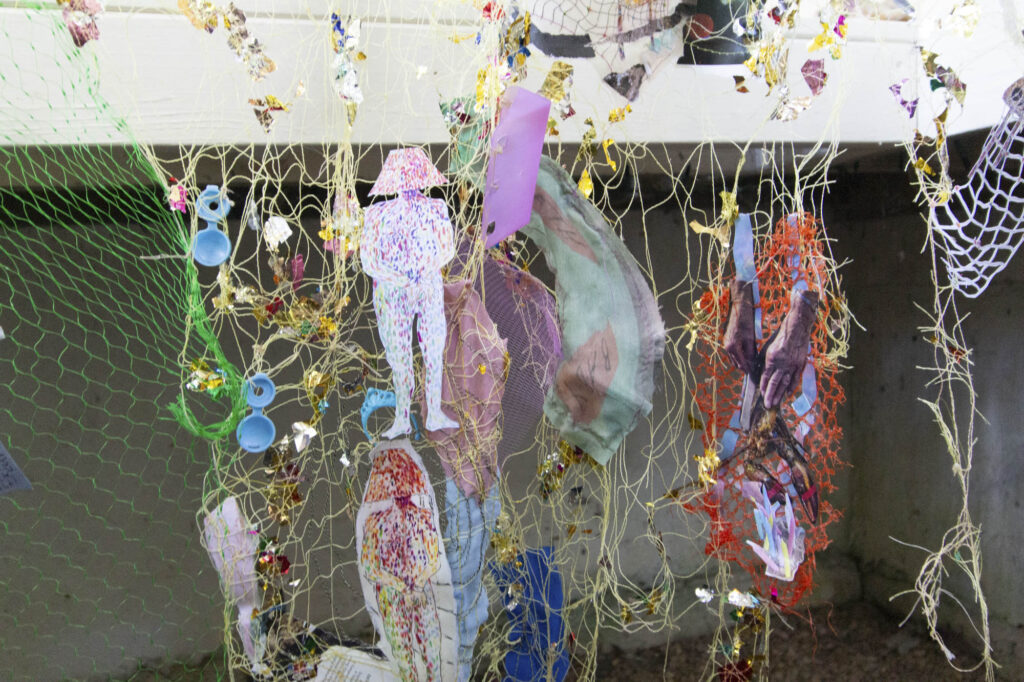
Stepping down into the gallery, it’s hard not to be overwhelmed. Incantational nectar: prism squeeze me, create structures for air — let me expand and contract in endless spirals (2025) is a large, webbed artwork that hangs from the ceiling. The piece droops down, connecting the floor, sidewalls and ceiling. Everything is interconnected, creating a banner which accurately describes both the physical makeup and emotional tenor of this exhibition.
Although reaching across the expanse of the small gallery, this artwork is visually weightless. Featuring a litany of materials such as fabric, trash, sticks and inkjet prints, these items have been atomized. Sticks have become twigs; fabric has become scraps. Trash has become plastic confetti. This mélange hangs from hand-sewn netting with stitching so loose as to become a diaphanous gossamer.
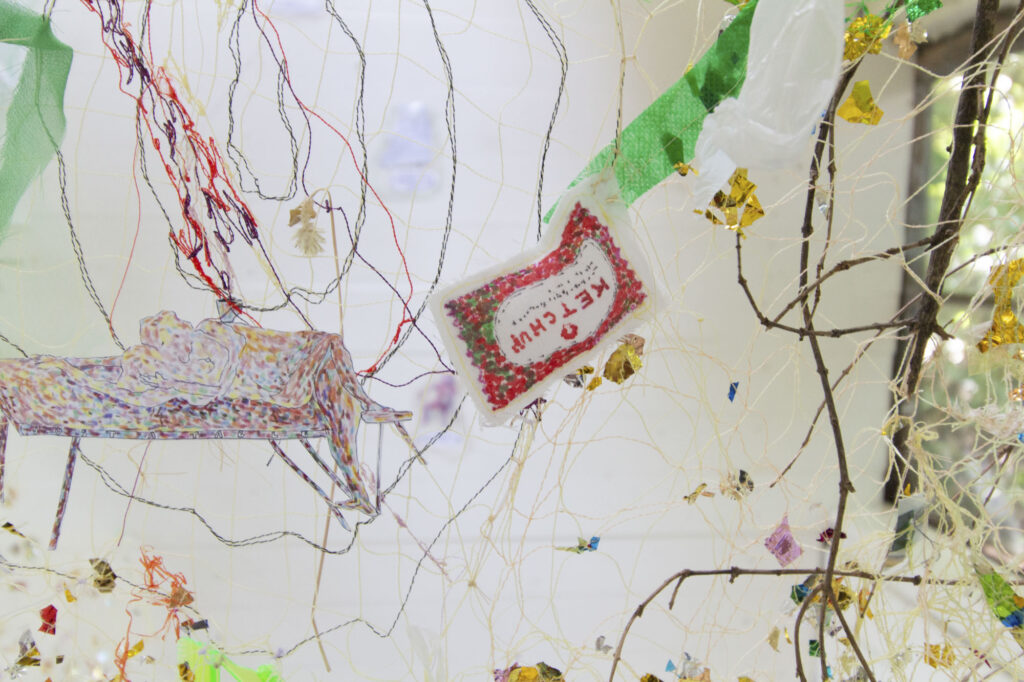
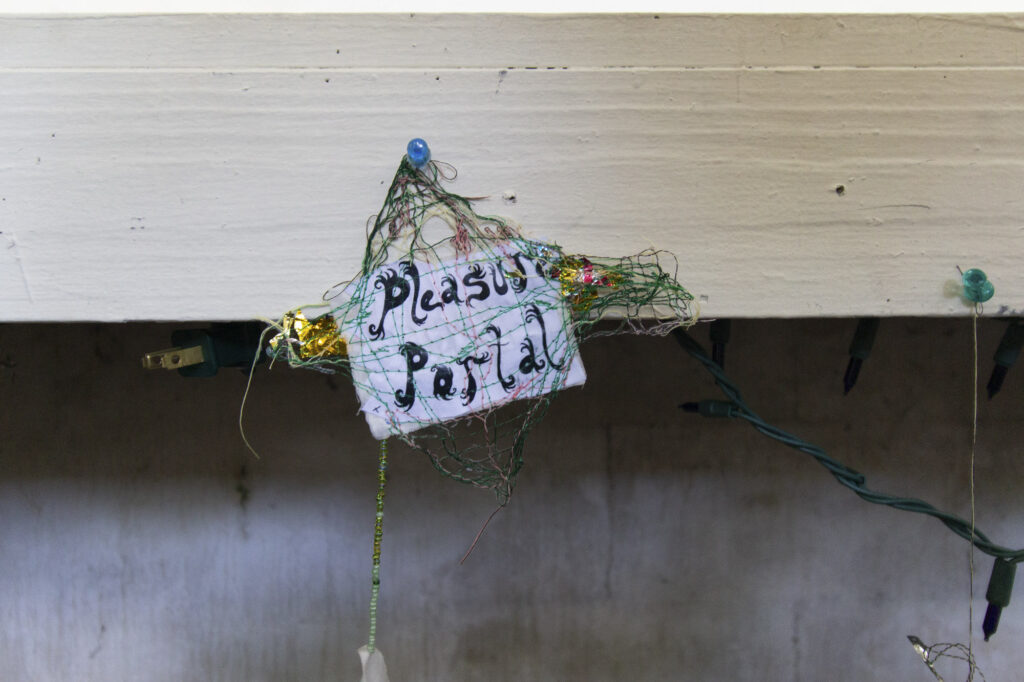
While occupying an enormous volume, this artwork is like a spider’s web; it could so easily give way under my slightest touch. The resulting sense of fragility and precarity — that everything is interconnected, but only just so — invokes a tender preciousness within me, a soft appreciation for the pellucid presence before me.
Perhaps, we are a flood. We have overflowed the banks of our river, and what we are witnessing is the smattered debris trailing in our wake.
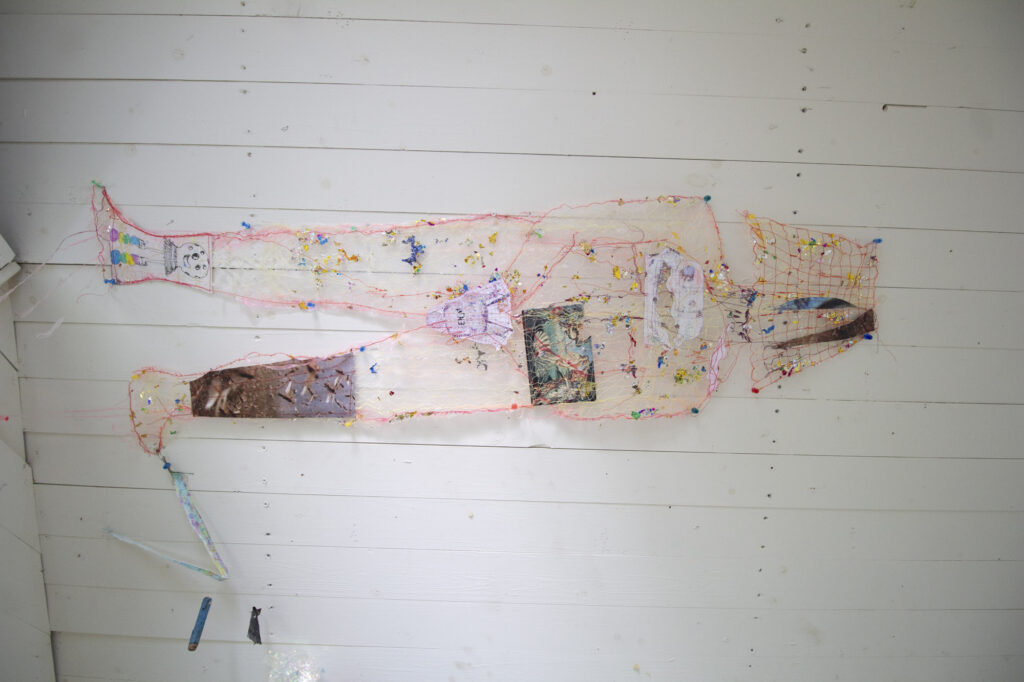
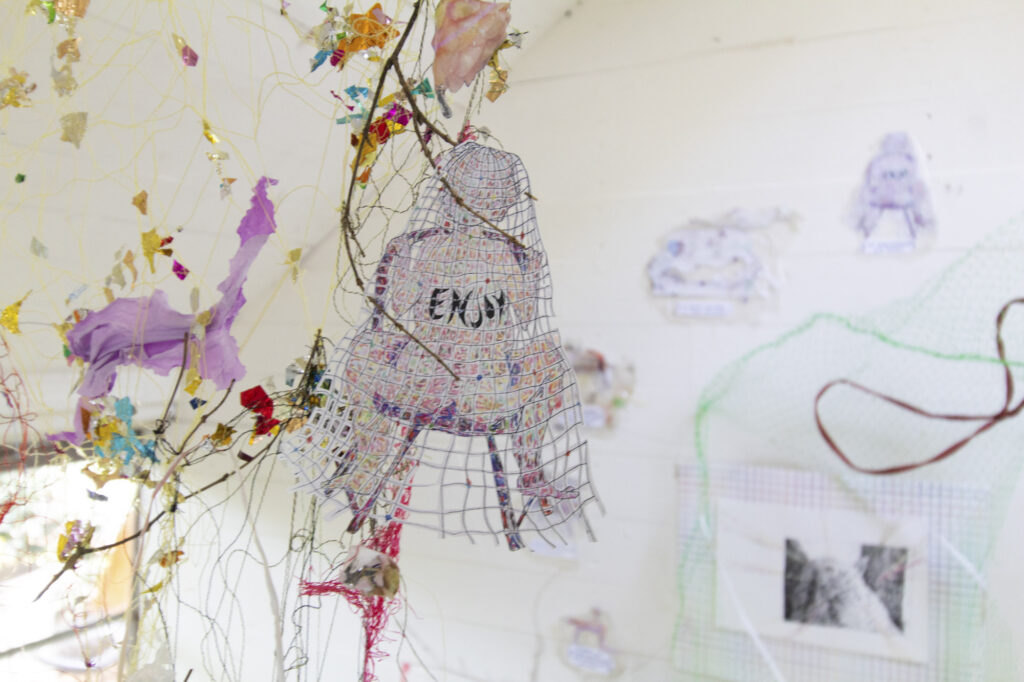
This lucent structure obliquely evokes the body, for what is netting without something to catch? Look closer and you will find them. Snagged in the net are several drawings of bodies, all sporting a lampshade in place of a head. Drawn with a pointillist technique — a fabulous replication of the trash-speckled net supporting the drawings — the simplified silhouettes are stippled with blues, oranges, purples and pinks. This largely analogous color scheme communicates warmth and energy.
The lampshades in turn evoke light as both energy and material, and one that emanates from and through a body. Perhaps, as the title of this exhibition elucidates, we are a prism, through which flows a prismatic array of energies, the remnants of which have been captured before us.
The jubilant excesses of energies and flows created by Incantational nectar: prism squeeze me, create structures for air — let me expand and contract in endless spirals are complicated by the additional drawings and sculptural elements littered throughout the gallery.
On the bench near the entrance, one small, scroll-like drawing articulates a two-dimensional rendition of the trash-filled net hanging nearby. Written underneath this languid mesh are the words “there is no death without openness.” The negative spaces of the netting have now gained double reading as memento moris: a literal representation of loss. A flood is a great release of energy, one which can lead to just as much loss as it does catharsis.
There is one word from this exhibit that I hung on to: “Enjoy.” Written on one of the drawn bodies, it reminds us that though we may overflow, though we may shatter, though we may grieve, we are only granted one life. We should do what we can to enjoy it.
::

Leia Genis is a trans artist and writer currently based in Atlanta. Her writing has been published in Hyperallergic, Frieze, Burnaway, Art Papers and Number: Inc. magazine. Genis is a graduate of the Savannah College of Art and Design and is also an avid cyclist with a competition history at the national level.
STAY UP TO DATE ON ALL THINGS ArtsATL
Subscribe to our free weekly e-newsletter.

