In the studio: Marie Munk on the exploration of biology and technology
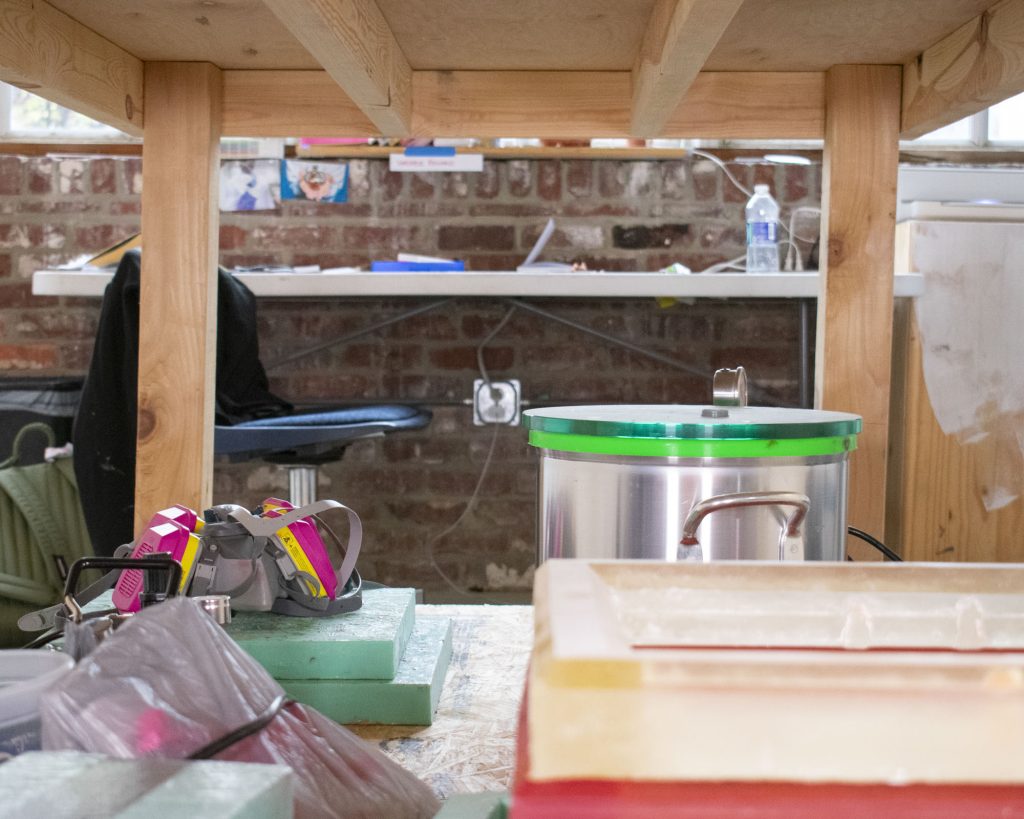
“I think the teachers were like, ‘Why is she talking about placentas?’” reflected Marie Munk in her studio at the Atlanta Contemporary on a chilly December morning. Munk, a resident studio artist since 2024, had just returned from Denmark, where she led an instructional workshop for an upcoming exhibition composed exclusively of placentas that were created by elementary school students. In an accidental homage to the act of birth itself, she noted that the crafting process was “a bit messy, which I kind of like.”
Beyond the somewhat humorous image of children crafting the very organ that sustained them before they took their first breath, the placenta epitomizes the strange relationship between humans, our bodies and modern technology that Munk explores in her work.
“Most of my work is about the body and our bodily self-understanding and how that is in constant flux,” Munk explained. “I’m really interested in how technology [and] the rapid change we see in the world around us constantly forces us to recalibrate our understanding of ourselves, as our biological, fleshy anchor in the world is, kind of, constantly up for renegotiation.”
“[The placenta is] what brings us all to life. But at the same time it’s an organ that a lot of people don’t even know. It only exists temporarily in the female body,” she shared. “It’s so magnificent inside our body. But, once it comes out, it’s disgusting and literally thrown into a bin.”

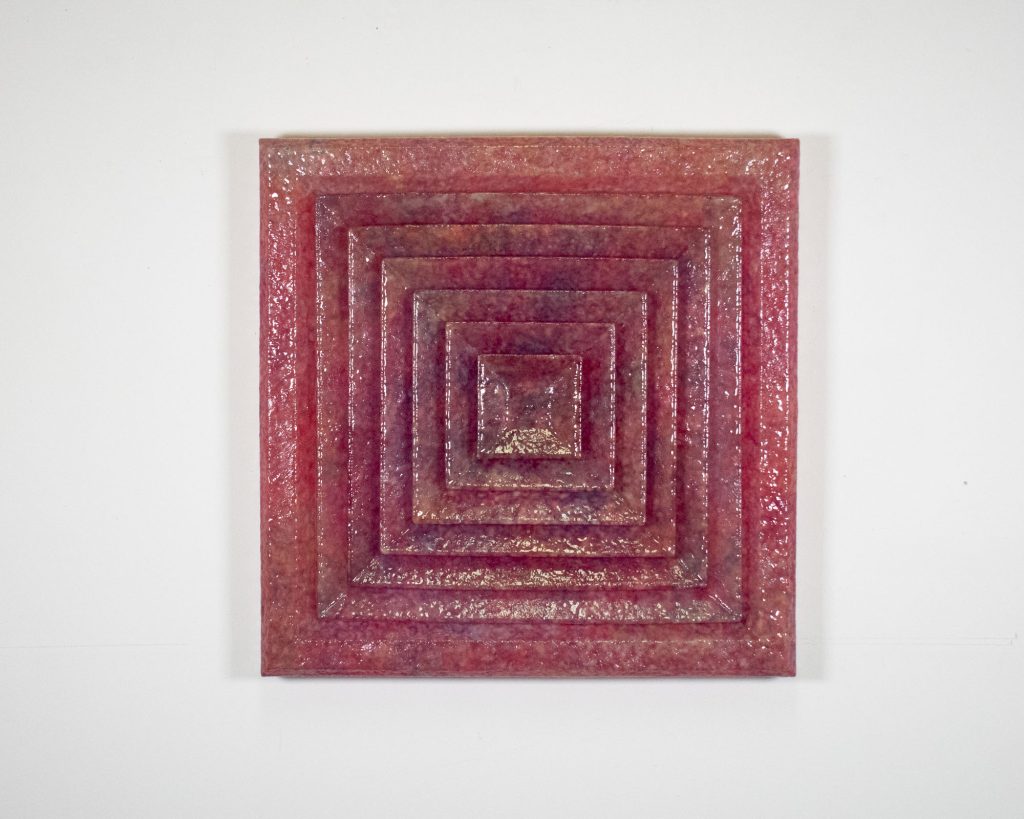
To engage Munk’s work is to confront this peculiarity on a grand scale. Her practice is typified by large sculptural installations, often of bulbous, wet-looking formations rendered in pallid pinks and muted blues that mimic human entrails with unsettling accuracy. They are veiny and organic, blurring the line between recognizable biological tissue and alien lifeforms. Whether fabricated from silicone, resin or plastic, they possess a visceral quality that provokes a physical reaction that oscillates between disgust and attraction. Munk plays skillfully in a liminal space that verges on the grotesque yet remains remarkably comfortable, refined and aesthetically pleasing.
“I think a mix between being really drawn to it and kind of familiar with it and then at the same time being kind of repulsed by it and feeling like they’re looking at something quite alien,” she said regarding the reaction she hopes to provoke with her work. “Because everybody has a body; everybody can kind of relate to it. They know it from themselves . . . And, yet, it’s kind of uncanny.”
Munk frequently employs her aptitude for biological mimicry to probe deeply technological themes and address modern infrastructure. A prime example is her 2022 solo exhibition Big Energy at Gammel Holtegaard in Copenhagen, an installation spanning six connected rooms where Munk hand-painted over 600 meters of cabling with silicone, transforming the space into a data center powered by endless coils of umbilical cords.
“It’s made of silicone . . . there’s a core of something else, but then it’s soft sculpture painted with silicone,” Munk explained, detailing the labor-intensive process in which she painted every inch of the “skin” herself. “It’s imperfect, which is kind of the point; it makes it very organic.”
The result was an embodiment of the dialectical relationship she explores between the technological infrastructures that exist inside and outside the human body. In Big Energy, cloud servers are reimagined as biological entities and, simultaneously, umbilical cords are cast as a conduit for electricity.

This fascination with flesh as artistic fodder stems from Munk’s background in fashion — a field she studied before realizing she was less interested in dressing the body than she was in morphing it. She still holds an affinity for designers who operate in this space, such as Michaela Stark, known for her body-altering corsetry. However, Munk’s practice has firmly settled into the realm of visual art, placing her in conversation with other pioneers of speculative biology like Patricia Piccinini and Lucy McRae.
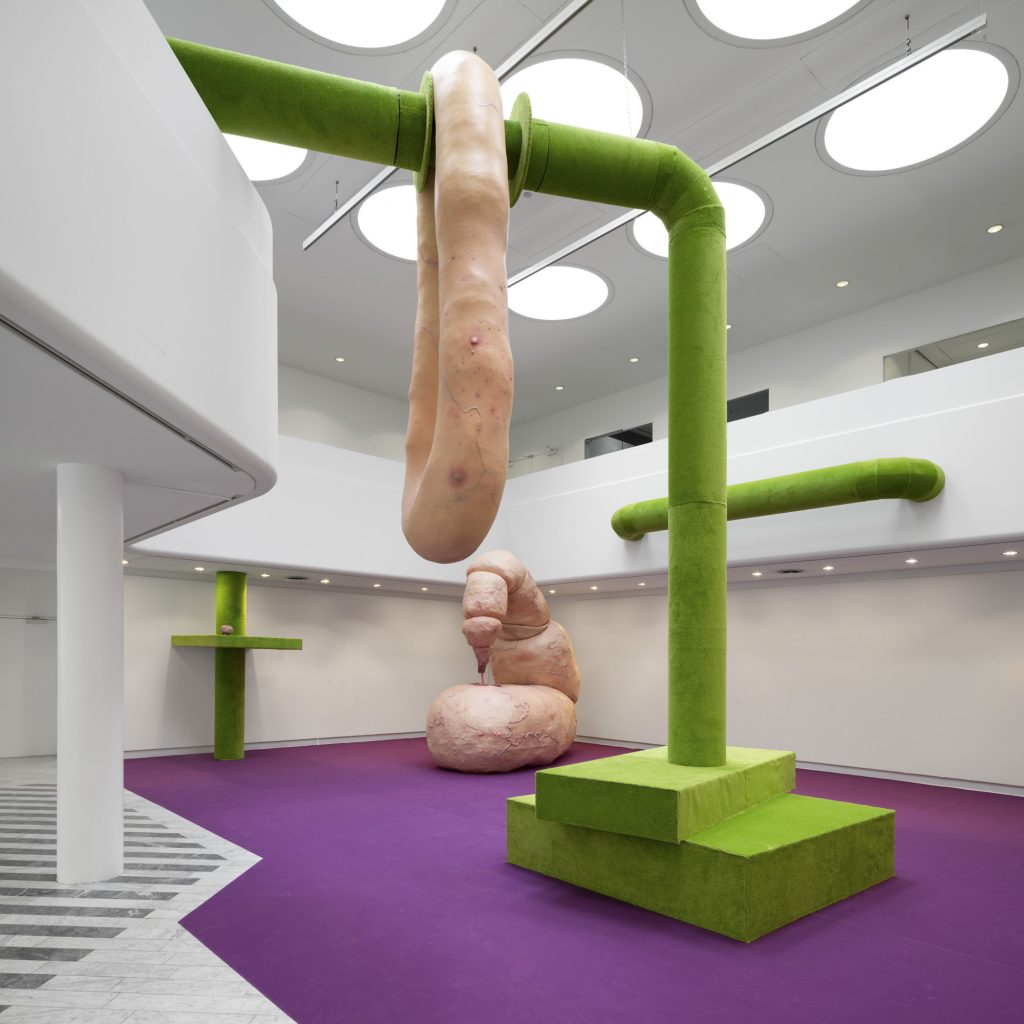
The role of speculation and storytelling in Munk’s practice is perhaps most explicitly visible in her 2019 installation Great Pets. Set at Tranen, a contemporary art exhibition site within Gentofte Library north of Copenhagen, Munk transformed the space into a massive, synthetic terrarium filled with towering, fleshy forms and custom infrastructure adopting the distinctive aesthetics of carpeted cat trees.
The conceptual seed for the work is a quote attributed to Apple co-founder Steve Wozniak, arguing that in a future dominated by superior artificial intelligence, the best-case scenario for humanity is that we become the benevolent AI’s pampered pets.
Munk does not necessarily subscribe to Wozniak’s view as being a literal prophecy, nor is she particularly invested in assessing the scientific accuracy of these future scenarios. Rather, she is fascinated by how the mere suggestion of techno-utopian visions shapes our collective psyche. “It doesn’t necessarily matter if the tale is true,” she argued. “But if we are exposed to it enough, we will find it affects how we see ourselves in the world.”
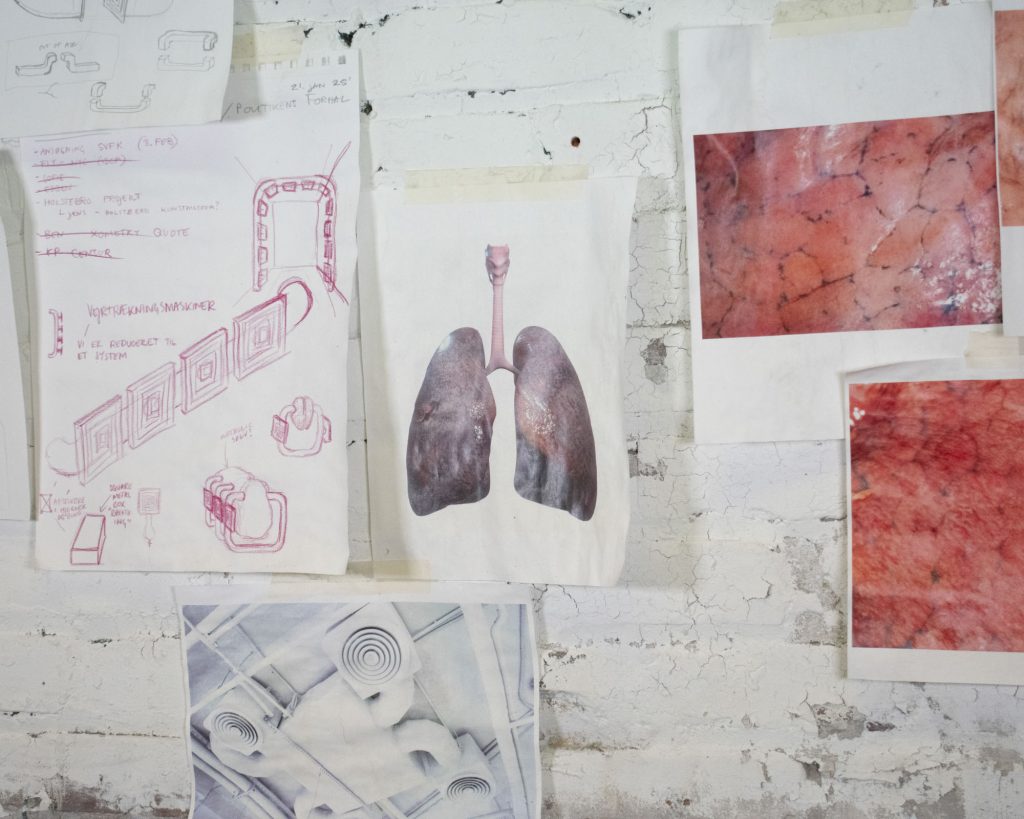
This engagement with narrative extends to the heavy reading materials that line the shelves of her studio at the Atlanta Contemporary. Munk is deeply read on topics of transhumanist and post-humanist movements which view the biological body not as a perfected outcome of evolutionary processes but as a platform awaiting a technological upgrade.
“What is really fascinating about this movement is that they’re so techno-optimistic,” Munk observed. While many people recognize technological development as a double-edged sword, transhumanists often view it as a universally positive solution — even to the ultimate problem of death.
“It’s like, ‘If we can become immortal, it’s just better,’” Munk said, channeling the mind-set. “But, what happens if we live forever? Like, aren’t there some weird other sides to that? [They argue] ‘No, it’s just better,’ like ‘I can spend more time with my kids,’ or whatever. You know? I find it really interesting.”
Despite this engagement with speculative futures, Munk avoids the trap of becoming a futurist herself. Rather than offering firm predictions or political stances, she treats these technological theories as sites for creative inquiry. “Technology is amazing; it’s making our world better day by day,” she said. “But it’s also never neutral. It’s always asking questions.”
Despite the dense theoretical underpinnings of her work — ranging from ectogenesis to artificial superintelligence — Munk is careful not to trap her practice in the ivory tower of academia. She rejects the label of being an “intellectual” artist, viewing it as a barrier that keeps the general public at arm’s length.
“I don’t fancy art that requires you to do a Ph.D. before you understand it,” she said flatly. “In the end, you know, art is just a place where people can feel met in some way to reflect on themselves.”
One could mistake the dichotomy between the highly intellectual materials which inspire Munk’s work and her insistence on prioritizing the visceral and intuitive power of art as a flaw. Within the full context of her artistic practice, however, this tension between logic and emotion reveals itself as the core engine driving the peculiar mood she adeptly crafts.
“Data is so powerful, because data is just fragments of truth, and the more fragments of truth we have, the closer we come to the truth,” she explained. “But I think sometimes it takes away our ability to use different senses to find the truth. We can also feel things within ourselves.”
Munk has been working in Atlanta for roughly two years, a move that offers her a blank canvas away from pre-existing expectations of her practice, which is well-established internationally. She described the city as a place where she is free to explore without preset ideas attached to her name.
Ultimately, whether she is building gigantic human pet furniture, constructing a fleshy cyst protruding from a public bench or helping a child paint “unicorn energy” onto a model placenta, Munk’s goal is the same.
“What I really want my work to do is to create this unification of people,” said Munk. “Let’s have a shared feeling of being these fleshy bodies in a world that we are creating ourselves but that is constantly challenging us.”
::

Dr. Kevin M. Storer is a multidisciplinary computing researcher living, working and collecting art in Atlanta. His approach to art criticism and collecting prioritizes the discursive power of artistic practice over purely aesthetic qualities. This perspective is informed by his internationally-awarded scholarship on the complex relationships between people and the objects we create — especially as they shape our identities and social realities. Kevin earned his Ph.D. in informatics from the University of California, Irvine.
STAY UP TO DATE ON ALL THINGS ArtsATL
Subscribe to our free weekly e-newsletter.

PLEASE SUPPORT ARTSATL
Your Gift Sustains the Coverage You Count On!
Related Posts