Review: The High Museum takes unique, photographic dive into all things South
Picturing the South: 25 Years, on view at the High Museum of Art through February 6, is a massive retrospective that takes a deep dive into the visual representation of a region that consistently redefines itself.
For the last 25 years, the High has commissioned 16 photographers, emerging or mid-career, Southern or not, to produce work in and about the South. For some artists, it has become a watershed moment in their careers, allowing them to produce iconic projects.
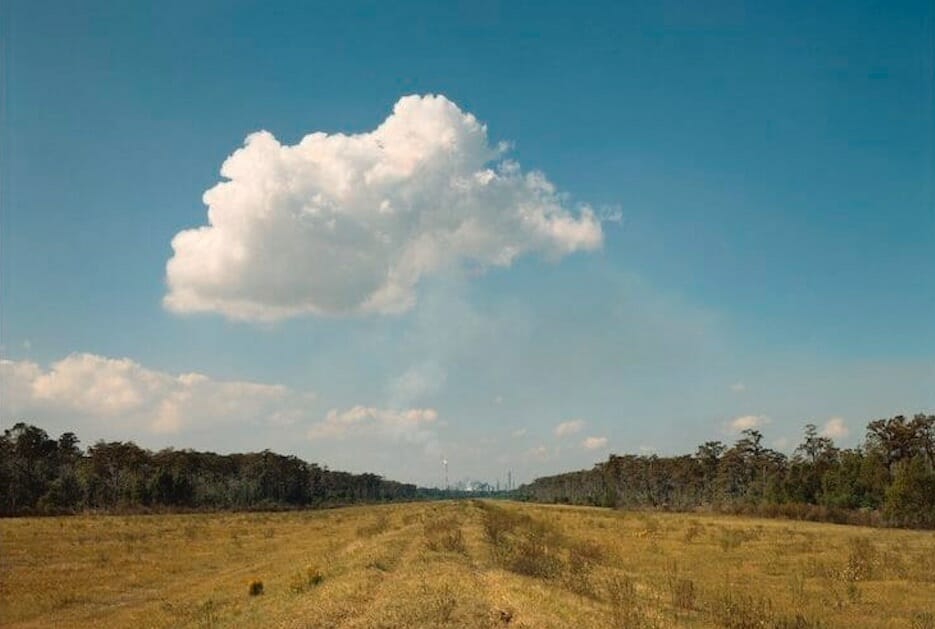
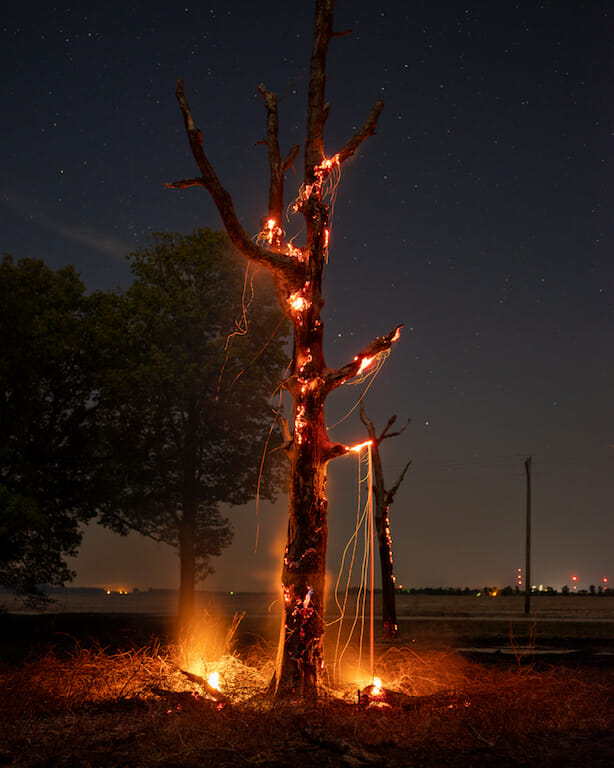
The exhibit opens with a disturbing, wall-sized image by Richard Misrach of a contaminated wasteland, taken from his remarkable 10-year study of the Mississippi corridor known as Cancer Alley. From there, viewers enter a room dedicated to Sally Mann’s dark and sometimes macabre Southern landscapes, paired with Sheila Pree Bright’s new series, Invisible Empire, taken in the landscape around Stone Mountain. Both works share similarities in their intention to grapple with the very complicated history of the South by using the landscape as a repository of humanity’s acts of the past.
Mann was the first photographer to be commissioned in 1996. At that time, she had no real concept of the work she was going to do but she knew it involved a tight turnaround and using film she had never used before, all of which made the proposition unsettling.
Mann recalled saying “no” several times to the offer. Then she “got that idea that I could take this opportunity to pivot and do some completely new, more challenging work.” The rest is history. The commission allowed Mann, who had by then concluded her series Immediate Family, to immerse herself in landscape work, which she still does today.
To be clear, this commitment is unusual, if not unique among American museums for its longevity and audacity. The commission attaches no strings to the chosen photographers, giving them carte blanche to produce work they feel best reflects their vision of the region.
At its core, it has a twofold purpose: to help build the museum’s collection of contemporary photography (which it did; the photography department has now acquired some 300 photographs from the initiative) and to generate a layered perspective of a place often stereotyped and subject to preconceptions.
Ample texts and explanations on the walls put every photographer’s work in context and help the viewer engage with the visual narratives. The curators added the photographers’ personal notes and memorabilia, offering fascinating insights into their process. They are sometimes deadpan serious: “Reinventing landscape photography . . . Landscape is the language of the human condition,” reads Misrach’s handwritten notes. Some are plain mundane: “Shoot two days per week – Anything! . . . Yoga three times per day,” wrote Kael Alford.
To complement the exhibition, the High has also published an extensive collection of digital resources on its new platform, offering artists’ video interviews, artwork annotations and multimedia content that allow viewers to explore each project in depth.
Most of the bodies of work presented have already been exhibited in some form, some extensively, as is the case most recently of Alex Harris’. But some will be on view for the first time, such as the 2015 commission of Louisiana-based photographer Debbie Fleming Caffery as well as work from three new commissions by An-My Lê, Jim Goldberg and Bright.
Geographically, the projects reach far and wide, spanning Georgia, Louisiana, Mississippi, Alabama, Tennessee, Florida and the Carolinas, extending all the way to Texas. For the topographically inclined, an interactive map on the High’s website allows viewers to see precisely where photographers took their pictures.
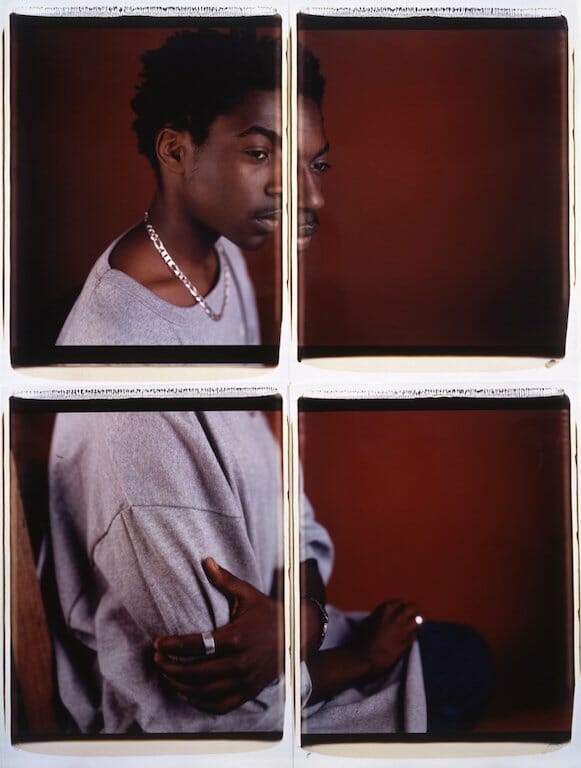
There is not one single narrative that emerges from all the works presented. To the contrary, a multitude of visions and approaches emphasize the complex reality of the region and its inherent richness. Dawoud Bey used the commission like a mini-residency and worked with Atlanta high school students to create evocative portraits reminiscent of 17th century aesthetics.
His 20” by 24” Polaroid camera allowed him to take over-life-sized, richly detailed photographs that he eventually deconstructed and reconstructed in separate frames, slightly out of alignment to emphasize the inherent inability of a photograph to comprehend the full complexity of an individual.
California-based Goldberg decided to shoot entirely in Arkansas, because, he says, “not many people know much about Arkansas.” In early 2020, he traveled to Augusta, a small, racially mixed, working-class town located along the White River in Arkansas’ Delta region, investigating small-town life and befriending the people there. With Whirlpool, he created an intriguing collage several feet long made of black-and-white photographs of the river overlaid with handwritten notes taken from his interactions with the Augusta residents. It offers a poetic vision of a place where landscape and people are intertwined with one another.
Shane Lavalette, on the other hand, worked playfully with the notion of music and shaped a road map along places of musical significance. “In musical terms, I wanted to experiment with ideas of tempo and repetition in a way that creates both harmony and discord,” he says. Working instinctively by relying on chance encounters, he produced work that reflects how “a place looks and feels,” exploring the relationship between music and landscape, and creating thoughtful portraits such as “Will with Banjo,” 2011.
Alford, whose work was exhibited alongside Lavalette’s and Martin Parr’s in 2012 at the High, used the commission to pursue a more personal project in the coastal marshlands of Louisiana, after covering conflicts and war zones for many years. Her subject matter is not much lighter — the slow disappearance of Native American communities tied to the physical erosion of the land due to excessive drilling and climate change — but her approach becomes more contemplative. The commission, she said, “allowed me to take the risk and explore the possibilities of switching from a 35mm format to a larger, slower one because nothing was moving.”
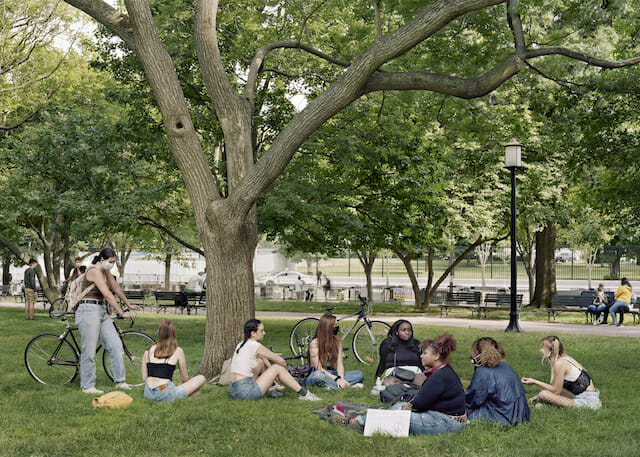
Lê’s work closes the exhibit with a subtle and lyrical take on what she described as “the theatre of life,” reimagining an American road trip based on locations where political and social disputes unfold. “What stands out for me is how so much happens outdoors, which makes things easier for me to photograph,” she says. She captures seemingly uneventful scenes such as the reinstallation of the irrigation system near the White House or a group of girls seated under a tree discussing the events of the day. Seen in a wider context, these images address profound issues of our conflicted times.
The next artist’s talk related to the exhibition is with Bright, January 27, 2022, at 7 p.m.
::
Virginie Kippelen is a photographer, multimedia producer and writer specializing in editorial and documentary projects. She has contributed to ArtsATL since 2014, writing mostly about photography. After 25 years in the United States, she still has a French accent.
STAY UP TO DATE ON ALL THINGS ArtsATL
Subscribe to our free weekly e-newsletter.

PLEASE SUPPORT ARTSATL
Your Gift Sustains the Coverage You Count On!
Related Posts