
Review: Stutzmann, ASO record Dvořák’s ‘New World’ for upcoming release
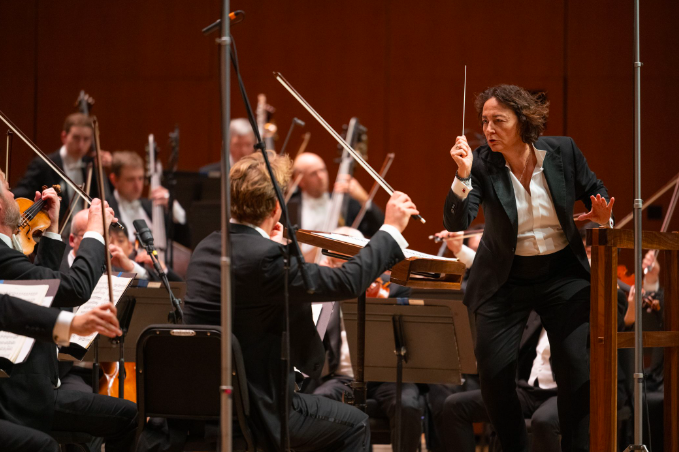
The audience energy soared Thursday in Symphony Hall for an unannounced event: Nathalie Stutzmann’s longtime record label, Warner Classics, had set up a metallic forest of tall silver and black microphone stands throughout the stage, with wires all over the floor. Audio engineers for the Paris-based music conglomerate were in town to record the Atlanta Symphony Orchestra’s program devoted to one Czech composer, Antonín Dvořák, including his Symphony No. 9 nicknamed “From the New World,” his lesser-known Suite in A Major nicknamed “American” and, for an encore, a waltzy and swooning Slavonic Dance (Op. 72, No. 2).
It’s the first recording that music director Stutzmann will make with the ASO, and, although the world emphatically does not need yet another “New World” Symphony recording, this one will document the budding partnership between a still-fresh conducting talent and her compliant orchestra.
Throughout the symphony, Stutzmann pushed many extremes, with overly brisk tempos where the music really wants to move, then drawing back almost to a standstill at key transition points. It’s a hands-on and rather old-school romantic approach, the opposite of many “objective” or clinical interpretations where the goal is to let the music speak for itself, as it were.
Instead, Stutzmann sometimes shaped phrases idiosyncratically, which heightened the drama and gave a sense of voyage and discovery. As the first movement powered to its peak, she pushed her players to a full gallop, an exciting sensation for the listener.
Although they’d been rehearsing this familiar music all week, the orchestra often wasn’t balanced and didn’t play ideally together. The brass choirs that open the magical Largo movement were ragged and misaligned, and elsewhere the band’s energy level remained high as they seemed to suffer a loss of focus. With our music director on the podium, you sometimes get the sense that the ASO’s musicianship and technical skills are exceedingly high, but everyone’s endurance needs improvement. (It begs the question: Does Stutzmann, a compelling artist, have the skill set and disciplined attitude to give the ASO what it needs to grow?)

Still, the best parts were bewitching. In that Largo movement, Emily Brebach’s long English horn solo — the tune of which was later rewritten, in the style of a spiritual, as “Goin’ Home” — was warm and throbbing. When the muted strings picked up the melody, it was ethereal, translucent — a divine mist of sound. And they caught the dancing, twirling motion of the third movement scherzo.
The finale was again less secure, with the horns and brass not quite unified, which might be one reason for the general sense of hesitation across the stage. Thankfully, the Warner engineers will have enough concert takes and rehearsal clips to patch together a sonically perfect product.
The evening opened with Dvořák’s “American” Suite, a 20-minute, five-movement work that the ASO had never before played. It’s charming and folksy and probably a little too long for its material. Written when the Bohemian composer was in New York, created between two masterpieces — his “New World” Symphony and epic Cello Concerto — the suite hits many right notes. There are just-folks-on-the-front-porch melodies and zippy, foot-stomping rhythms, with verdant woodwind solos and lush string writing. You hear echoes of the “New World” throughout. (Interestingly, in this unfamiliar music, Stutzmann took a clean, objective approach with minimal shaping of lines and few, if any, interpretive flights of fancy.)
In the middle of the concert sat Dvořák’s Violin Concerto. It’s well-known and rather frequently performed — usually as a virtuosic showpiece for a star soloist — but often comes off as a bit of a letdown. (The concerto is not part of Warner Classics’ new recording.)
The concerto was a sensation after its 1879 premiere but has largely faded in popularity, which I like to think is due to its tepid opening movement. Unlike golden-age violin concertos written around the same time (by Brahms and Tchaikovsky among them), Dvořák’s lacks the knockout tunes and coherence that keeps listeners on the edge of their seat. There are daredevil moments from the violin soloist, to be sure. But the first movement halfheartedly aims for the heroic but the expression rambles, till finally it unobtrusively, meekly, slips into the slow second movement, which also isn’t especially memorable. Only the peppy finale delivers on its assignment.
Czech violinist Josef Špaček, educated in Prague and New York City, made an award-winning recording of the concerto and played Thursday with blazing intensity, alive to every bit of the score. He makes a big, attractive sound, and there’s just a hint of sweetness in his dark tone, rich and caramelly in color. For all the power of his playing, the audience didn’t applaud long enough to bring him back for an encore. (Blame the concerto!)
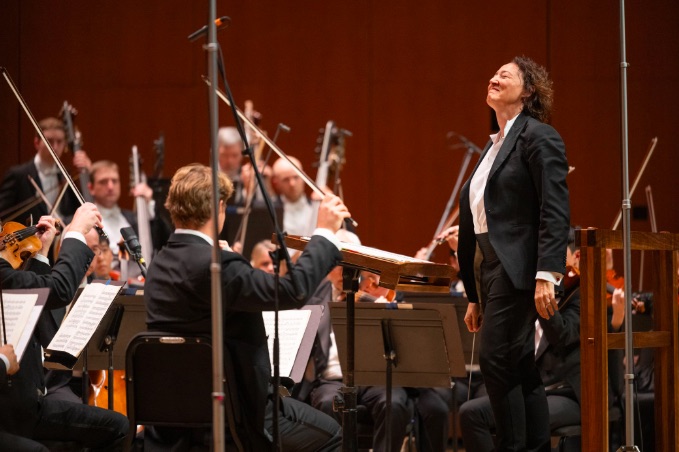
At evening’s end, after the “New World” Symphony and the cheers and standing ovation, after Stutzmann gave most of the orchestral principals recognition for their solos, after a lot of people trudged up the aisle on their way out, the orchestra sat down for an unexpected encore. Stutzmann and crew waited a long moment for all the rustling to stop (the microphones were still on), then played the Slavonic Dance with panache. (It was a repeat from the set of Slavonic Dances performed on last week’s ASO program.)
And there were other reasons the audience was so happy and excited. Just before the ASO performance, we heard an a cappella choir concert in the Woodruff Arts Center’s lobby. Columbus State University’s Schwob Singers, a vocally superb and exacting ensemble led by David Hahn, sang a diverse swath of music, from English Renaissance composer Orlando Gibbons to a wet-ink work by Marques L.A. Garrett. The group is in town for the National Collegiate Choral Organization annual conference, hosted this year by Morehouse College.
The ASO program, microphones and all, repeats Saturday at 8 p.m.
::
Pierre Ruhe was the founding executive director and editor of ArtsATL. He’s been a critic and cultural reporter for the Washington Post, London’s Financial Times and The Atlanta Journal-Constitution and was director of artistic planning for the Alabama Symphony Orchestra. He is publications director of Early Music America.
STAY UP TO DATE ON ALL THINGS ArtsATL
Subscribe to our free weekly e-newsletter.

