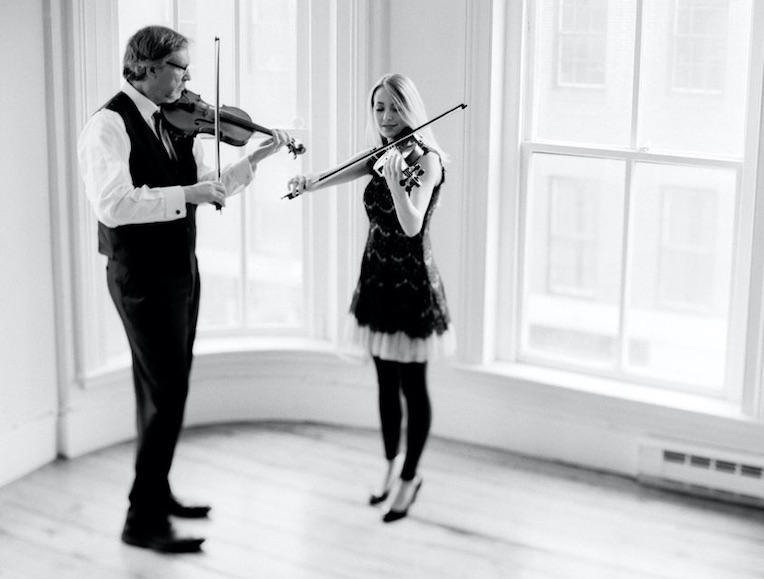
Review: Mark and Maggie O’Connor brilliantly fuse Bach and bluegrass
A common question among musical laymen regards the difference between a fiddle and violin. They are, ultimately, simply two names for the same instrument, and the difference arises from the styles of music played — the violin is associated with the regal grandeur of classical music while the fiddle is a staple of bluegrass, country and Celtic, among other folk styles. That stylistic departure formed the basis of “Bach & Bluegrass,” Saturday’s opening concert of the Emory Chamber Music Society of Atlanta’s 31st season.
William Ransom, the Society’s artistic director, loves combining seemingly dissimilar styles. “Bach & Bluegrass” drew a packed house to Emory’s Schwartz Center for Performing Arts in an evening that featured Ransom and Vega Quartet violinist Emily Daggett Smith as the classical segment of an evening largely devoted to bluegrass fiddle virtuoso Mark O’Connor and Maggie O’Connor, his equally skilled wife.
Mark O’Connor’s backlog of credits is a testament to his formidable talent. He has played on more than 450 albums, won multiple Grammy awards and played with artists as diverse as The Dregs, Yo-Yo Ma and Alison Krauss. Maggie O’Connor is a more recent upstart in the fiddle world but has amassed considerable accolades. Their chemistry proved to be undeniable and would come to dominate the stage.
The evening began with Vega violinist Smith playing Johann Sebastian Bach’s Partita No. 3 in E Major in its entirety. Seeing Smith in a solo environment and removed from the familiar bulwark of the Vega Quartet was a pleasant surprise. She is an engaging soloist with the kind of bright, shimmering tonality that highlights the violin’s high end without becoming shrill. The work itself was an apt choice to set the stage for the hybridized evening at hand: The piece contains the kind of swirling, protracted, melodic development commonly associated with the Scottish reels and jigs that form the cultural foundations of bluegrass.
O’Connor emerged to thunderous applause and began alone on stage with a medley of his own bluegrass compositions. Within the first opening notes, the atmosphere was shifted from the marble halls and vaulted cathedrals of the classical world to the folksy, earthy expanse of bluegrass. That central concept of bluegrass fiddle — the uptempo barrage of melody notes against a sustained tone from the same instrument — kicked in and carried the audience off to the Celtic isles, the foggy mountains of Appalachia and the languid journeys of riverboats across the Mississippi. O’Connor’s skill is in capturing the inner workings of the genre to such a degree that his playing becomes paint on the canvas of the imagination.
Smith joined O’Connor for his “Menuhin Caprice” and the combination was pleasant if somewhat jarring. Both players carried themselves with professional aplomb but struggled to fully gel. O’Connor’s folksy warmth and Smith’s classical grandeur circled around one another in complementary but nonetheless disparate orbits. It was enough to call into question whether or not Ransom’s cross-genre gambit would pay off. The evening was set to culminate in a full-on fusion of the two styles and these early exchanges seemed less than promising.
The audience, however, ate up the duet with such excitement that they were rushing to applaud even during prolonged moments of silence within the piece. Much of that energy is owed to O’Connor himself — he has a rugged charm that transcends the often dry, surgical aura of traditional classical performers, and that understated charisma is a skill in and of itself.
Maggie O’Connor finally made her appearance on the traditional “Sallie Gooden” playing musical spoons. The combination was delightful and afforded her the opportunity to kick out some surprisingly intricate motifs on the unorthodox percussion instrument.
The second half began with Smith, fellow violinist Jessica Shuang Wu and pianist William Ransom performing the first two movements of Bach’s “Concerto for Two Violins in D Minor.” The performance was superb and carried off by some of Atlanta’s finest classical players, but it felt superfluous in the face of Mark and Maggie O’Conner’s overarching presence. This was their show, and they could have easily carried the entire night on their own.
The husband and wife returned for “Jerusalem” and “Gold Rush,” selections from their Duo album, and “Cadenza” from Mark O’Connor’s “Double Concerto for Two Violins.” The segment saw Maggie O’Connor once more emerge as a force to be reckoned with — this time on fiddle. Her solo passages were fiery and filled with a dazzling passion that dared to outshine her more genteel counterpart.
After another changing of the guard — this time for Wu and Ransom to perform Mark O’Connor’s “Waltz” from Fiddle Sonata — the entire cast of players took the stage for a finale that saw Ransom’s penchant for stylistic blending pay off in spades. The ensemble played two final O’Connor compositions: “Hoedown” from Fiddle Sonata and “Olympic Reel,” which brought the previously clashing worlds of bluegrass and classical together in a kaleidoscopic tapestry. All those mental images of marble halls and the Appalachian Mountains were suddenly comfortable drifting gaily in and out of one another.
As the quintet closed out the night, it was clear that Will Ransom’s eye toward fusion was sure to yield prodigious results, not the least of which was a thrilling opener for the Emory Chamber Music Society’s 31st season.
::
Jordan Owen began writing about music professionally at the age of 16 in Oxford, Mississippi. A 2006 graduate of the Berklee College of Music, he is a professional guitarist, bandleader and composer. He is currently the lead guitarist for the jazz group Other Strangers, the power metal band Axis of Empires and the melodic death/thrash metal band Century Spawn.
STAY UP TO DATE ON ALL THINGS ArtsATL
Subscribe to our free weekly e-newsletter.

PLEASE SUPPORT ARTSATL
Your Gift Sustains the Coverage You Count On!
Related Posts