
Review: Jessica Blinkhorn’s ‘20 Years of Atrophy’ at End Project Space
A gray line circumscribes the gallery. At hip height, this line serves as the base for the artworks which hang on and above it. With vertical branches off this center line connecting select artworks, Jessica Blinkhorn’s solo exhibition, Timeline: Two Decades of Atrophy, through April 27 at The End Project Space, is deceptively simple.
A mini-survey exhibition cataloging an artist’s oeuvre over two decades, organized chronologically, sounds like it has more didactic efficacy than artistic. But this is more than a catalogue raisonée. As the artist charts the development of her art practice, she simultaneously resists subsuming her art to her disability, instead describing her growing disability as an evolution — not a devolution — of her practice and a way of bringing much-needed attention to people with disabilities.
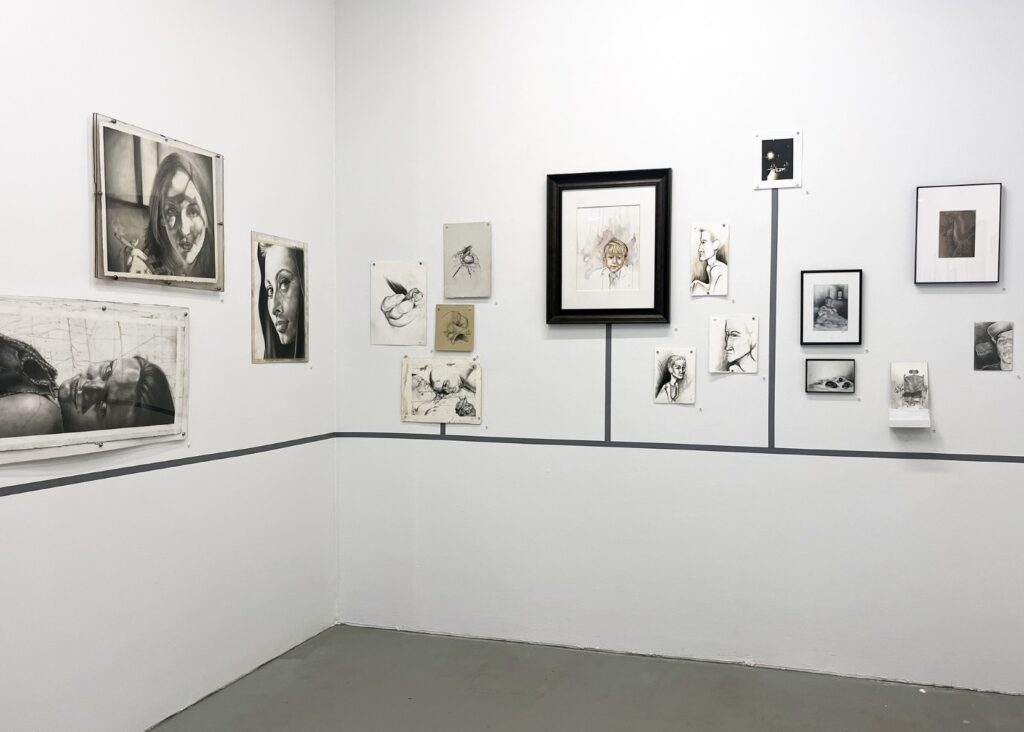
The earliest works presented are midsized drawings. What the fuck are you looking at? (2005) is one of the earliest. It’s a portrait of a woman, the composition cropped to show mainly her face, which gazes out directly at the viewer. She holds a cigarette from which smoke rises lazily, ash building on its tip.
The title of this piece and the confrontational gaze of the protagonist establishes from the beginning that Blinkhorn will not be intimidated. A defiance that both keeps the viewer in check and serves to remind just how many times the artist has likely been reduced or minimized. The technical mastery of the artwork, rendered in graphite, shows Blinkhorn’s prowess at manipulating the medium. While her draftsmanship makes this artwork intriguing, her disability strengthens it — giving it a gusto a more traditional portrait would lack.
As the timeline progresses, the perspective shifts from her own artwork to photographs of her. Where I Found You (2012) is a nearly all-black composition. The only light illuminating the scene is a single spotlight that shines on the artist. Lying naked on a bed on the far left of the composition, the artist seems to be under examination — interrogated. Taken from the artist’s right side, it is as if we are bystanders watching a woman be stripped bare and publicly displayed. This point of view fills the artwork with precarity. Will we intervene and help shield her from the alienating lighting? Will we do anything at all? The artist dares the viewer to respond.
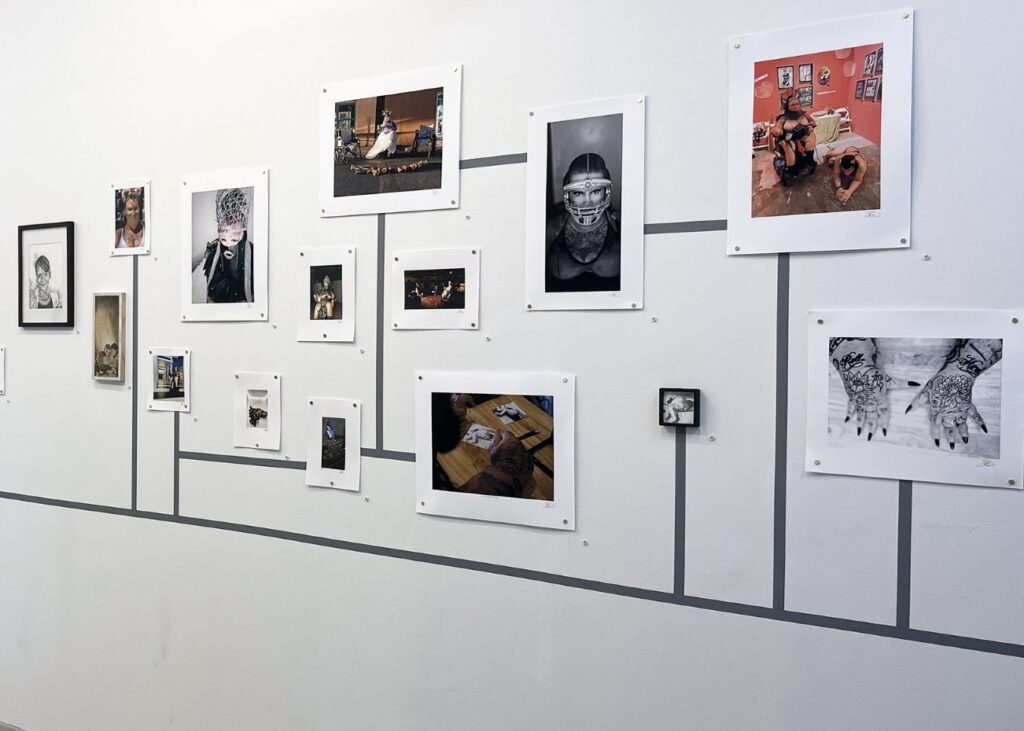
Looking around the gallery from left to right, the exhibition begins with mid-sized drawings that continue to decrease in scale until they are no longer included. Inversely, the photographs begin small and slowly increase to midsize, at which point they are the only medium represented.
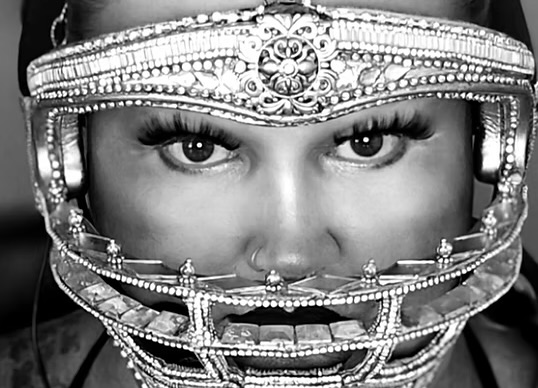
At a point about halfway along the timeline, when the drawings and photographs are comparable sizes, lies one of the most powerful artworks of the exhibition. Revenant Warrior (2022) is a photograph of the artist. Cropped to show only her head and shoulders, it is taken frontally, but not much of her face is visible. The artist wears a gold chain mail shroud which hangs across the lower half of her face.
As with What the fuck are you looking at?, this artwork is defiant. It comes at a time in the artist’s career when drawing has been subsumed by performance and photographs of her and her work. While this shift is likely due to her growing disability, Revenant Warrior shows it is not a devolution.
All artists face struggles within their practice, some more severe than others, but Blinkhorn does more than adapt to her challenges, she embraces them. Refusing to let her body limit her artistic output, she has found new methods of expressing the same stalwart independence seen in her early drawings.
So while this exhibition may at first read as a survey, it is in fact a battle cry. With each piece in the exhibition, Blinkhorn shouts that she and her practice aren’t going anywhere. No matter what.
The exhibit continues through April 27. A gallery talk is scheduled for April 21 at 5:30 p.m., and Blinkhorn will give an artist talk via Zoom on April 23 at 5:30 p.m. Check with the gallery for details.
::

Leia Genis is a trans artist and writer currently based in Atlanta. Her writing has been published in Hyperallergic, Frieze, Burnaway, Art Papers and Number: Inc. magazine. Genis is a graduate of the Savannah College of Art and Design and is also an avid cyclist with a competition history at the national level.
STAY UP TO DATE ON ALL THINGS ArtsATL
Subscribe to our free weekly e-newsletter.

