
Review: Gorgeous, exuberant Kim Chong Hak at the High
Kim Chong Hak: Painter of Seoraksan, at the High Museum of Art through November 2, delivers a timely gift to Atlanta and a great reason to celebrate. This is the first American museum exhibition dedicated to the Korean artist, and it informs and delights with paintings of such breadth, beauty and sheer exuberance that you will leave asking “how could I not have known this artist?”
Fortunately, this exhibition and the informative, eloquent essays in its don’t-miss catalog go a long way toward answering this question. Director Rand Suffolk poses variations in his foreword: Why here and why now? Why here in part because, Suffolk writes, Korean Americans are the second largest and fastest growing immigrant community in Georgia. Why now? Well, Kim, is 88 years old, and it’s time, and, well, you’ll see.
Though Kim is one of Korea’s best-known artists and has earned the moniker “The Painter of Seoraksan” for the gorgeous paintings he made for decades in and around Mount Seorak in Eastern South Korea, he is virtually unknown or at least undercelebrated in this country. (This will no doubt change on the wings of this gorgeous show.)
Occupying two floors at the High, the show is ordered loosely chronologically and by season. Beginning with some of Kim’s early work, we see the influence of earlier movements, some of which he was instrumental in forming and most of which he left behind.
Wall text in the first gallery offers this quote from Kim: “In the summer of 1979, I ran away to Mount Seorak. I wanted to run away from my family and from the art world . . . I wanted to live as I please. And I wanted to be truly alone . . . (to) spend all four seasons with the mountain, drawing spring in spring, summer in summer, autumn in autumn and winter in winter.”
Born in 1937 in what is now North Korea, Kim experienced the Japanese colonization of Korea (1910-1945), the dividing of Korea into North and South (1948), the Korean War (1950-1953) and, in its aftermath, the turbulence of a divided country (one of the reasons this show is also timely in ours). But it may have been the democratic movements of the 1970s and 1980s and strained climates of his country and his personal life that shaped him most. For it was then, in that summer of 1979, that Kim escaped to the mountains, as Thoreau escaped to his woods — to live deliberately.
Abstraction (1970), a blood red painting that incorporates ochre burlap around a central void, recalls both the colors and form of a Rothko painting and the textures of the Catalan painter Antoni Tàpies.
This symbolic void is echoed in the sumptuous Untitled from 1978, but here the mountain-shaped ink wash at its center evokes the late-15th century traditional landscapes of the Joseon Dynasty (1392-1910), reflecting Kim’s desire to draw upon Korea’s own traditions and folk art which had long been overshadowed by colonial and post-colonial struggle — both political and personal. Incidentally, Kim’s collection of Korean craft and folk embroidery enlivens the show and helps to shape our understanding of his artist’s eye.
It was in his seclusion at Mount Seorak that Kim found, as he describes in a letter to his daughter, a turning point in the direction of his paintings. Turn the corner and you will be so glad he did.
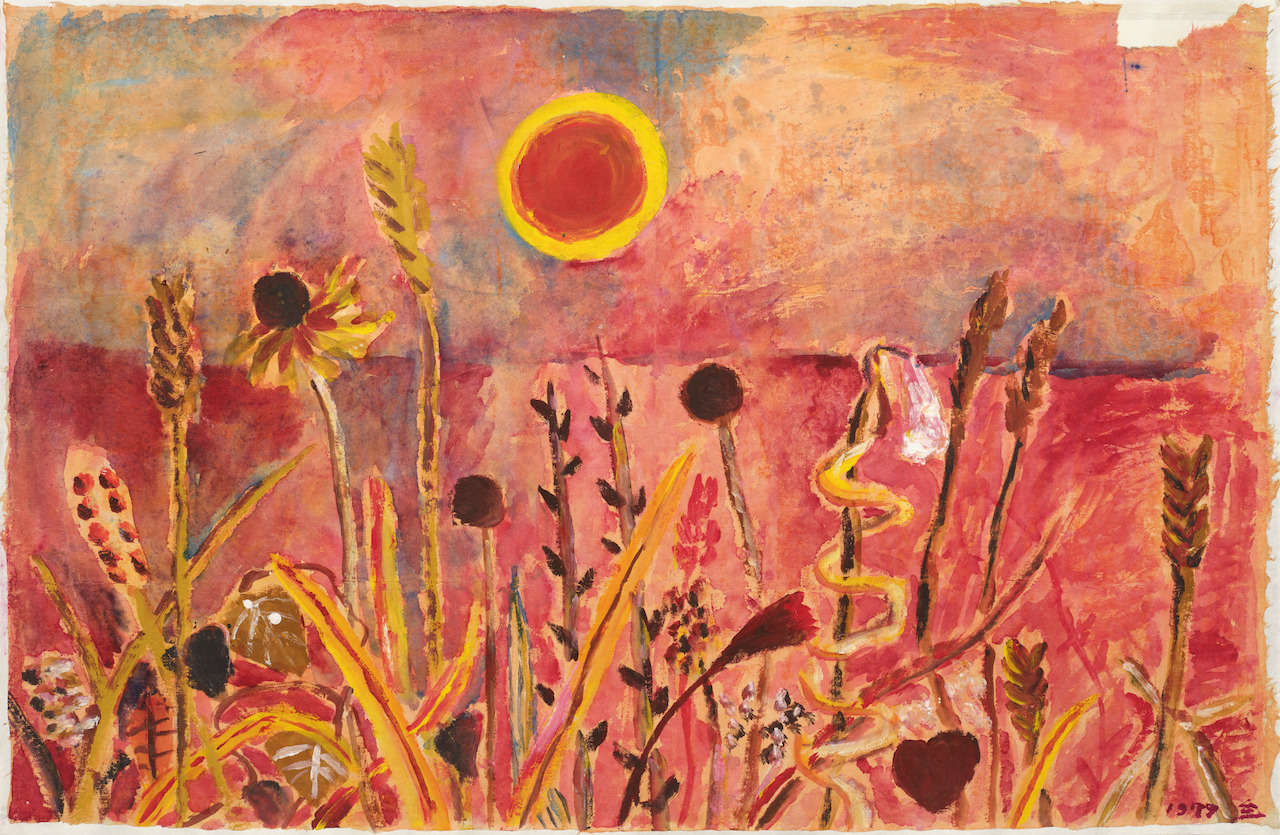
Eye-popping color and large-scale paintings reflect an intense observation of and an apparent joy in the nature that surrounded him upon his perennial returns to Mount Seorak. Autumn Sunset (1980) vibrates with dizzying Charles Burchfield-like form and color. In its all-over, edge-to-edge exuberance, Autumn (1992) recalls Jackson Pollock’s Mural from 1943.
These allusions to other artists serve as exposition and not as an attempt to categorize or limit the man, for one of the pleasures of this exhibition is Kim’s singular vision.
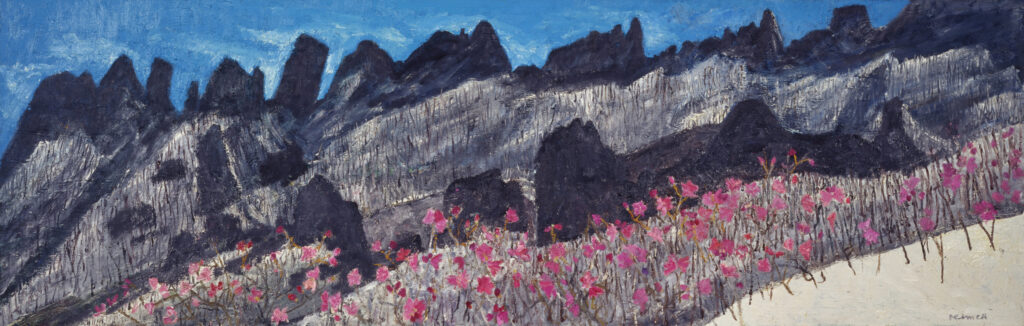
Kim’s winter paintings, according to wall text, “embrace the philosophical potential of nature’s vitality in all things . . . (its) hidden promise.” Mount Seorak dominates many of these paintings.
The panoramic Untitled (Winter) (2020) is a tour-de-force of seeing. It is as if by having to try harder in winter’s starkness, he must look even more closely, and, in so doing, he demonstrates his power of seeing and his ability to convey expressionistically what he is feeling about what he sees.
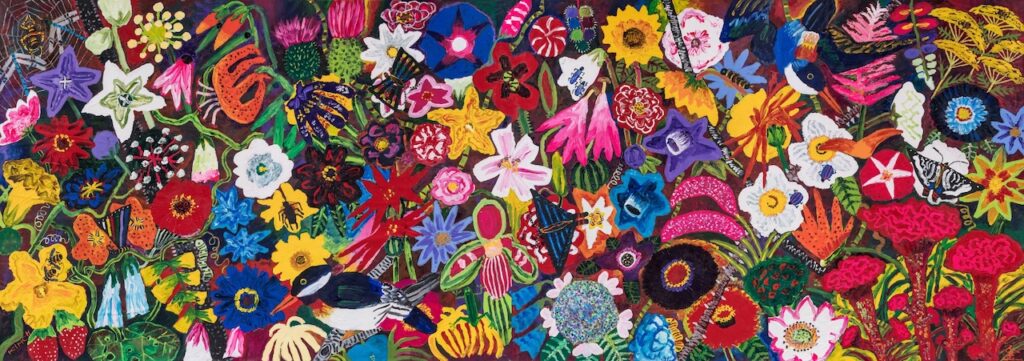
Moving upstairs into the exuberance of Kim’s summer and spring paintings becomes a literal experience of the changing seasons. Joyous and fecund, spring’s bright flowers and summer’s lush greens make for riotous paintings, especially so when seen beside Kim’s quieter practice of daily botanical studies drawn from nature.
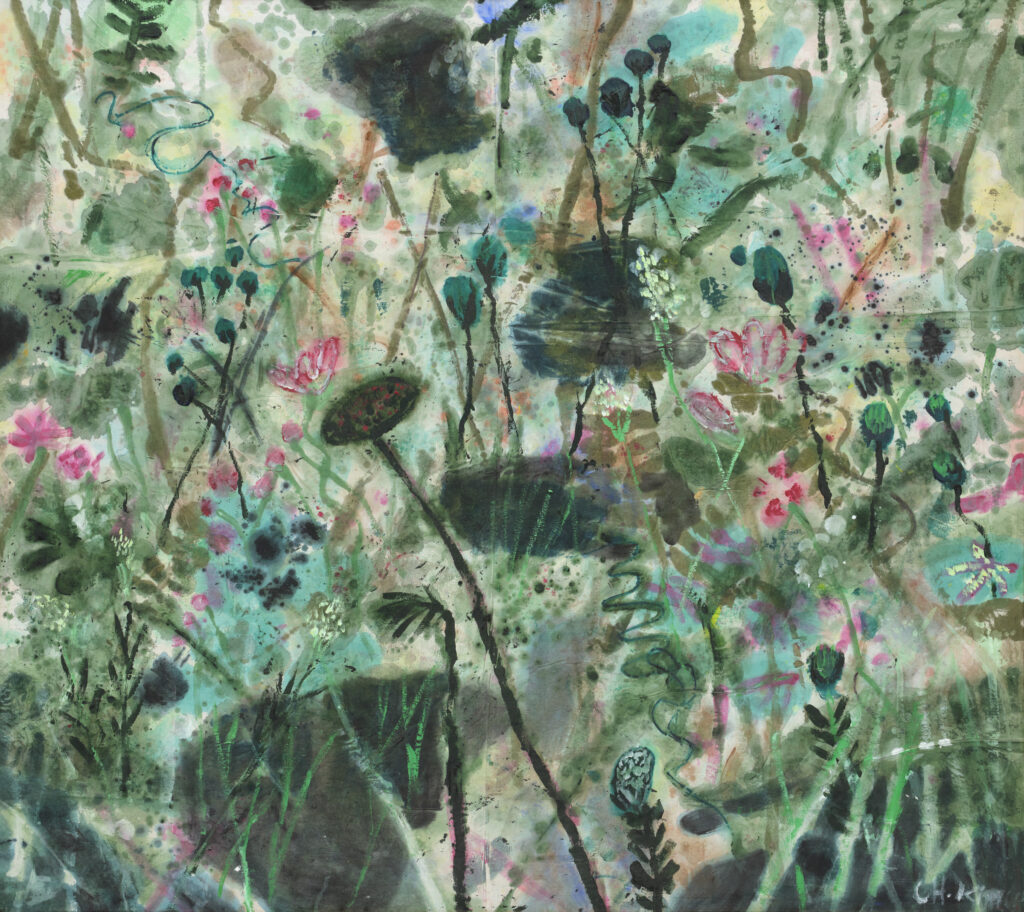
From the all-over visual field flower paintings, for which he is best-known in Korea, to 1987’s Forest and the eight-paneled folding screen River, with its bug’s-eye, riparian view of bright blue water, Kim seems to rejoice in the act of seeing, which, when done well, to paraphrase French philosopher Simone Weil, is a form of prayer.
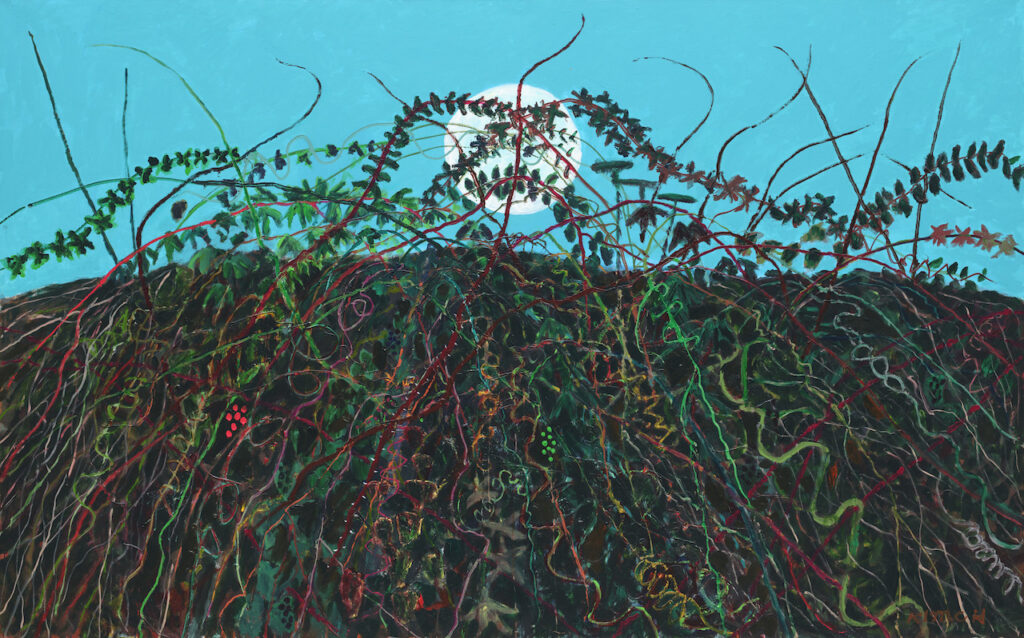
Coming full circle, Pandemonium (2018), Kim’s largest work to date, suggests an ecstatic surrender.
Surrender, not in the form of the void in his earlier paintings but to nature and beauty itself, to individualism and individual expression unfettered by acceptable norms and, above all, to an appreciation of the sheer vitality of it all.
It was at Seoraksan, revitalized by his surroundings, that Kim discovered his own answers to the questions he had struggled with as an artist at the forefront of the Korean art movements of the ’60s and ’70s. It looks as if one of them is joy in communion with the natural world — at least this is how it feels and why this show, right here, right now, feels so vital today.
In the catalog foreword, Suffolk thanks Michael Rooks, the High’s senior curator of modern and contemporary art, for introducing Kim to the High and its audience and for the passion and insight he brought to the project. Kim Chong Hak: Painter of Seoraksan will compel you to do the same.
::

Donna Mintz is a visual artist who writes about art and literature. A current studio artist at Atlanta Contemporary, her work is in the permanent collections of the High Museum of Art and MOCA GA. She writes for the Sewanee Review, Sculpture magazine, BurnAway and ArtsATL, where she is a regular contributor. She recently completed a book on the life of writer James Agee and holds an MFA from Sewanee’s School of Letters at the University of the South.
STAY UP TO DATE ON ALL THINGS ArtsATL
Subscribe to our free weekly e-newsletter.

