
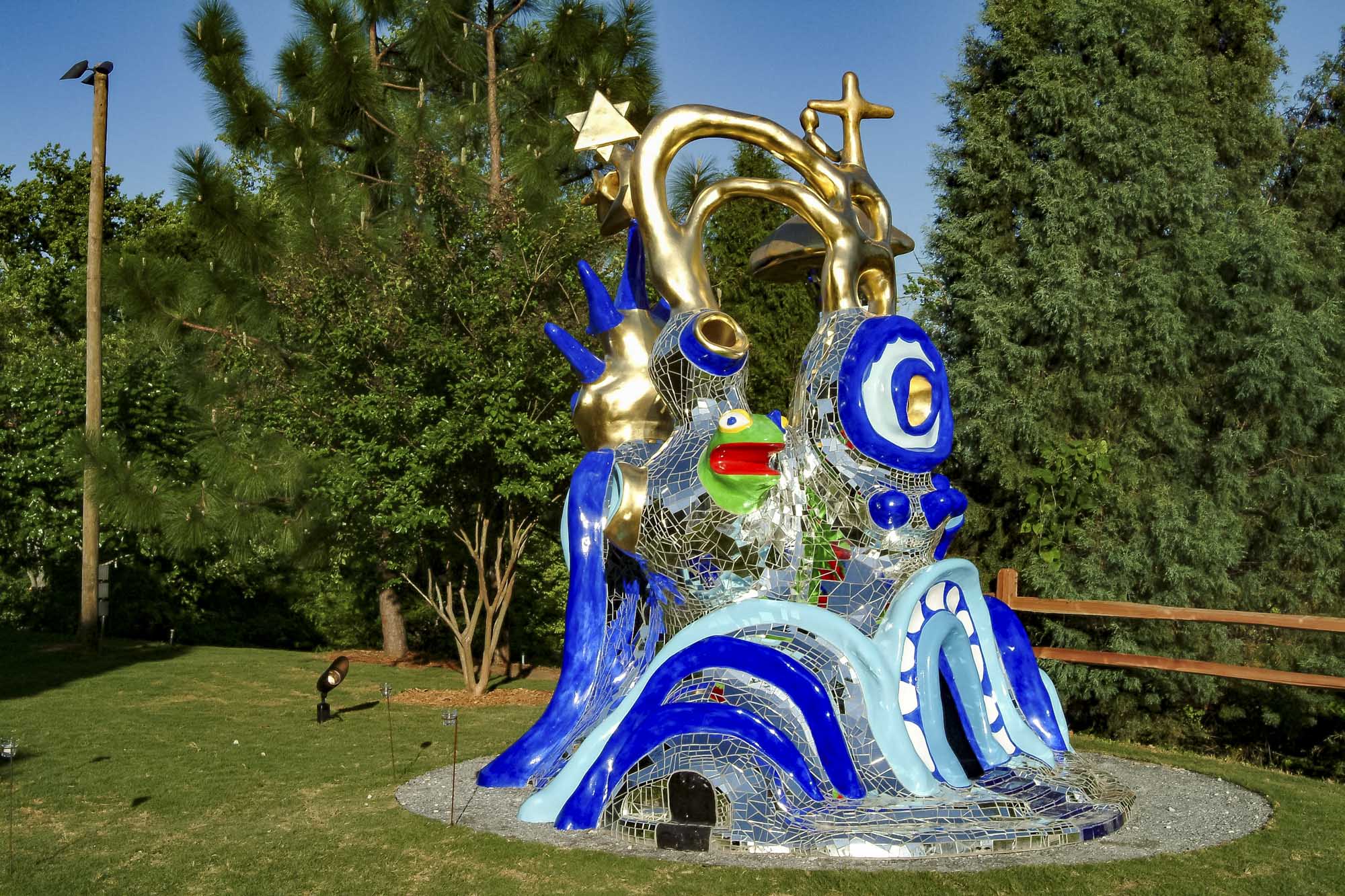
‘Niki in the Garden’ marks 50 years for the Atlanta Botanical Garden with myth, music and monumental joy
In the lush heat of the tropical greenhouse at the Atlanta Botanical Garden, Adam and Eve seem right at home. They sit together spread out on a picnic blanket, sharing an apple as if it were the most natural thing in the world, the weight of myth reduced to a casual picnic. Hidden in the dense leaves nearby, a serpent coils silently, less a threat than a patient presence — unseen, happily waiting his turn.
This is just one of many delightful encounters in Niki in the Garden, an art exhibition for which there is no single, contained space for the work. Instead, this show unfolds across the paths, lawns, plazas and fountains of the Botanical Garden, requiring visitors to encounter sculptures in the rhythm of wandering.
The occasion is a revival of the Garden’s 2006 presentation of the same name, now marking the institution’s 50th anniversary with what is believed to be one of the largest outdoor presentations in North America of works by renowned artist Niki de Saint Phalle. Roughly 40 sculptures are distributed across the grounds and indoor spaces, drawn largely from the Niki Charitable Art Foundation and private collections.
In early May, Niki de Saint Phalle’s daughter, Laura Duke Condominas, visited the Atlanta Botanical Gardens and spoke with ArtsATL about the success of the installation during her visit. “I came here and saw the Omega sculpture, and there were two women — one was looking after the other, who had some sort of imbalance. The woman who was caring for her asked, ‘What do you see?’ and then the woman started dancing and saying ‘happy, happy!’ in response to the sculptures. It was really amazing. My mother’s mission was totally accomplished at that moment,” said Condominas.
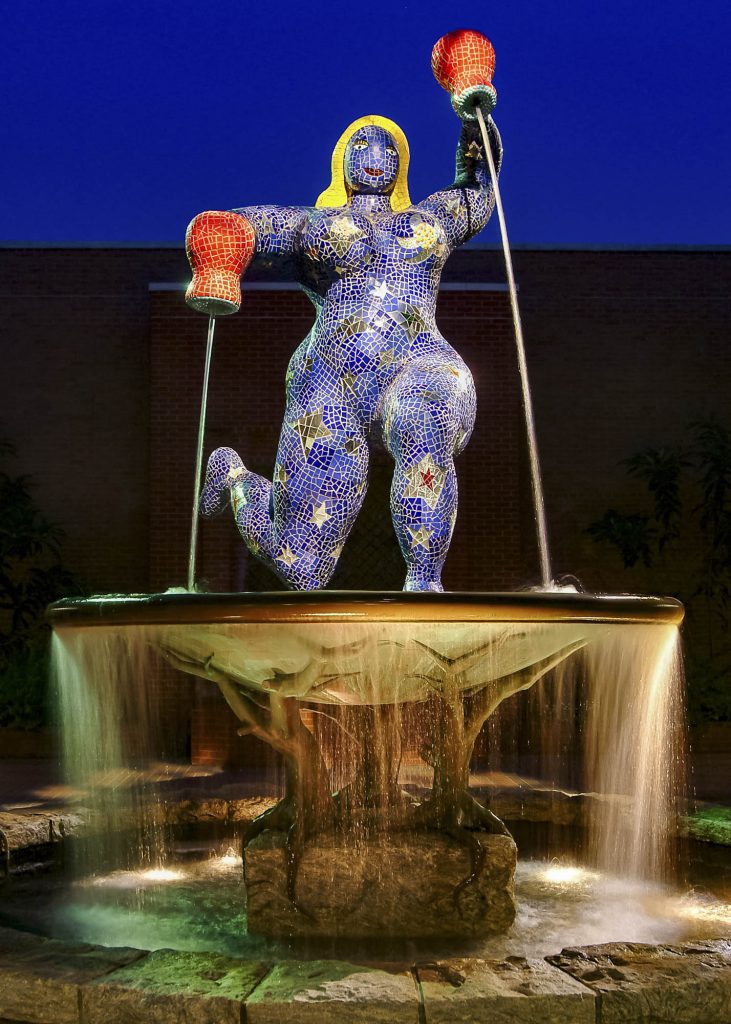


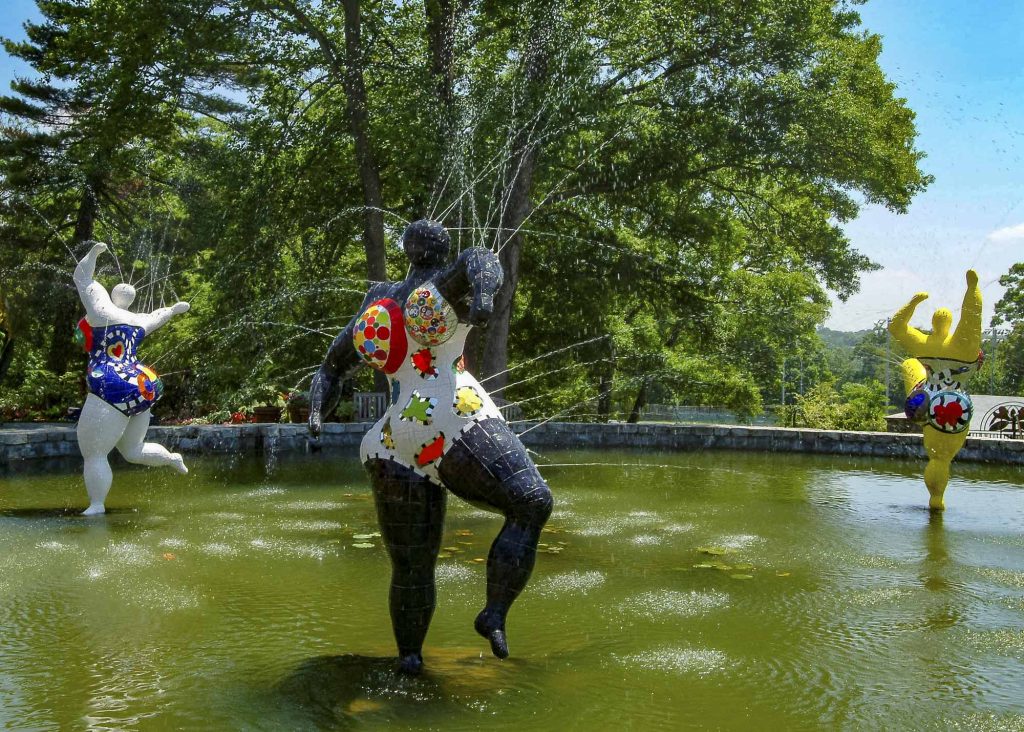
All photos © 2026 NIKI CHARITABLE ART FOUNDATION. All rights reserved.
Saint Phalle’s work has long occupied a complicated position between public joy and private anguish. Though widely celebrated for the exuberant “Nanas” that made her an international figure in the 1960s and ’70s, her practice also emerged from childhood trauma and violence. Earlier works such as her rifle-shot “Tirs” paintings framed violence itself as a form of artistic production, making the later monumental sculptures feel transformational rather than purely decorative.
What emerges at the Garden is less a linear exhibition than a series of encounters; moments where sculpture and setting briefly lock into something like narrative. A Louis Armstrong figure appears mid-performance in a sunlit plaza, brass horn blasting toward the open air of a busy path; nearby, Miles Davis sits in quieter opposition, head down, shaded and inward. Elsewhere, mirrored surfaces dissolve a sculptural form almost entirely into its surroundings, hovering somewhere between presence and absence.
At its strongest, the exhibition thrives on these site-specific dialogues. The Adam and Eve greenhouse scene is one; the “Omega” figure, nearly erased by reflection, is another. Even the familiar “Nanas” — Saint Phalle’s famously exuberant, monumental female figures — come alive when placed in relation to water and movement, as in the fountain installations where their celebratory postures seem to activate the space with dance rather than simply occupy it.
Whether encountering mythic figures, jazz musicians or playful totems, there is an ease to moving between works that resists the stiffness of more conventional gallery environments. It would be difficult not to find moments of joy here.
And yet that very expansiveness is also where the exhibition becomes more complicated. Saint Phalle’s practice spanned an extraordinary range of reference points, from mythology, tarot and Jungian symbolism to jazz, sports figures and monumental female archetypes. In this presentation, those worlds are placed side by side rather than deeply explored. The result is a kind of visual abundance that can feel exhilarating in the moment but also slightly unresolved, as if many distinct projects have been condensed into a single gesture rather than allowed to fully develop on their own terms. Here, the breadth of her interests is presented as a kind of survey rather than a series of deeply articulated investigations. The effect is generous but diffuse.
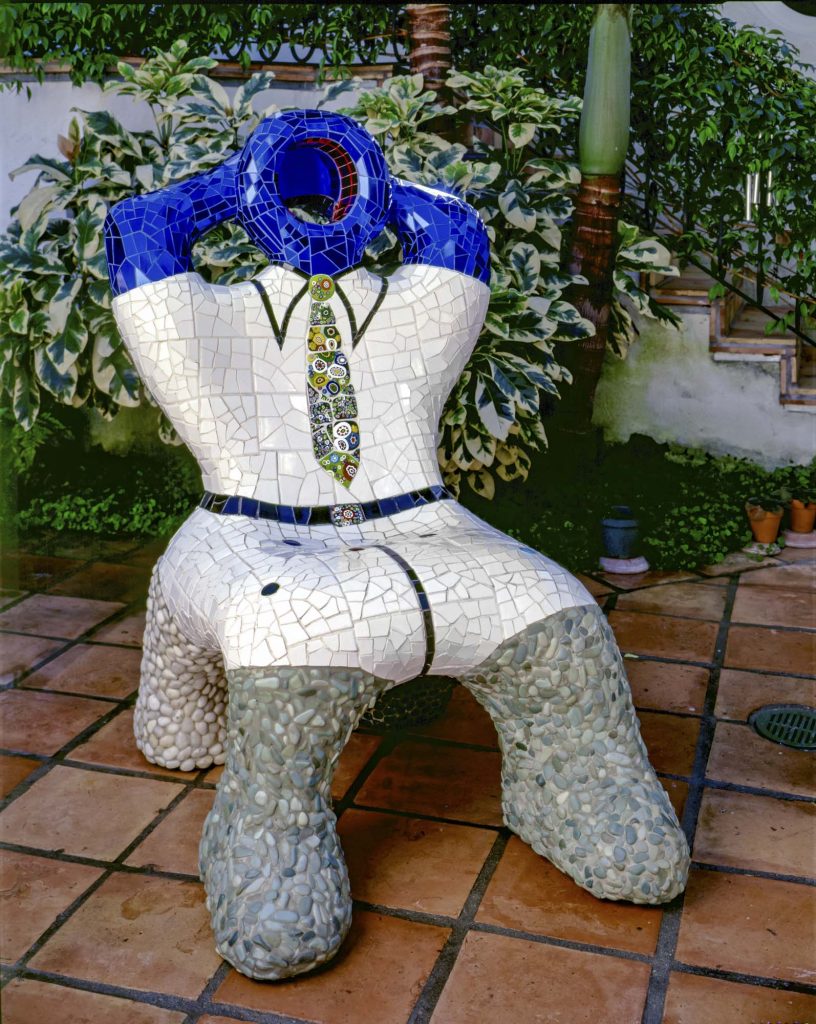
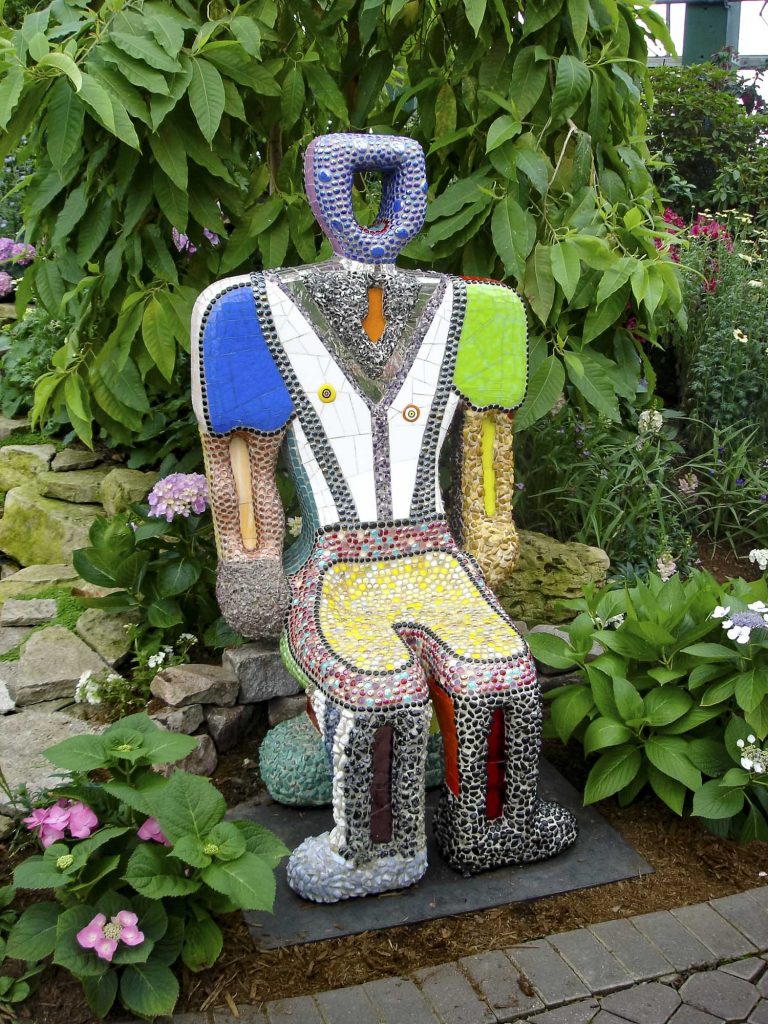
There is also a more subtle tension embedded in the presentation itself. Some of the works included — benches, chairs and sculptural forms clearly designed for interaction — are roped off and placed beyond reach. The restriction is understandable in a public garden setting and necessary for preservation, yet it introduces a quiet contradiction. Works clearly designed for touch, rest and proximity are instead experienced only visually, slightly removed from their intended use in a landscape that otherwise invites physical engagement.
Saint Phalle’s work often hinges on accessibility — on the collapse of distance between viewer and object; on scale that invites rather than intimidates; on surfaces that demand bodily relation even when they are monumental. In a garden context, those instincts are both partially fulfilled and partially withheld.
Still, it is difficult to leave this experience unmoved. The vitality of the installation, the sheer pleasure of encountering sculpture in motion with landscape and the occasional moments of striking precision give the exhibition a lasting charge. Even when uneven, it never feels inert.
In the end, Niki in the Garden succeeds as an experience, a way of moving through the world in which art is not isolated but embedded. The result is less a definitive statement about Saint Phalle’s legacy than a reminder of its range — and of how much it still resists easy containment.
Niki in the Garden will remain on view at Atlanta Botanical Garden through September 6.
Editor’s note: if you’d like to learn more about this exhibition, be sure to check out Lois Reitzes’ recent interviews with Atlanta Botanical Garden President and CEO Mary Pat Matheson and with Saint Phalle’s granddaughter, Bloum Cardenas on the ATL Arts Collective podcast.
::

Andrew Alexander is an Atlanta-based writer.
STAY UP TO DATE ON ALL THINGS ArtsATL
Subscribe to our free weekly e-newsletter.

