
Atlanta variety shows offer laughter, screams and clowns to counter modern-day woes
On the fourth Monday of every month, Joy Deficit host Gina Rickicki gives the audience at her variety show at Red Light Cafe an opportunity to just scream collectively and release whatever frustrations they’re carrying around with them — for 13 seconds.

“When I first started the show, I knew I wanted to start with the scream for a couple reasons,” she said in a recent interview. “I like to have layers to things. One is because, much like in chorus when everybody is singing the same note or the same song, everybody’s breath syncs up. Their heartbeats sync up. It’s part of human biology, right? Unison. We focus on the same thing, and we’re all in the same zone.”
Since Joy Deficit began in January 2024, Rickicki said the beginning screams have only gotten louder — and not just because her attendance has grown. The world is a maddening place these days, she said, and gathering together is a way to combat the darkness.
“The idea is that you came in with a bunch of negative stuff from the outside world, so we need to scream all of that out — scream whatever you want, cover your ears and scream, say the bad words and the scary thoughts,” she continued. “Say everything out loud, and it will be lost in the soup of community. And then we’ve made room for the joy to get in. At the end, if you do it right, you’re a little bit lightheaded, and it feels great.”
Joy Deficit’s monthly shows carry a theme, and performers can submit proposals to Rickicki for stage pieces — like music, burlesque, comedy, puppetry, poetry and more — that last about seven minutes. It and a number of other shows on smaller stages across Atlanta have emerged since the pandemic as places to congregate for silliness, tears, storytelling and connection. To many performers and attendees — and attendees who find themselves onstage as part of the show — these variety shows provide relief.

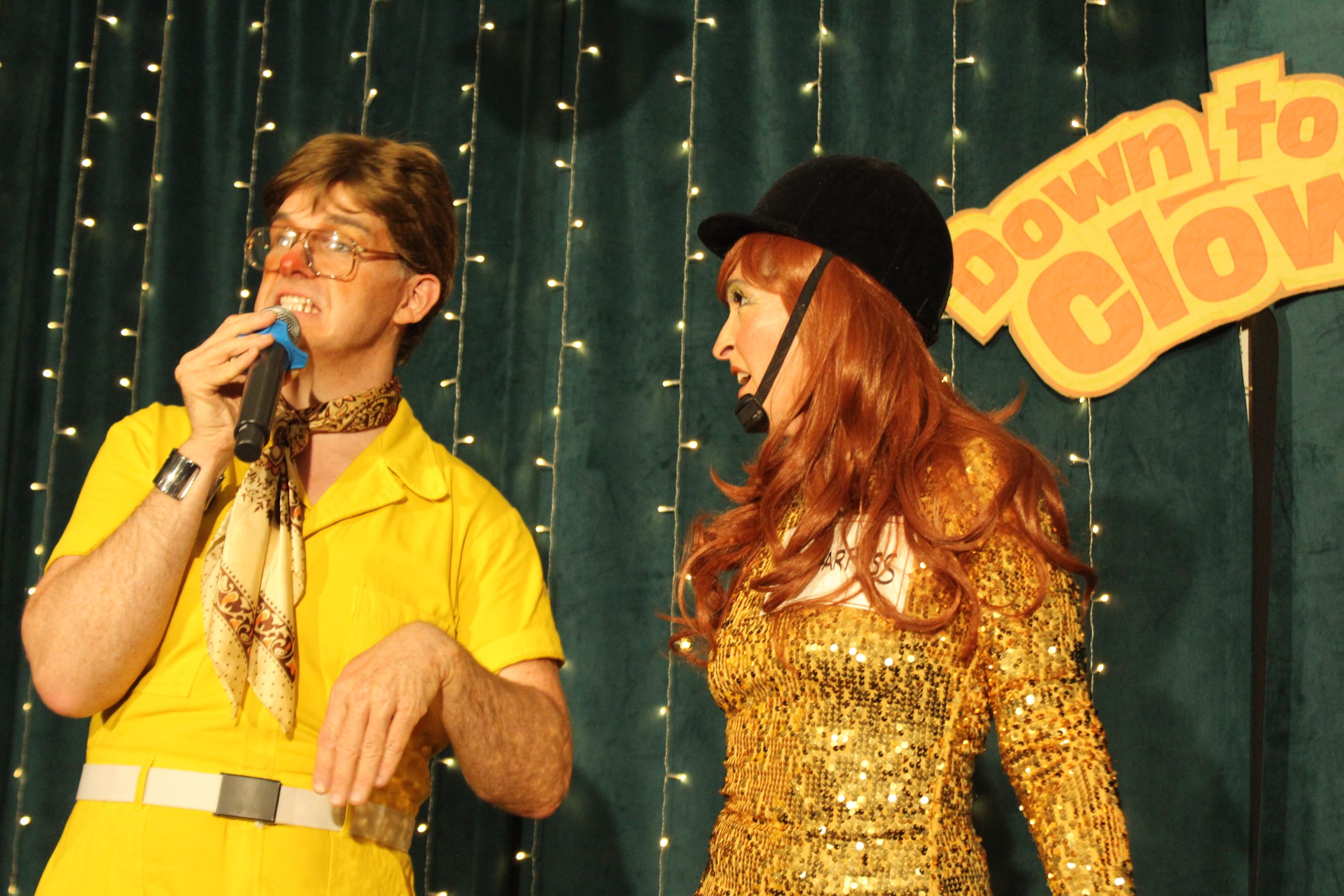
Scottie Rowell (they/them), a puppeteer, clown and musician who was the first performer to ever take the stage at Joy Deficit, now serves as host of Down to Clown, which will have its next production on July 17 at 8 p.m. in the Teller Productions Workshop on Park Avenue.
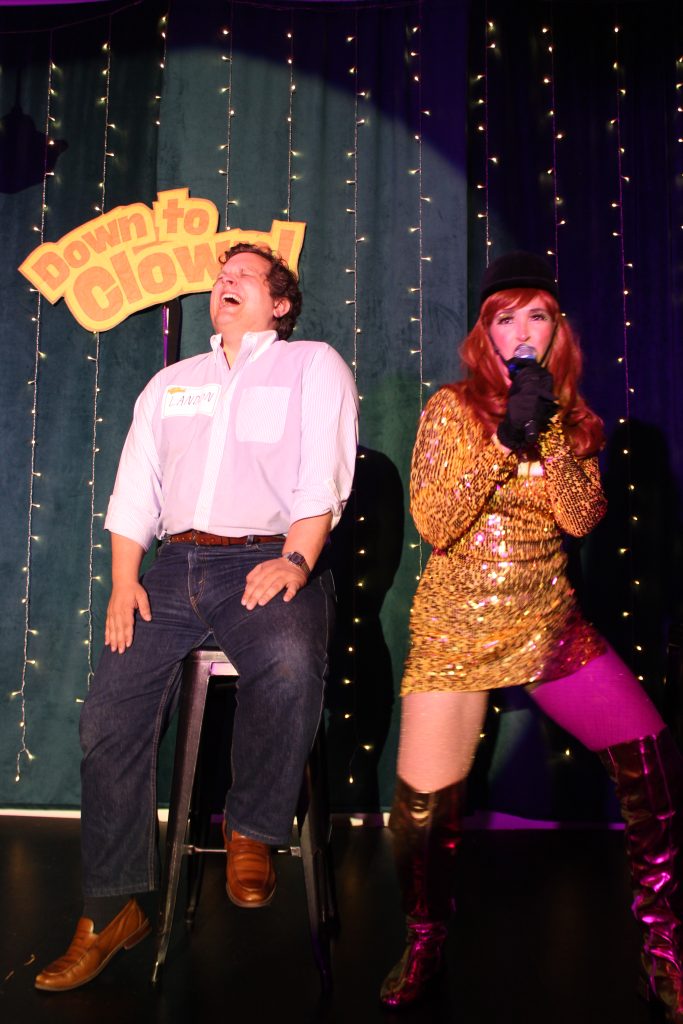
Down to Clown, a 1970s-style game show mashup featuring a cast of rotating clown performers and contestants pulled from the audience, was devised by comedian Karie Vieira, who realized that Rowell was the ideal co-producer to help her to bring their wacky, unpredictable show to life. The show began performances this year in Adair Park, evoking elements of old game shows such as Password, Match Game and more, and it is planned to recur each season.
“I think people are just very, very hungry for nonsense right now in a way that we are very happy to provide,” Rowell said. “Because of the state of the world, a lot of things are bogging us down. We are getting audiences who just want to check out and see something silly.”
Beyond that, a live theater show with other real people has a different appeal.
“People are so hungry for real things since AI is being pushed upon us in frustrating ways,” Rowell said. “People are like, ‘No, I want something tangible. I want to be holding a banana while a clown eats it! I want to go see a puppet show! I want something that is tactile right now in ways that I’m not getting otherwise in my life.’ We’re so on screens, gauging if something is real or not. And you know it’s real when a clown is accidentally spitting on you. You know it’s real when somebody is sitting in your lap.”
The audience interaction is what makes Down to Clown a special experience.
“There’s so much magic in having an audience member on stage because they want so badly to do well,” she said. “I think most people want to do well when you’re placed in a situation where eyes are on you, and the clown wants that, too, but the clown wants to do whatever pleases the audience.”
Rowell has repeatedly taken the stage at Joy Deficit and said the show has succeeded and grown because it’s tapping into an audience seeking common ground and hope.
“That show definitely has some clowning to it, but other performers are just there to make you feel,” Rowell said. “You want to connect with other people and have a sense of community.”
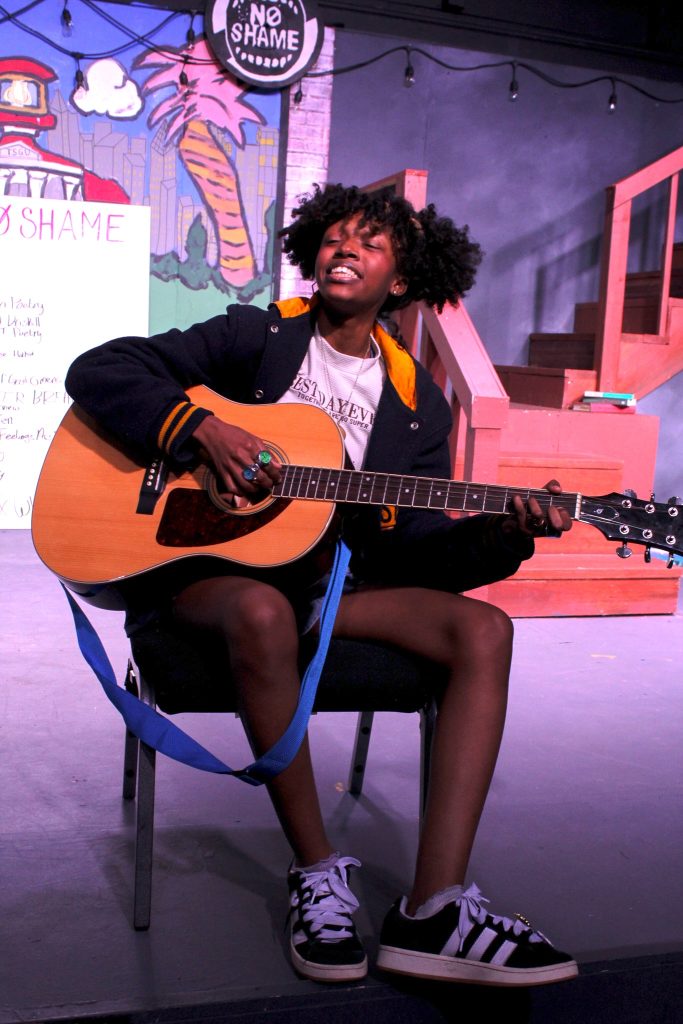
With its last show at Georgia Ensemble Theatre in Sandy Springs happening this Friday, May 15, the show NoShame Atlanta gives performers five minutes onstage to perform their own original pieces, so long as they’re safe, respectful and don’t break anything.
Co-hosted at 10 p.m. weekly by Nick Lynn-Rulon and Quincy Terrell, NoShame is a show format that began in the Midwest in the 1990s, where theater makers frustrated with the gatekeeping of some drama festivals created a free-for-all format wherein anyone who wanted stage time could perform from the back of a pickup truck.
Lynn-Rulon brought the show to the area after performing regularly at one at a theater in Columbus, Georgia, where he created the character Grimey the Clown, who he has since performed at Atlanta Fringe Festival and Down to Clown.
“A lot of what shaped me as an artist was having that regular Friday night deadline,” Lynn-Rulon said. “I’d tell myself, ‘This Friday I’m going to do something. I’m going to do something at NoShame. I don’t want it to be Friday and not have anything to do tonight.’”
Since NoShame Atlanta began in the winter, he has seen other performers inspired to return to the stage with new material weekly, building a supportive community.

After the May 15 show and going forward, Lynn-Rulon said NoShame will also be staged at the Teller Productions Workshop.
“This is the opposite of being on your phone and doomscrolling,” he said. “Being in an audience and not only laughing together but coming out on stage — getting on stage together. I think the common thread between Joy Deficit, Down to Clown and NoShame is that the audience is a part of it. The audience does make the show.”
For instance, Joy Deficit has multiple points in its format that allow for audience interaction. There is no cost to attend, and even parking is free. Audience members are encouraged to write what brings them joy onto a slip of paper, which is read onstage.
In each show, at a key moment, Rickicki invites an audience member on stage for a pep talk, provided the person is willing to stand up and share about any hardships they’re facing. And Rickicki and her audience do their collective best to lift that person up.
“Every show, someone trusts me in a room full of usually complete strangers or mostly strangers, even sometimes in front of their friends and family [and] they get up and they say something that’s real scary to them,” Rickicki said “And they trust that they’re going to be taken care of on stage. And for a lot of people, that’s a blind leap of faith.”
For the audience, the opportunity to help someone is just as valuable.
“When people realize they have a specific skill that can tangibly help someone in front of them, they get excited,” Rickicki said. “That is what humanity is supposed to be.”
::

Benjamin Carr is an ArtsATL editor-at-large who has contributed to the publication since 2019 and is a member of the American Theatre Critics Association, the Dramatists Guild, the Atlanta Press Club and the Horror Writers Association. His writing has been featured in podcasts for iHeartMedia, onstage as part of the Samuel French Off-Off Broadway Short Play Festival and online in The Guardian. His debut novel, Impacted, was published by The Story Plant.
STAY UP TO DATE ON ALL THINGS ArtsATL
Subscribe to our free weekly e-newsletter.

