Review: Emory’s “Artistic Directors” showcases the best of chamber music
In the world of classical chamber music, where ensembles are small and frequently interchangeable across the course of the bill, it’s easy to become immersed in the novel possibilities — from the traditional string quartets and organ solos to the more unexpected duets and trios. For that reason the format is one that generally rises or falls based on the efficacy of its conceptual continuity. The concentrated minimalism of “The Three Artistic Directors,” the Emory Chamber Music of Atlanta’s February 19 concert at the Schwartz Center for the Performing Arts, was a rousing success.
That success owes as much to the intriguing origins of the event as it does to the selection and ordering of pieces. According to the opening remarks by artistic director and pianist William Ransom, the concert had its conceptual roots in the work of violinist Linda Rosenthal and the Juneau Jazz and Classics festival, held in the far-flung reaches of Alaska.
Deciding to retire after 30 years of professional performance and education, Rosenthal reached out to Ransom in hopes of tapping him as her replacement as the head of the festival. Ransom would decline, owing to his already busy schedule, and nominate Grammy Award-winning cellist and accomplished artistic director Zuill Bailey as an excellent replacement, especially considering that Bailey was already heading the Alaska-based Sitka Summer Music Festival. With that professional rapport established, the three directors thought it would be appropriate to perform together at the 2020 installment of Juneau Jazz and Classics. That summit that was forestalled, like most things, by the Covid pandemic.

The years-long planning and globe-trotting that would eventually bring us to the Schwartz concert would ultimately prove to be time well spent, with two pieces by Beethoven (Sonata No. 3 in G Major, op. 30 and Sonata No. 3 in A Major, op. 69) and one by Shostakovich (Trio No. 2 in E Minor, op. 67) providing the basis for the evening’s meeting of directorial minds. It would prove to be a stirring and deeply personal event for the three performers, with the minimalist setlist and small chamber creating an almost voyeuristic level of intimacy.
The opening Sonata No. 3 in G Major found Ransom and Rosenthal burrowing deep into Beethoven’s signature world of dark, brash complexity with the kind of fluid passion befitting seasoned veterans. Rosenthal’s command of the violin’s tone is nothing short of captivating: Eschewing the sort of overly smooth tone so often heard in the realm of commercial violin performance, she instead wholeheartedly embraces a more traditional and penetrating vigor from her instrument. The result is an interpretation that captured the brooding passion inherent to Beethoven’s work.
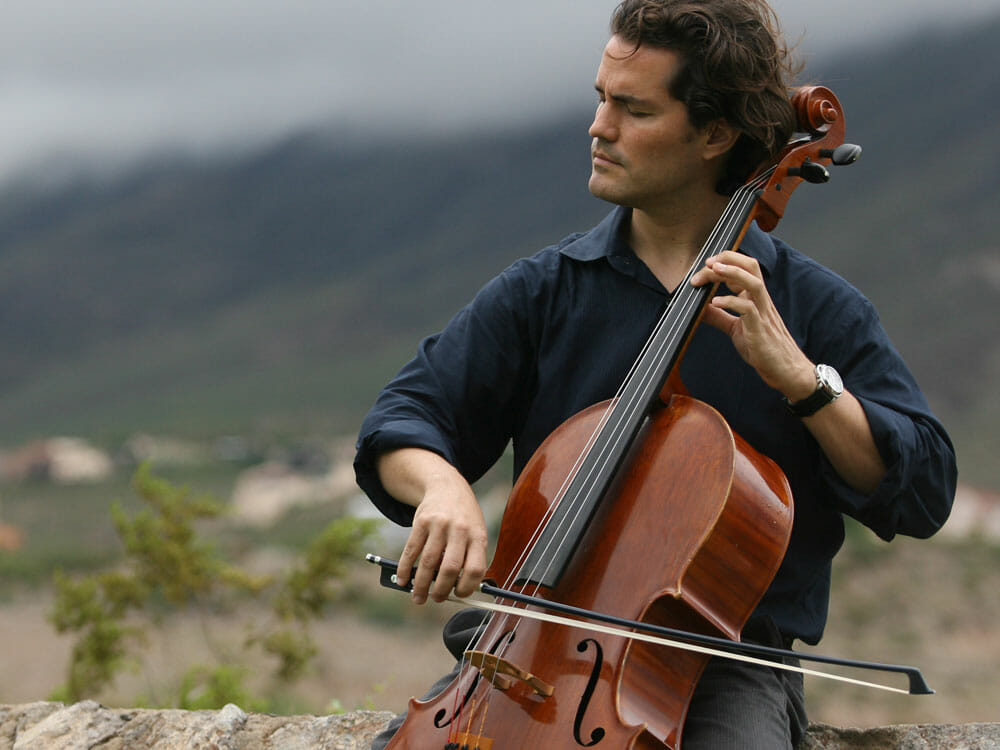
Beethoven’s Sonata No. 3 in A Major would focus Zuill Bailey as the evening’s most commanding presence. His tone is impeccable and his technical acumen unmatched but both are delivered with the sort of charismatic stage presence that casts an imposing shadow across his fellow performers — a trifecta that often made his duet with Ransom seem like a solo performance.
That zeal for presentation sets Bailey apart to such a degree that I was genuinely curious how he would meld with Rosenthal for the Shostakovich trio. Surprisingly, Bailey was more than willing to temper his rock-star grandiosity for the sake of a gentle dance of interplay with his two colleagues, one that was by turns rhapsodic, chaotic, and suddenly cheerful.
The Trio No. 2 in E Minor was written as a tribute to the passing of Shostakovich’s dear friend, Russian polymath Ivan Sollertinsky. As such, the work is often wildly disjointed, with moods shifting in and out of one another seemingly at random. It is, nevertheless, a fitting embodiment of the process of grief, one where shock, anger, depression and acceptance lurch in and out of each other in sudden, unexpected bursts. Bailey is more than comfortable in that chaotic realm, as his deft handling of the false harmonics at the cello’s upper register in the Trio’s opening bars attested.
Given the third and final piece’s shorter length, the performers opted to open the floor for questions from the audience. As before, Bailey would dominate with a charismatic personality to match his commanding presence on the instrument. That grandiosity would, once again, prove justified as he regaled the audience with stories of the crafting of his 329-year-old cello and the magical splendor of visiting Alaska.
All in all, it was a captivating night. I did not expect to leave the concert hall having a new favorite cellist, but Zuill Bailey would have it no other way.
STAY UP TO DATE ON ALL THINGS ArtsATL
Subscribe to our free weekly e-newsletter.

PLEASE SUPPORT ARTSATL
Your Gift Sustains the Coverage You Count On!
Related Posts