Review: Modern renovations don’t improve upon the original “Designing Women”
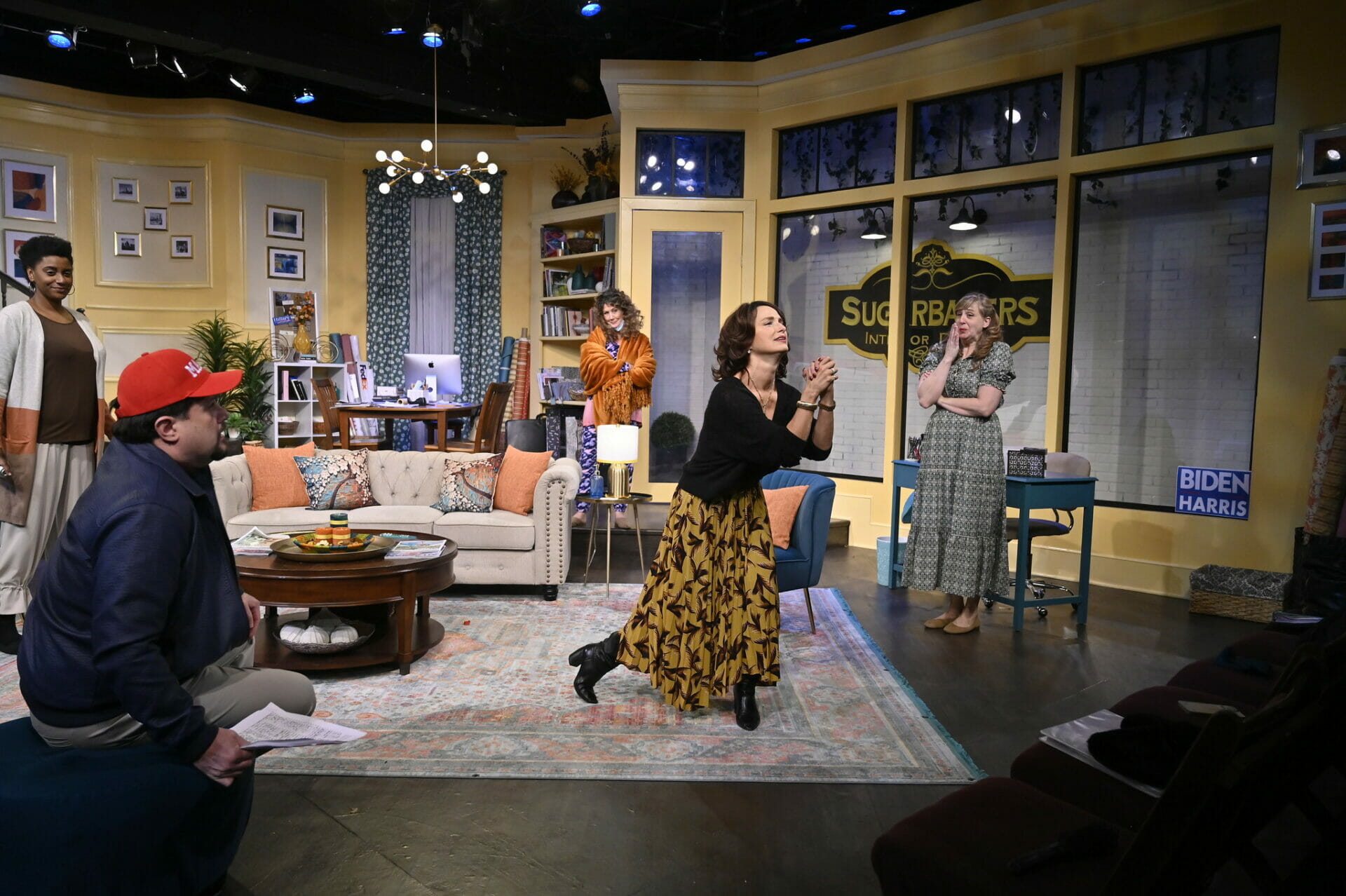
The lights have gone up in Georgia with the staging of Linda Bloodworth-Thomason’s theatrical adaptation/update of her hit mid-80s-early-90s television show, Designing Women, running at Horizon Theatre through November 6. Almost 30 years after the beloved sitcom aired its final episode, Thomason has written a play that imagines how the original characters would be faring if they had been plopped down in 2020. How would they be reacting to the pandemic, the Trump presidency and the movement for Black lives?
It’s an irresistible idea, particularly given its famously outspoken lead character (remember when Liz Lemon gives a sleep-deprived Julia Sugarbaker-style rant in 30 Rock?). Also, the show, about four Southern White women at an Atlanta-based design firm, was groundbreaking during its run from 1986-1993. Like Golden Girls, not only were the lead roles all women ages 30 and older — a Hollywood rarity still — but many episodes boldly explored issues like misogyny, religion, mental illness, homophobia, racism and the HIV/AIDS epidemic. All to millions of viewers tuning in every week.
The fact that the show is still quite funny upon rewatch is owed, in large part, to the iconic original cast. You have the late Dixie Carter as the firm’s whip-smart and passionate speech-maker president Julia; Delta Burke as Julia’s hilariously self-centered former beauty queen sister Suzanne; Jean Smart as big-hearted Charlene; and Annie Potts as sardonic single mom Mary Jo. Rounding out the cast was the late, great Meshach Taylor as Anthony Bouvier, the show’s only Black central character, who goes from being the firm’s delivery person to full partner throughout the show. Both Taylor and Burke garnered Emmy nominations.
The play transports these characters to shortly before the 2020 election, right before the rollout of Covid-19 vaccines began. But what starts as a promising premise fails to pay off due to some strangely dated references, shallow attempts to humanize/transform MAGA supporters and a general lack of specificity about time and location.

A couple of examples: Thanks to Julia’s new blog, the firm is now receiving threatening phone calls — one caller promises to bring an AK-47 to their office — which the characters shrug off. Is no one concerned that someone might bring in a gun, as happens just about every week in this country now? Have they not already had “mass shooter event” training like most office workers these days? I guess it’s not funny if they take it seriously, but then why include that at all?
Also, as powerful as Julia’s speeches could be, I suspect they’re not enough to make a MAGA devotee ranting about “stop the steal” magically decide to soften his views.
While this play mocks Trump in the way some did in 2016 — there is a quip about The Apprentice, for instance — it fails to truly account for how frightening he was and still is as the face of a movement centered on White supremacy. I was reminded of Ronan Farrow’s tweet about the Golden Globes tribute to Woody Allen in 2014: “Missed the Woody Allen tribute — did they put the part where a woman publicly confirmed he molested her at age 7 before or after Annie Hall?’”
If you’re still making fun of how Trump and his cronies are just silly and dumb, you’re missing the impact of his administration’s disregard for democratic norms and the numerous threats to the well-being of women, people of color, immigrants and the LGBTQIA community. We’re now seeing some alarming consequences, such as the overturn of Roe v. Wade, and many say the Supreme Court will continue to make things worse. But hey, remember how rib-tickling it was back when Trump tweeted “covfefe?’”

The parts of this show that work best are when the dynamic women Bloodworth-Thomason created interact, push each other’s buttons and love each other despite their flaws. While Bloodworth-Thomason is still a very gifted comedic writer, one wonders if she might have benefitted from hiring some co-writers to help fill out the update and make the show feel truly edgy and current. How this might have come alive with an entire diverse writing team, including some Gen Z-ers and millennials — and maybe a handful of Atlanta locals to make this resonate with an Atlanta audience. (The show originally premiered in Arkansas, where a lack of ATL specificity may not have been as glaring.)
The other problem is that it’s a two-hour show structured as if it were still a 22-minute sitcom. This means that the stakes are the same in scale as a sitcom-length show, which means that everything feels dragged out.
It’s a shame that the story doesn’t hold together better, too, because the cast is delightful — particularly Katherine LaNasa as Julia, who is so spot-on, she made me wonder whether the ghost of Dixie Carter had come back to possess her. There’s terrific physical comedy during a quarantined love scene between Julia and her new romantic interest, Wynn (Robin Bloodworth), that plays out at the large glass window of the shop and gets increasingly over the top.
The play also adds a couple of new characters to the mix. There’s Haley (an excellent Eve Krueger), Charlene’s cousin and a Bernice stand-in, who’s in a toxic, fundamentalist Christian marriage. And there’s Cleo, Anthony’s cousin, who has a fraction of the lines of other characters but, as inhabited with the sharp comedic timing of actor Tiffany Porter, earns some of the night’s biggest laughs. Unfortunately, as the only Black, gay character, Cleo also bears the burden — as written by Bloodworth-Thomason — of having to be the only one to explain to others why certain things are problematic.

None of this should imply that there aren’t incredibly effective and cathartic ways to process dark times through comedic art; endless examples exist. And you can see the skeleton frame of the bitingly funny satire that might have been here about the Sugarbaker cohort reacting to a world gone completely off the rails. How might these characters have been forced to confront some of their own biases and hang-ups? How might they have adapted to the rapid growth and gentrification across Atlanta? But for now, give me a rerun of the original TV show any day.
::
Alexis Hauk is a member of the American Theatre Critics Association. She has written and edited for numerous newspapers, alt-weeklies, trade publications and national magazines including Time, The Atlantic, Mental Floss, Uproxx and Washingtonian. An Atlanta native, Alexis has also lived in Boston, Washington D.C., New York City and Los Angeles. By day, she works in health communications. By night, she enjoys covering the arts and being Batman.
STAY UP TO DATE ON ALL THINGS ArtsATL
Subscribe to our free weekly e-newsletter.

PLEASE SUPPORT ARTSATL
Your Gift Sustains the Coverage You Count On!
Related Posts