Review: Conductor Han-Na Chang, ASO showcase composer Anna Clyne
We’re still living in complicated times and Symphony Hall, by a long shot, isn’t a haven of musical escapism. At Thursday’s Atlanta Symphony Orchestra concert, everyone on stage who wasn’t blowing into an instrument wore a pandemic mask — all the strings and percussion and the keyboard and harps and even stagehands and guest conductor Han-Na Chang. (Covid has ambushed several ASO members in recent days.)
The complications included the evening’s big work, Modest Musorgsky’s Pictures at an Exhibition, which required an asterisk and footnote to explain that the Russian composer, in the 1870s, used the Russian spelling of Ukraine’s capital city for the crowning final section, transliterated as “The Great Gates of Kiev,” instead of the Ukrainian “Kyiv.” A small matter, perhaps, but one that again jolts familiar old music into the present state of the world.

The concert opened with music by Anna Clyne, a 40-something British composer whose ferociously inventive music — a very self-confident and assertive sound — is getting played all over. She has a knack for grabbing your attention and holding it tight till the very end. Her best works — maybe most of her works — are uncommonly attractive, as much as any active composer’s. She fills them with exuberance and the sort of complex, charged emotions that stay with a listener long after the music stops. Like many orchestras, the ASO is now playing her music frequently, as recently as last season.
This Midnight Hour, from 2015, holds many of Clyne’s sure-footed traits, yet sounds a bit less linear, more a collection of images and textures than an unspooling thread of storyline. Indeed, in a program note the composer writes, “Whilst it is not intended to depict a specific narrative, my intention is that it will evoke a visual journey for the listener.”
The piece was inspired by two poems, by Juan Ramón Jiménez and Charles Baudelaire, of a naked woman running mad through the night, of flowers exhaling perfume, of a melancholy waltz mixing with the evening air. Clyne is a master of atmosphere. This Midnight Hour opens with an intense, scowling march, but just when you think this might be a harbinger of doom or death, it picks up a darling little skip and a hop in its step. Soon we hear Doppler effects, like delayed and fading echoes across the orchestra, a wonderful sensation.
At moments of peak intensity, Clyne has the piccolo wail like the high winds (a device also used at the howling peak of the thunderstorm in Beethoven’s “Pastoral” Symphony). Just when you think the moment couldn’t get more intense, Gina Hughes played her piccolo with piercing beauty to cap off the scene. By the work’s end, Clyne’s unerring sense of emotional depth and resolution reminded us why she’s at the front ranks among today’s composers.
Last week the ASO played Prokofiev’s large-scale cello concerto from late in his life, the Sinfonia concertante. This week it was the composer’s Violin Concerto No. 1 in D, written when he was 26 in the seismic year of 1917 — when World War I and the Russian Revolution overturned his world.
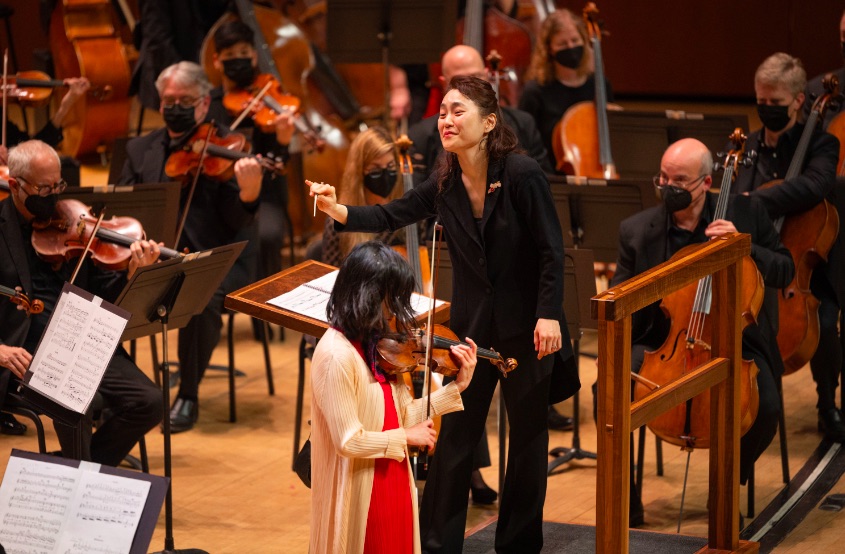
Violinist Sayaka Shoji, born in Tokyo, educated in Italy and Germany, has won several violin competitions and cut albums of the major repertoire for the Deutsche Grammophon label. As soloist in the Prokofiev, her playing was always exquisite and cleanly etched, with a sweet but never cloying tone.
In the opening movement, Prokofiev has the soloist play almost continuously, first in a dreamy mood and then more as a storyteller, with force and bite. Shoji could make a big, roaring sound and showed pinpoint accuracy, although always in the service of the music, never as an athletic display.
The concerto comes alive in the playful middle movement, what one commentator likened to “a fairy on a rampage, bitty but menacing.” It’s fun to hear and it was fun to watch Shoji navigate the devilish double stops — playing two strings at once — which she made perfectly lucid, articulating each voice. Yet for all her seemingly effortless virtuosity and musical focus, she didn’t come across as a strong musical personality. And the three-way partnership — violin soloist, orchestra, conductor — never seemed to click.
Thursday’s guest conductor, Han-Na Chang, first came into view as a child, a precocious cellist making CDs with great conductors and performing on the world’s biggest stages. By her mid-20s, she turned her attention to conducting, with increasingly prominent guest gigs on the horizon, from Singapore to Oslo plus Atlanta, Detroit, Milwaukee and more.
But throughout Thursday’s concert, she conducted and perhaps over-conducted the orchestra, paying attention to all the small details, seeming to cue and shape phrases for almost everyone. Despite this, the orchestra played well but without much purpose. There didn’t seem to be much chemistry on stage.
After intermission, we heard Pictures at an Exhibition (1874) in the exceedingly vivid orchestration (1922) by Maurice Ravel, where the French composer took Musorgsky’s piano original and somehow decided which instrument of the orchestra ideally suited the timbre and color of the notes from the piano. Want to learn how to write for an orchestra? Study Ravel’s cosmopolitan brilliance.

Pictures comes with a wonderful backstory: Musorgsky visited an art exhibition by his late friend Viktor Hartmann, and he set his impressions of each painting to music. “The Old Castle” taps modal troubadour tunes to evoke a distant medieval past. “Tuileries” shows children romping around the famous playground and public gardens in Paris.
Ravel’s precise orchestration included instruments that are now obsolete. Given his instrumental specificity, it’s obviously worthwhile to return to the original.
And the ASO has obliged. “Bydlo” is based on a watercolor of a peasant ox-drawn wagon with huge wooden wheels (bydlo means cattle in Polish). The movement is built around a long tuba solo, depicting the ox at its labor. Typical for an American orchestra, ASO tuba principal Michael Moore plays the jumbo-sized contrabass 16’ tuba, as he did for most of Pictures.
But Ravel wrote the “Bydlo” solo for a six-valved French 8’ C tuba, which has an almost four-octave range and is uncommon outside of France. Playing the smaller instrument for the one movement, Moore made the case for featuring this speciality horn, sounding at once brighter and more soulful in familiar music. (Moore told me that the ASO owns the instrument — two of them, actually — and will use them in April for Berlioz’s Symphonie fantastique.)
Chang and the ASO found a lot of excitement, in parts, and the crazy-epic “Hut on Fowl’s Legs” was suitably loud, thrilling and over the top. At the end, the audience roared its approval.
The program repeats Saturday at 8 p.m.
::
Pierre Ruhe was the founding executive director and editor of ArtsATL. He’s been a critic and cultural reporter for the Washington Post, London’s Financial Times and The Atlanta Journal-Constitution, and was director of artistic planning for the Alabama Symphony Orchestra. He is publications director of Early Music America.
STAY UP TO DATE ON ALL THINGS ArtsATL
Subscribe to our free weekly e-newsletter.

PLEASE SUPPORT ARTSATL
Your Gift Sustains the Coverage You Count On!
Related Posts