Review: ASO’s intoxicating take on Beethoven’s Sixth and Eighth Symphonies
The Atlanta Symphony Orchestra continued its Beethoven Project last Thursday and Saturday, with performances of the composer’s Sixth and Eighth Symphonies. On Thursday, February 27, the orchestra was embracing material that played to its strengths as an ensemble and as a result yielded powerful results.
These symphonies pair nicely because in both compositions Beethoven worked against the elements of his signature sound. His Fifth Symphony is full of the brash grandiosity for which he is best known — much of the writing in his later symphonies was intended to open new avenues both sonically and thematically. In the case of the Sixth and Eighth Symphonies, that translated to explorations of bucolic countrysides and playful emotions.
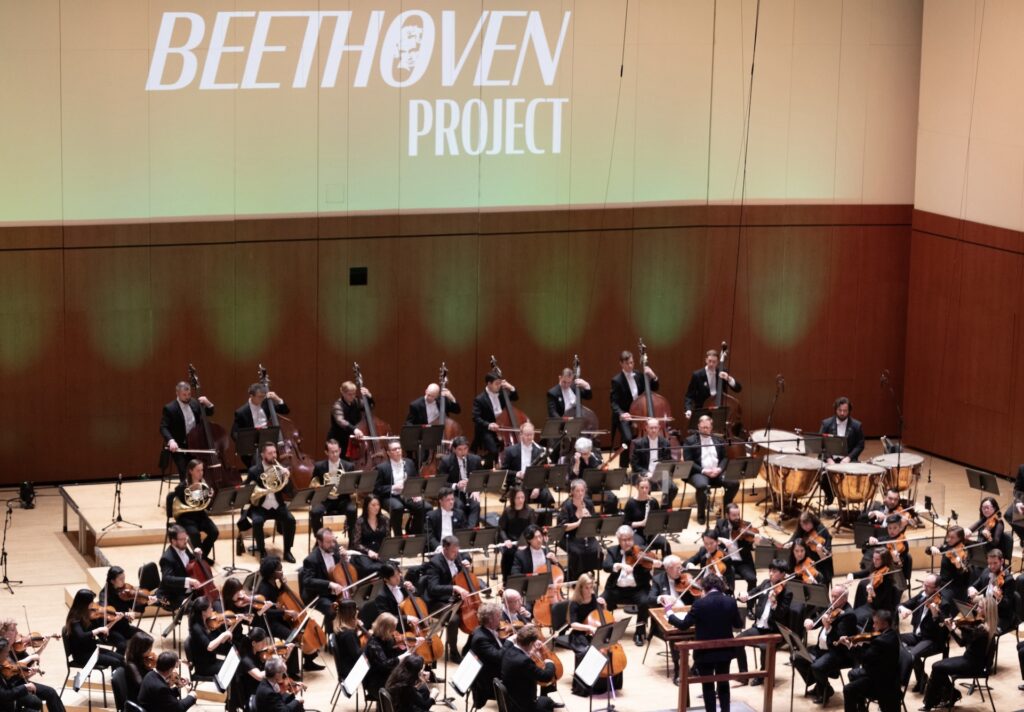
From the outset, it was clear that the uncertainty and rough edges that plagued the orchestra’s previous Beethoven Project performance (symphonies One and Three) because of weather-related lack of rehearsals was a fading memory.
Here, the orchestra was playing to one of its signature strengths: its uncanny ability to meld together so well that it sounds less like a live performance and more like the kind of pristine, precisely leveled listening experience that can only be heard in a high-definition audio recording.
That seemingly telepathic sense of balance is the result of an orchestra whose members are as aware of the acoustic space as they are of their own parts.
In the Eighth Symphony, the evening’s opener, this meant that the trace elements of Beethoven’s bombastic signature sound were appropriately restrained to allow for a stronger presence from the woodwinds and upper register horns.
All the cheerfulness and harmonic color the composer intended were on full display and accentuated, rather than dominated, by the stronger undertones. It’s a careful balance that would have eluded players with a less thorough knowledge of Beethoven’s compositional layers.
It was easy to get lost in the orchestra’s intoxicating performance — so much so that the ending arrived unexpectedly. It was a pleasant surprise and a positive development for an orchestra that I’ve recently criticized for delivering soporific first halves. The lighthearted atmosphere was most apparent in conductor Nathalie Stutzmann’s upbeat demeanor. She seemed to be having a good time, and it radiated out across the ensemble.

The Sixth Symphony (also known as the “Pastorale,” one of only two symphonies that Beethoven named himself) afforded the ASO an opportunity to expand on that captivating balancing act. Beethoven wrote the piece after leaving Vienna for Oberdöbling, in search of a quiet escape from city life. The change so moved him that he eschewed the usual descriptors for sections of a symphony in favor of illustrative titles such as “Awakening of cheerful feelings upon arrival in the country” and “Shepherd’s song — glad and grateful feelings after the storm.”
Though the Sixth Symphony was written as a gentle, whimsical response to the fire and fury of the Fifth, it nevertheless carries echoes of its predecessor. It’s as if the blasts of powerful emotion that Beethoven enshrined in the previous work had not fully left his system by the time he committed to writing the Sixth. As such, the sense of balance that made the ASO’s performance of the Eighth so satisfying felt slightly less apparent in comparison, but it was a quality of the composition itself, not of the cohesion of the ensemble.
The opening strains of the Sixth lean heavily on a sense of gentle majesty from the strings — something the ASO has always done well. The ending is much the same, but between those points is a contemplative realm where noticeable but never jarring stabs of Beethoven’s compositional darkness intertwine with playfulness.
The ASO’s decision to perform the symphonies out of sequence is a wise one. The compositional evolution of Beethoven’s nine symphonies has always been studied with an eye toward the Ninth, where the composer laid down a grand summation of his life and his work. Grouping the pieces around their sonic and conceptual commonalities allows listeners to better examine and appreciate the creative process that led to the looming beast of the Ninth.
The Beethoven Project launched in turbulent weather, but, judging from the February 27 concert, the ASO has reached a comfortable cruising altitude through Beethoven’s repertoire. The journey continues March 6 with symphonies Four and Seven.
::

Jordan Owen began writing about music professionally at the age of 16 in Oxford, Mississippi. A 2006 graduate of the Berklee College of Music, he is a professional guitarist, bandleader and composer. He is currently the lead guitarist for the jazz group Other Strangers, the power metal band Axis of Empires and the melodic death/thrash metal band Century Spawn.
STAY UP TO DATE ON ALL THINGS ArtsATL
Subscribe to our free weekly e-newsletter.

PLEASE SUPPORT ARTSATL
Your Gift Sustains the Coverage You Count On!
Related Posts