Review: Alliance Theatre’s “Everybody” is not going to please everybody
Everybody, a modern take on a morality play at the Alliance Theatre through October 2, is experimental theater that seems to work better in theory than in practice. It must be a terrific challenge for the performers involved, but the play is an odd and not particularly profound undertaking to sit and watch.
In morality plays, characters can appear as concepts to help the audience face some philosophical truth, often grappling with the inevitability of death or the indifference of the universe. To lighten things up for this modern take on the 15th-century play Everyman, written by Branden Jacob-Jenkins, the show is loaded with lots of whimsical touches.
For example, the audience gets glow sticks to wear! The set onstage mirrors the theater we’re sitting in! Some patrons are sitting on the stage! The introduction to the play is provided by an Alliance usher! There are actors embedded in the audience!
Meanwhile, we wrestle with God, question whether life has meaning, wonder if we are fundamentally alone and attempt to evade an inevitable death. Fun.
The silly touches lead the play to its central and most interesting gimmick. Five actors in the production are playing “Somebodies,” and a lottery, conducted by the Usher, is held mid-play and assigns the Somebodies to different roles. Thus, the actor playing the central protagonist in the show has no idea they are playing the lead until the lottery happens. The other Somebodies take on different roles randomly assigned through the lottery, such as Friendship, Kinship and Stuff, so it’s possible to have 120 different combinations of performers in this production’s run.
This type of experimentation is unusual for the Alliance, a theater known for more straightforward narratives, even when dealing with similar subject matter. The theme of doomed people grappling with life’s meaning, for example, was at the forefront of their excellent 2019 musical Ride the Cyclone, which killed off Canadian kids in a roller-coaster accident.
Despite the attempts to create flourish, Everybody doesn’t resonate. Specifics help audiences connect. The framing of this morality play just doesn’t help us invest or care, no matter how much we wave our glow sticks or appreciate the design. It’s instructive and sermonizing and without stakes.
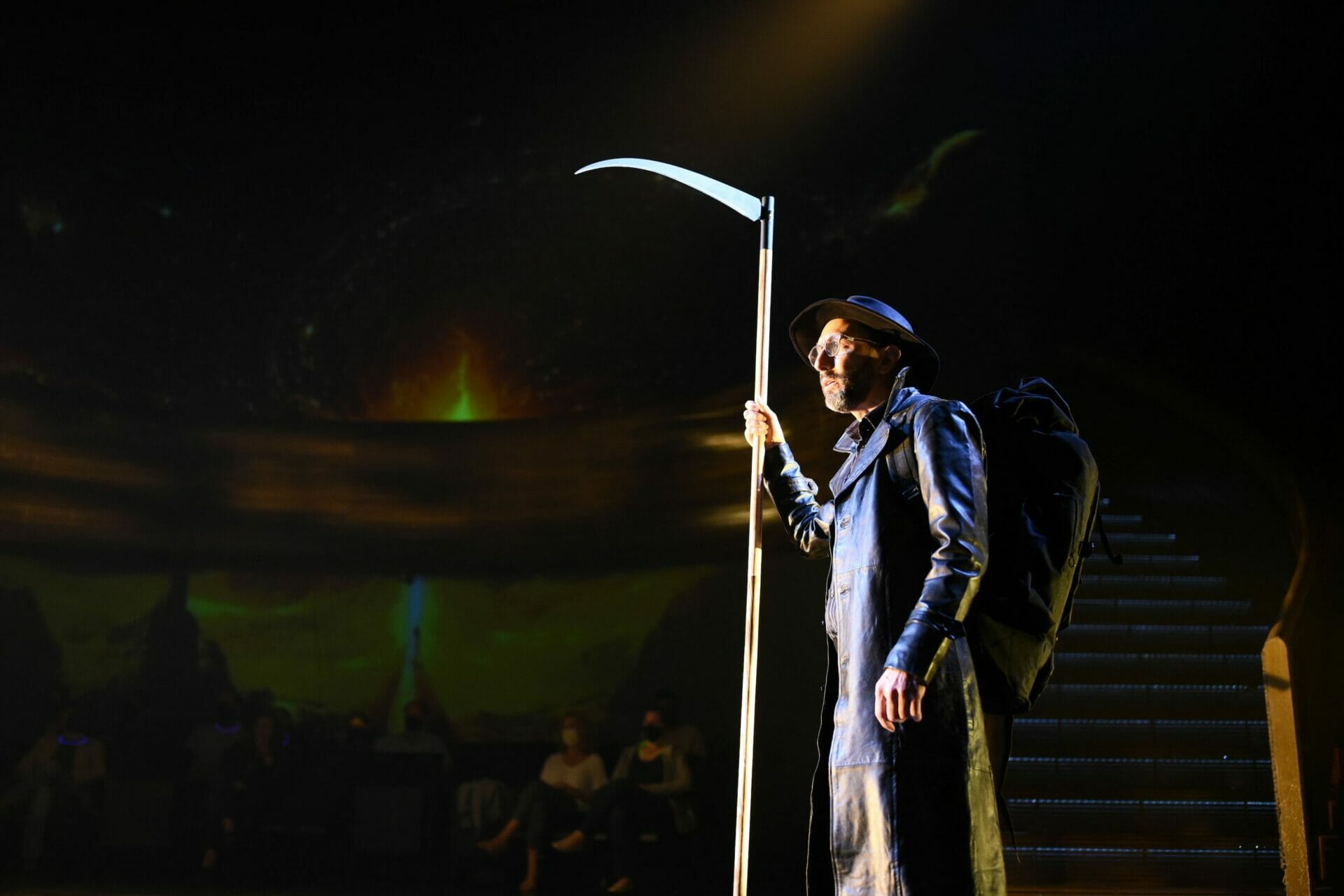
At the September 10 performance, the lead protagonist, Everybody, was played by Courtney Patterson. The other Somebodies became Friendship (Joseph J. Pendergrast), Kinship (Chris Kayser), Cousin (Bethany Anne Lind) and Stuff (Brandon Burditt). All the play’s Somebodies have different traits to their identities — diversity in age, race and gender. The fact that any of them can play the central role underlines that the play is written to highlight the common ground people share.
But, by its nature, the script requires a lack of specifics to the Somebody characters, so lines are delivered in a baffling Mad Libs style where no one has made any choices and every possibility applies.
For example, here is a line delivered by Friendship to Everybody:
“What is going on? You seem a little depressed! Is it still the election? Is it the weather? Is it global warming? Or is it just politics? Is it identity politics? Or is it your job? Is it your career-slash-lack of a career? Is it that person we both hate? Oh no! It’s not that person we both love, is it? Is it your relationship-slash-lack of a relationship?”
As an exercise, this would be interesting to perform. All of the Somebodies, after all, had to learn every role in that section of the play. But watching it feels preachy, noncommittal and bland. The actors are doing a metaphorical tightrope walk where they’re trying to survive the stunt more than imbue their characters with emotional weight, depth and vitality. Strangely, the play’s boldest departures from traditional theater are its most annoying bits.
Additionally, some voiceover segments take place between larger scenes, in which the Somebody performers lip sync along to a pre-recorded track. This scripted choice lessens the danger of the central gimmick.
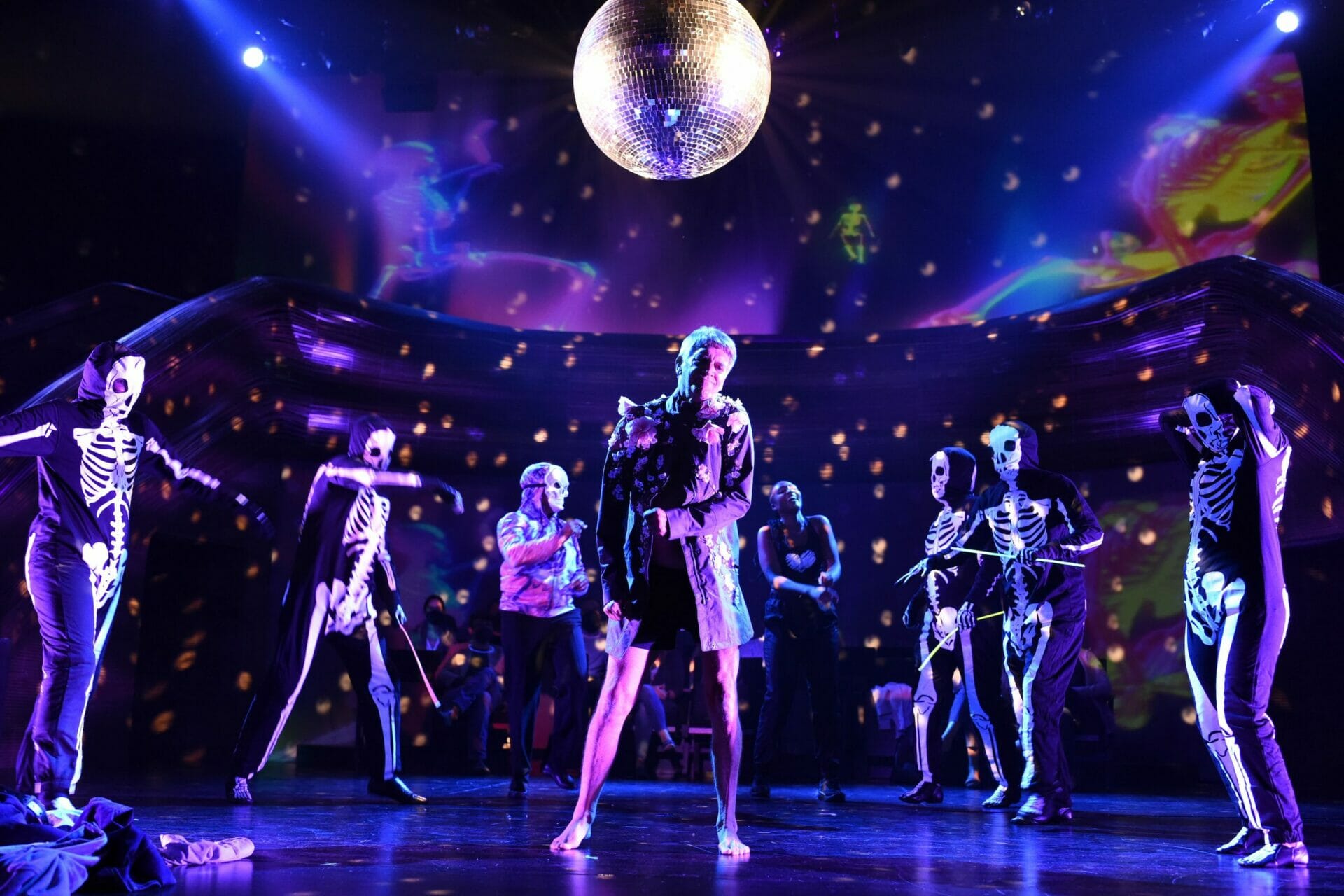
From a design perspective, Everybody has nice touches. The recreation of the theater seating onstage, as designed by Lex Liang, is clever. Thom Weaver’s lighting and Milton Cordero’s projections occasionally bathe the entire room in a dark sky full of stars, and the audience’s glow sticks add to the effect.
But frankly, a show about everybody and everything should resonate deeper than this. Instead, it feels flippant. The lead character is struggling and dying, yet only just learned about this burden to be shouldered and is unprepared. The lead character should matter immensely, but the audience isn’t as invested in a character they know so little about.
The message of the show, also, feels repetitive and without much variation — basically, we’re all going to die, and you can’t take much with you. This should surprise no one.
The performers playing specific characters fare so much better than the Somebodies in this production. Deidrie Henry, playing the Usher who sometimes becomes possessed by God, is spectacular at guiding the audience through the beginning of this play. Henry has warmth, wit and attitude in this role. Whenever she’s onstage, the play livens up. Henry’s God, meanwhile, is cool and terrifying.
As Death — Andrew Benator, who was last seen as Scrooge in A Christmas Carol — creates a character who’s a nerdy, goofy sort and who’d rather coast around undetected and not have to answer to God. When called upon or challenged, though, Benator’s Death can take command of a scene.
And Shakirah DeMesier plays Love with frustration and warmth. It’s an interesting take, and the play could’ve used more of that character throughout its length.
Everybody, co-directed by Susan V. Booth and Tinashe Kajese-Bolden, is Booth’s last play as artistic director of the Alliance, where she began in 2001. As a challenge to seasoned performers, there is appeal. But for the audience, it’s a dud experiment.
::
Benjamin Carr, a member of the American Theatre Critics Association, is an arts journalist and critic who has contributed to ArtsATL since 2019. His plays have been produced at The Vineyard Theatre in Manhattan, as part of the Samuel French Off-Off Broadway Short Play Festival, and the Center for Puppetry Arts. His novel Impacted was published by The Story Plant in 2021.
STAY UP TO DATE ON ALL THINGS ArtsATL
Subscribe to our free weekly e-newsletter.

PLEASE SUPPORT ARTSATL
Your Gift Sustains the Coverage You Count On!
Related Posts