Partners in the Arts: Charly Palmer and Dr. Karida Brown
It was a hot summer night in Atlanta, and Dr. Karida Brown had just finished her doctoral program at Brown University. She returned home to visit her family before heading to the West Coast for work. While in Atlanta, one of her friends dragged her out for a night of poetry and art, which Brown was none too happy about.
Reluctantly, and with an attitude, she attended the event with her friend. It was packed. Only a few seats were available when they arrived, positioned close to the poet who was reading. Not wanting to be there, Brown looked everywhere but at the poet onstage until the words drew her in and something stirred inside of her spirit. Soon, she began connecting with the poetry flowing through the microphone. This was the first time art had ever moved her.
After the event, Brown hugged the walls, taking in the art while everyone else talked around her. A man walked up to her and asked her if she liked the artwork and she responded that she did. She felt that the art was saying, visually, what it took her 200-plus pages to write. When she and her friend walked outside she saw the man again as he was receiving accolades for the exhibition.
She put two and two together — this man was the artist, Charly Palmer, who created the pieces she had looked at just moments before. They talked yet again, and Palmer gave her his email address, telling her not to wait too long to use it. After moving to Los Angeles, Brown realized that Palmer was the one. She bought one of his paintings — the first piece she’d ever collected. She likes to say that she collected his piece and then the artist himself. She later moved to Atlanta in 2022.
Since then, Brown and Palmer have been a power couple in the arts. Brown is a sociologist, oral historian and public intellectual; her research centers on the fullness of Black life. She is the author of The Battle for the Black Mind, for which Palmer created the cover art. Featuring a painting of George Stinney Jr., the young man who was 14 when the state of South Carolina executed him, Brown shared that Palmer paints him every year as a way to always remember George. In this way, anyone who owns the book is collectively remembering George, “as someone who was a victim to the system but also a boy who was beautiful, loved and had dreams,” said Brown.
Palmer has been an artist for more than 30 years. He considers himself a griot, a storyteller through paint. He’s been commissioned by John Legend, the United States Postal Service and many others to create award-winning art. Palmer and Brown also co-authored The New Brownies’ Book, which received the NAACP Image Award for Outstanding Literary Work in Non-fiction in 2024.
When asked about what collaboration looks like between them, the couple explained that it tends to happen organically. When working on The Battle for the Black Mind, for example, Brown’s team found the image of George Stinney Jr. on Palmer’s page and felt it suited the text.
There tends to be a natural flow between Palmer and Brown when they work together. During their collaboration on The New Brownies’ Book they had a sense of what they wanted and “The artists and writers showed up and showed out,” said Palmer.
Brown also mentioned that she and Palmer are successful when they are creating something because they prefer to get out of the way and let spirit work through them. She described their relationship as “one long conversation” since she first laid eyes on his work — she understood that he was telling stories similar to the ones she tells, just using a different medium to do so. When they collaborate, it is often because the work is aligned spiritually.
During the production of The New Brownies’ Book, the duo managed to collaborate without bumping heads. They compiled all of the content and then brought in Kieron Lewis, an African-British designer. They did not want to get in the way, so once they finished their parts, they handed it to their publisher, and the designer nailed the vision. It was a wonderful surprise to see the final product.
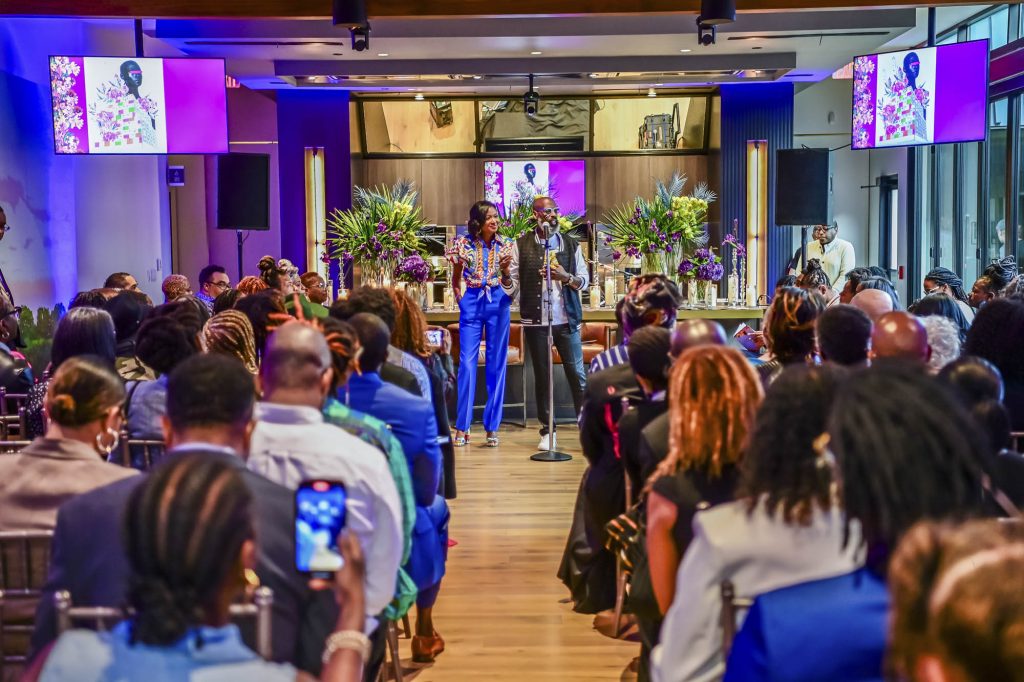
Palmer explained that he and Brown “are for everything Black,” so if there is something elevating, educating or inspiring the Black community, they are going to be involved. It can become tricky because there are times they are able to monetize what they are doing, but they shared that money is never the endgame. Ultimately, they love giving back to the community. Palmer put it best when he said “we don’t have a mission statement, but we are on the same mission.”
Palmer and Brown have learned a lot about love and each other through the act of creating together. They say that going to the ancestors and being obedient to them and where they are being led, creatively, has always kept them on the right path and allowed them to move without friction. This has helped to strengthen their marriage that continues to grow.
Brown said that she respects her husband — and always has — and believes he is a creative genius. She is genuinely inspired by the work he creates. She learned his praxis and how differently their brains are wired, which has in turn given her an appreciation of all humans and their varying experiences of life. She has learned how to appreciate, respect and see the difference in the way she and Palmer think.
Brown used the expression “see the forest for the trees,” describing herself as the one who is the forest-thinker, always looking at the endgame and thinking of the trees later. Palmer, however, is a tree-thinker who wants to process how to get things done and tackle what’s directly in front of him. She also said that he offers both the structure and spontaneity to their creative projects, asserting that striking a balance is important. They show up as a team and let their natural capabilities and strengths shine. That foundation of respect, appreciation and curiosity about the thoughts of others is paramount to their collaborations.
When asked about how their methods of storytelling overlap and diverge, they explained they are not trying to teach each other anything as they are both still learning. Sometimes, one of them may be working on a project, and that inspires the other.
Brown’s experience as an archivist who gathers materials helps them a lot, Palmer explained. Brown gave an example of how their work overlaps by detailing Palmer’s series, Eminent Domain, which he produced around the time of their first meeting. The works dealt with how eminent domain was used to displace thousands of Black households from valuable real estate across cities in the United States and confront topics of race, place and displacement. Brown wrote about the same topic in her first book, Gone Home: Race and Roots through Appalachia, and she noted that addressing similar issues through various mediums makes the conversation deeper and richer. “My thinking is better since art came into my life,” said Brown.
There are many challenges and joys of blending art, activism and academia. Palmer went back to teaching at a Historically Black College and University (HBCU) last semester, hoping to make a difference in young minds. Palmer found that the young people in his class were unprepared and had misguided ideas of what this world looks like — especially from an artistic and business standpoint. He wanted to help but felt frustrated with how little they knew. Thankfully, he has seen their understanding grow with time.
For Palmer, the joy of education is that if he reaches even one student, he feels he has done something important. He always strives to make a positive impact, even if the results are not immediate. Brown said that she does not label herself as an activist but understands that Black educators often operate as such — not merely because of skin color but also because educators in the Black pedagogy are inherently political.
Brown says that 30% of her work takes place in the academy and 70% in the streets (within organizations, in community and the like) as she aims to touch as many people as possible. Her main job is to truth-tell, as a keeper of Black history and our culture. She does this through archives, Black stories, context and world history. She knows that it is powerful and dangerous to tell the truth to your people because knowledge is power, and, once you transmit that information, you give power to the people. It is through this gift of knowledge that she sees her activism, especially in such a time as this, where the regime is trying to compel us to be quiet and to shy away from the truth.
Palmer added, “There’s a reward in not being woke, educated and informed, and people are buying it.” For Brown and Palmer, silence is never an option.
When navigating critique, Palmer and Brown said they are kindly honest. Palmer said that his wife has an opinion that he values deeply, so if his wife does not like a piece or wants clarity on something, he is very open to it. He realizes that she is only trying to encourage him to go further, and so he is not defensive. Palmer said that “You’re fortunate if you have a partner on your team, because there are times that partners are in competition with one another,” paraphrasing a quote by Chris Rock. He went on to explain that the most dangerous place to be is with a partner who’s in competition with you. Palmer encourages people to find someone who’s your biggest cheerleader — he and Brown have that kind of dynamic.
Brown emphasized that they are gentle with one another in every aspect of life. Palmer is her closest confidant, and he reads all of her work before the public or her editor gets to see it. He pushes her in ways that are sometimes uncomfortable, but she needs that insight and she trusts that when he says it, he’s right. Though she can be reluctant to accept unwanted critiques from others, she seeks out wise counsel and takes feedback into consideration because “Only a fool is out there by themselves.”
Atlanta and the artistic community here has influenced Palmer and Brown. Palmer shared that there are many cliques and sometimes it feels like artists are competing but insists that there is more power in collaboration. He’s big on connecting artists, which he does through elevating others and supporting one another as community cheerleaders. Brown said the Atlanta community and the Black creative and scholarly community show up for them when they’re in a time of need, and they don’t take that for granted. Relationships become more valuable as they get older. “Shout-out to our community,” said Brown with gratitude.
I asked that if Brown and Palmer had to leave behind one joint project as their legacy, what would it be? They agreed that it would be The New Brownies’ Book. “That book makes me so proud,” said Brown. It is a crown jewel of their love, channeled through their creative vision, and it will outlive them both.
W.E.B. DuBois, Brown’s hero, founded the original Brownies Book and co-founded the NAACP. Now, The New Brownies’ Book has received the NAACP Image Award For Outstanding Literary Work in Nonfiction — an award also held by the likes of Barack Obama, Toni Morrison and Maya Angelou — which Brown thinks is the ancestors’ way of looking down and saying, “My son and daughter: well done.” That project means so much to them and she loved working with Palmer on it. He agreed that they can be proud of this project for the rest of their lives, and that even if there’s nothing else they do as collaborators, this book is one that was the most special.
::

Jhazzmyn Joiner (aka Jhazzy) is a writer, poet and creative spirit with a soft spot for storytelling that uplifts community voices. She’s the editor-in-chief of Three Panels Press and leads communications at L’Arche Atlanta. With a background in gerontology, media and making meaning out of everyday moments, her work lives at the intersection of art, equity and expression. A singer, traveler and lover of bold ideas, she’s often deep in a playlist, scribbling a poem or wandering an art show, dreaming up her next big project.
STAY UP TO DATE ON ALL THINGS ArtsATL
Subscribe to our free weekly e-newsletter.

PLEASE SUPPORT ARTSATL
Your Gift Sustains the Coverage You Count On!
Related Posts